Archive | February 7th, 2012

Board moves forward with implementation of testing accommodation restrictions

By Matthew Tungate
matthew.tungate@education.ky.gov

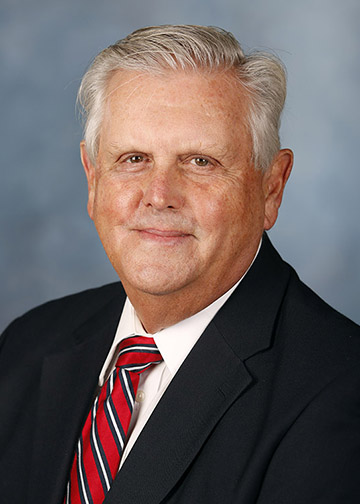
Vice Chair Roger Marcum speaks with the board about the use of readers on state tests during the February Kentucky Board of Education meeting. Photo by Amy Wallot, Feb. 1, 2012

Vice Chair Roger Marcum speaks with the board about the use of readers on state tests during the February Kentucky Board of Education meeting. Photo by Amy Wallot, Feb. 1, 2012

While acknowledging parent and teacher concerns, the Kentucky Board of Education decided last week to move forward with a new regulation that would limit the help special-needs students could receive on mathematics and reading fluency portions of the Kentucky Performance Rating for Educational Progress (K-PREP) tests.

The board discussed delaying the new regulation, which prohibits students from receiving help from a reader on state reading comprehension tests and a calculator on some state mathematics tests, until August – the start of the 2012-13 school year.

The discussion arose following a plea from Betty Muntz, executive secretary for Kentucky Council for Exceptional Children and other comments about the regulations.

Muntz, at one point choking back tears, told the board, “Students aren’t prepared this year. Teachers are not prepared this year.” Continue Reading

Posted in Features0 Comments

STEM classes a major success at Muhlenberg school

By Susan Riddell
susan.riddell@education.ky.gov

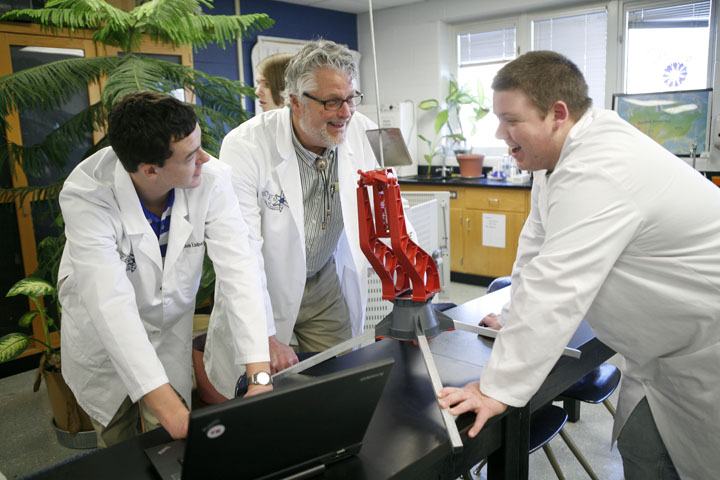
Craig Scharf talks with his STEM Academy students Josh Lindsey and Vaughn Reed about entering the Team America Rocketry Challenge at Muhlenberg County High School. Photo by Amy Wallot, Jan. 6, 2012

Craig Scharf talks with his STEM Academy students Josh Lindsey and Vaughn Reed about entering the Team America Rocketry Challenge at Muhlenberg County High School. Photo by Amy Wallot, Jan. 6, 2012

Craig Scharf, who taught college classes prior to coming to Muhlenberg County High School, could always spot the students who were prepared for his classes from the ones who weren’t.

“I could tell the kids who had a good background in research and critical thinking from the ones who hadn’t,” said Scharf, who has been at the recently consolidated Muhlenberg County High for 10 years. “I come from a research background, and I honestly believe students who think for themselves and can master independent research will be best prepared for college.”

With that in mind, Scharf and his colleagues at Muhlenberg County High launched an effort this school year that aims to help students better prepare for college by taking a rigorous series of science, technology, engineering and mathematics (STEM) classes.

The STEM Academy, as it is called, is an outgrowth of a Project Lead the Way (PLTW) biomedical science program the school started in 2009. The biomedical science program was such a hit with students that administrators decided to form an entire STEM Academy.

“The academy was brought on board to increase the rigor of our course offerings, provide in-depth training for our instructors and put real-world applications and technology in the hands of our students,” said Principal Matt Perkins. Continue Reading

Posted in Features0 Comments

The cost of not raising compulsory school attendance

Commissioner Terry Holliday

Commissioner Terry Holliday

Twenty-six million dollars is a big number.

That is the amount some are estimating it will cost Kentucky taxpayers to raise the compulsory school attendance age from 16 to 18.

I and the Kentucky Board of Education (KBE) have counted such a change as a top priority in past legislative sessions. The 2012 session is no exception.

We believe the change is in line with reform efforts we have been undertaking as part of Senate Bill 1 (SB1) – a piece of legislation passed in 2009 with the overwhelming support of the House and Senate.

That bill has numerous components and directives, but at the end of the day it calls on us to do one thing for all Kentucky students: Prepare them for college or the workplace. In turn, those prepared students will succeed and benefit our commonwealth.

Given that mandate, how can we then deem it acceptable for a 16-year-old to drop out of high school without the necessary skills and knowledge to succeed? How can we turn our backs on the students that likely need us the most? These students may be some of the hardest to reach, but they also are some of the most vulnerable.

There are those who see dropouts not as a problem, but rather a solution that rids our schools of unmotivated students who can be disruptive and uncooperative. (Dropouts, by the way, also rid schools of SEEK funding they would receive had those students stayed in school.) Continue Reading

Posted in Commissioner's Comments0 Comments

Sign up to receive e-mail updates from us!

Kentucky Teacher is a publication of the
Kentucky Department of Education.

Education Resources


More Education Resources

Content Calendar

February 2012
S M T W T F S
« Jan   Mar »
 1234
567891011
12131415161718
19202122232425
26272829