Archive | Features

Reflective practice, professional growth a cyclical path to improvement in PGES

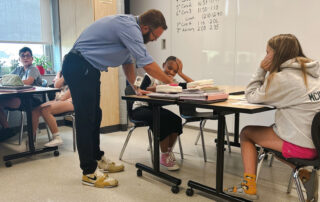
Jennifer Howard, right, helps students in her geometry class at Magoffin County High School. With the proposed Professional Growth and Effectiveness System (PGES), she said she is working on telling less and questioning more. Photo by Amy Wallot, Jan. 9, 2013

Jennifer Howard, right, helps students in her geometry class at Magoffin County High School. With the proposed Professional Growth and Effectiveness System (PGES), she said she is working on telling less and questioning more. Photo by Amy Wallot, Jan. 9, 2013

The Kentucky Department of Education, along with several partners and more than 50 school districts, is in the third year of a four-year plan to develop the Professional Growth and Effectiveness System (PGES). Schools statewide will pilot the new system in the 2013-14 school year, with full implementation scheduled for 2014-15. This is the third in a series of stories that will examine different aspects of the proposed system.

By Matthew Tungate
matthew.tungate@education.ky.gov

At the beginning of the school year, Jennifer Howard tested her Magoffin County High School honors Algebra II students to get baseline scores. What she found was students were coming into the class with a wide range of knowledge levels.

Now she knew where her students stood on the material. Next she had to find out where she stood as a teacher.

As part of the field testing for the Professional Growth and Effectiveness System (PGES), Howard sat down with the Kentucky Framework for Teaching for two hours to impartially look at her practice.

“It was the most reflection I had done on my teaching ever, and this is my 18th year,” she said. Continue Reading

Posted in Features0 Comments

Report helps educators identify students who may be off track for graduation

By Matthew Tungate
matthew.tungate@education.ky.gov

Teacher Scott Howie gives junior Shantha Davis some good news, that she is working ahead of schedule in the Focus and Finish program at Madison Southern High School (Madison County). Davis said she enjoys having class this way. “You can focus on what you need to do and get it finished,” she said.

Teacher Scott Howie gives junior Shantha Davis some good news, that she is working ahead of schedule in the Focus and Finish program at Madison Southern High School (Madison County). Davis said she enjoys having class this way. “You can focus on what you need to do and get it finished,” she said.
Photo by Amy Wallot, Dec. 14, 2012

Kirsten Estep, the Positive Approach to Student Success (PASS) coach at Madison Southern High School (Madison County), is teaching a new class twice a day this year called Career Connections. In it, students who are at risk of dropping out of school or are struggling academically find out what it takes to enter the workforce by learning things like resume writing and interview skills, appropriate dress for the workplace and job requirements.

Estep said many of the students don’t realize how difficult it is to get a job, especially if they drop out and get a GED.

Madison Southern Principal David Gilliam said many students find themselves at risk of not graduating because they have either no goals or ones that are unrealistic.

“The Career Connections class is to let them see what’s out there and help them identify the things they would like to do, and then they can see high school graduation as an integral part of that plan.”

What sets the class apart from similar initiatives throughout the state is that it was filled entirely with students identified through the Persistence to Graduation Tool (PtGT). The tool creates a report with a list of students ranked in descending order on numerous research-based risk factors. As schools analyze the list, they can provide targeted interventions based on the factors indicated for each student. The Kentucky Department of Education (KDE) has compiled resources to assist schools with identifying appropriate strategies and interventions. Continue Reading

Posted in Features0 Comments

Getting students excited about reading

By Susan Riddell
susan.riddell@education.ky.gov

Library media specialist Terri Kirk talks with a group of about their favorite books at Reidland High School (McCracken County). Photo by Amy Wallot, Dec. 11, 2012

Library media specialist Terri Kirk talks with a group of stidents about their favorite books at Reidland High School (McCracken County).
Photo by Amy Wallot, Dec. 11, 2012

Terri Kirk, library media specialist at Reidland High School (McCracken County), feels that most readers simply don’t honor the phrase, “Don’t judge a book by its cover” anymore.

“I know we shouldn’t (judge), but we do,” she said. “The books that are available to students need to be pretty. They need to be up to date.”

Kirk suggests schools repurchase library books – even the classics – to keep more timely versions available for students. Modernized covers will better catch the eyes of students who otherwise might not give a John Keats or Louisa May Alcott read a try, Kirk said.

In fact, there are several ways both library media specialists and teachers can motivate reluctant readers, according to Kirk and Cindy Parker, literacy coordinator for Kentucky Department of Education’s Office of Next Generation Learners.

A love of reading naturally fosters literacy’s role as the key component to academic success, Parker said. Additionally, two different but very important purposes for reading are to gather information and share experiences vicariously.

“Students who don’t read as much as their peers lack background knowledge and an understanding of the world around them,” she said. “This relates to a key reading strategy – making inferences or coming to a logical conclusion by connecting background knowledge with what is seen, heard or read.” Continue Reading

Posted in Features1 Comment

Do you see what I see?

The Kentucky Department of Education, along with several partners and more than 50 school districts, is in the third year of a four-year plan to develop the Professional Growth and Effectiveness System (PGES). Schools statewide will pilot the new system in the 2013-14 school year, with full implementation scheduled for 2014-15. This is the second in a series of stories that will examine different aspects of the proposed system.

By Matthew Tungate
matthew.tungate@education.ky.gov

Principal Curt Bieger talks briefly with Mandy Young before she starts her 6th-grade mathematics class at Gallatin County Middle School. Bieger was observing her class as part of the Professional Growth and Effectiveness System.

Principal Curt Bieger talks briefly with Mandy Young before she starts her 6th-grade mathematics class at Gallatin County Middle School. Bieger was observing her class as part of the Professional Growth and Effectiveness System.
Photo by Amy Wallot, Dec. 3, 2012

Being observed by the principal traditionally is a stressful part of a teacher’s evaluation, according to Mandy Young, a 6th-grade mathematics teacher in her fifth year at Gallatin County Middle School. But as a participant in the field testing for Kentucky’s proposed Professional Growth and Effectiveness System (PGES), Young got a “dress rehearsal” by being observed first by colleague Kim Jones, a teacher and mathematics instructional coach in her 26th year.

“My job isn’t based on her evaluation, so I felt comfortable to try different things with her in there, plus she could give me feedback and I didn’t feel that my job was on the line because of it,” Young said.

Young even knew what Jones was looking for because they had discussed items on the younger teacher’s professional growth plan prior to the observation. Afterward, they discussed what Jones observed. Young said she can use PD 360 or talk with her professional learning community about any areas for improvement.

Observation is one measure of teacher effectiveness in the PGES. Peer observers and principals or other supervisors are trained to document evidence during their observations based on two domains of the Kentucky Framework for Teaching: classroom environment and instruction. Afterward, they discuss evidence from the observation with the teacher based on the indicators and the criteria from the Framework for Teaching rubric. Continue Reading

Posted in Features0 Comments

Seeing what Kentucky schools are all about

By Susan Riddell
susan.riddell@education.ky.gov

Commissioner Terry Holliday, right, talks with Hart County High School junior Tyler Shirley, computer technician D.L. Talley and curriculum, instruction, and technology specialist Crystal Thompson about the school's one-to-one computer program. With the visit to Hart County, the commissioner reached his goal of visiting all of Kentucky's school districts. Photo by Amy Wallot, Jan. 15, 2013

Commissioner Terry Holliday, right, talks with Hart County High School junior Tyler Shirley, computer technician D.L. Talley and curriculum, instruction, and technology specialist Crystal Thompson about the school’s one-to-one computer program. With the visit to Hart County, the commissioner reached his goal of visiting all of Kentucky’s school districts.
Photo by Amy Wallot, Jan. 15, 2013

Education Commissioner Terry Holliday got some Ski soda and loads of Amish delicacies, but more importantly he completed a goal he set nearly two years ago.

Holliday, in a 2011 self-evaluation, pledged to visit every school district in the state – all 174 of them. The commissioner already had several district visits under his belt prior to the commitment, and he finished his quest with a greater understanding of what schools are facing on a daily basis.

“I know the big challenges facing teachers are time and money,” Holliday said. “I’m trying to work on the money.”

The commissioner completed his quest last Tuesday with visits to the Green and Hart County school districts.

“I think it was a great goal to have, and we’re thrilled he made us one of his final stops,” said Green County Schools Superintendent James Frank. “We feel like we are a hidden treasure down here, and we really appreciate the commissioner taking the time to come see what we’re all about.”

Hart County High School interim principal Debbie Fowler said her school has been excited about the visit ever since it was planned last fall.

“We had a brief faculty meeting the day before, but we also wanted to keep everything as normal as possible,” Fowler said. “We felt like that was what he wanted to see here.” Continue Reading

Posted in Features0 Comments

Teaching to the choir

By Susan Riddell
susan.riddell@education.ky.gov

Mike Bell, director of the virtual arts program, directs students in the virtual choir on the opening day of the 2012-13 school year for the Floyd County school district.

Mike Bell, director of the virtual arts program, directs students in the virtual choir on the opening day of the 2012-13 school year for the Floyd County school district.
Photo by Pam Caudill/Floyd County school district

A few years ago, Floyd County school district Superintendent Henry Webb attended a conference where he viewed Eric Whitacre’s virtual choir video and watched as the Grammy winner simultaneously directed 185 singers from 12 different countries.

“I was moved by what the composer was able to accomplish and thought of the talented kids in our district who could benefit from a performance platform such as this,” Webb said.

Luckily for Webb, teacher Mike Bell already was working in his district and was enthusiastic about bringing the concept to Floyd County

In its first year, more than 200 students in grades 4-12 joined the program and participated in a virtual choir performance of The Star Spangled Banner and My Old Kentucky Home.

This year, the virtual choir will be performing an arrangement of Wade in the Water, created by Betsy Layne High School band director Mike Cooley. Continue Reading

Posted in Features0 Comments

Career and technical education, preschool funding and dropout prevention lead 2013 legislative agenda

By Tracy Goff-Herman
tracy.herman@education.ky.gov

Meghan Jones, a student at the Barren County Area Technology Center, participated in the Community Service Day held in conjunction with the 2012 Kentucky Leadership and Training Institute. KLTI is held yearly and provides leadership training opportunities for members of SkillsUSA Kentucky, an organization comprised of students enrolled in skills trades programs in technical education centers and high schools throughout Kentucky. Photo by Tim Thornberry

Meghan Jones, a student at the Barren County Area Technology Center, participated in the Community Service Day held in conjunction with the 2012 Kentucky Leadership and Training Institute. KLTI is held yearly and provides leadership training opportunities for members of SkillsUSA Kentucky, an organization comprised of students enrolled in skills trades programs in technical education centers and high schools throughout Kentucky.
Photo by Tim Thornberry

With the start of the New Year, the beginning of the 2013 Regular Session of the General Assembly is at hand. This is not a budget session, but rather a short, 30-day session that traditionally focuses on policy issues that do not impact the budget.

Still, two fiscal issues are looming that likely will have significant long-term financial implications, state employee pension funds and tax reform. 

The Legislature and Governor established task forces to look at both issues during the interim. Several lawmakers believe that addressing the shortfall in the public employee pension fund will dominate the 2013 session. Final reports from both groups are forthcoming, but some of the possible solutions vetted during meetings of both groups would address the issues of the underfunded pension fund and the lackluster rate of growth in the economy. Among the options discusssed: raising taxes; legalizing gambling; restructuring current taxes; and closing loopholes created by tax expenditures. Continue Reading

Posted in Features0 Comments

Operation Preparation expands to monthlong event

Wayne County High School sophomore Trevor Shearer, volunteers Shannon McCracken and Keli Carter and sophomore Cheyenne Chaney look over Carter's newborn photography during Operation Preparation at the school last spring.

Wayne County High School sophomore Trevor Shearer, volunteers Shannon McCracken and Keli Carter and sophomore Cheyenne Chaney look over Carter’s newborn photography during Operation Preparation at the school last spring. Photo by Linda Jones/Wayne County school district 

By Susan Riddell

susan.riddell@education.ky.gov

Districts across Kentucky participated in Operation Preparation last year for one week. This year, when the event returns in March, it will be a monthlong initiative.

“We can’t wait,” said Katherine Kidd, the 21st century coordinator for Wayne County Middle School. “We know this is really preparing our students for the future.”

When Operation Preparation began last year, schools worked closely with community partners, who met with 8th and 10th graders across the state to talk about college and career planning and options.

Kidd said the Wayne County school district tried to make the 2011-12 event insightful for students, and also fun. She said this year’s participants can expect more of the same.

“We wanted a meaningful event, and we felt it would be more memorable if it was fun, too,” Kidd said.

To kick off last year’s program, Wayne County schools held a big pep rally in the gym, which was decorated with streamers and college banners, to get students excited about the notion of college. A student-made video was shown that featured students “operating” on another student. The “patient” given a dose of better attendance and “more rigor” during the pretend surgery. When the patient woke up, he was prepared with what he needed to succeed in high school and beyond.

On the second day, teachers wore college shirts or hoodies from the college they attended.

“We wanted to springboard conversations about college,” Kidd said. “We also blew up a map of Kentucky and pinpointed everywhere in the state where there is a place of higher learning.”

Wayne County rounded out the week with counseling and breakout sessions. Special rooms were designated for different entrepreneurs and students who were deemed on the fence regarding college and career were targeted with one-on-one sessions. Kidd said of those 25 students chosen for the personal counseling, only one said afterwards they weren’t sold on going to college.

Community volunteer Joe Tipton talks about career plans with sophomore Aaron Neal at Wayne County High School last school year during Operation Preparation. Photo by Linda Jones/Wayne County Schools

Community volunteer Joe Tipton talks about career plans with sophomore Aaron Neal at Wayne County High School last school year during Operation Preparation.
Photo by Linda Jones/Wayne County Schools

“We had some very successful people come in and talk to our kids,” Kidd said. “I think we did a good job matching them up. If we had a kid who liked to be outside, we paired him up with a forest ranger, for example. We really focused on the interests of the students.”

Franklin County school district Superintendent Chrissy Jones said her district – like Wayne County – embraced the Operation Preparation experience a year ago, and looks forward to the opportunity to participate again.

“The focus for 8th graders was on preparation for high school whereas the focus for 10th graders was preparation for college and/or career,” Jones said.

High school sessions centered on: advising time with community volunteers; 21st century job skills; a panel of high school graduates and educators from Kentucky State University (KSU); and preparing for postsecondary life (college, technical school or military.)

Jones said that preparing for postsecondary life included student-selected sessions on college fair/admissions; financial aid at the KSU office; and a testing center booth.

Middle school students attended mentor sessions with community volunteers and a panel of former high school students.

“The life after high school panel featured a diverse group of high school graduates who shared what life was like after graduation, mistakes to avoid and what they wish they’d done (differently) in high school,” Jones said.

Kentucky State University’s Career Center offered a session on soft skills, problem-solving skills and communication skills to 10th graders.

Jones said her district was very thankful for assistance it received from community volunteers and KSU.

“We have a strong relationship with KSU, and I feel that Operation Preparation strengthened the partnership,” Jones said. “KSU was instrumental in making this happen for our students. I cannot begin to say how much I appreciate all they did and continue to do.”

Last year 122 districts, the Kentucky School for the Blind and the Kentucky School for the Deaf, as well as 10 youth detention centers participated in Operation Preparation, according to Sharon Johnston, program consultant in the Kentucky Department of Education’s (KDE) Office of Next-Generation Learners.

“We are hoping to have more schools participate this year, particularly since we have new statewide partners – the Kentucky Masons and the Kentucky Area Health Education Centers – who will serve as advisors in local schools,” Johnston said.

The KDE website has a host of resources and toolkits related to Operation Preparation, the Individual Learning Plan and college and career advising.

Feedback from Operation Preparation 2012 led KDE to add new resources to the Operation Preparation toolkit including a video on using Individual Learning Plan data to match students with advisors, Johnston said.

MORE INFO…
Operation Preparation
Sharon Johnston, sharon.johnston@education.ky.gov, (502) 564-2106, ext. 4517
Chrissy Jones, chrissy.jones@franklin.kyschools.us, (502) 695-6700
Katherine Kidd, katherine.kidd@wayne.kyschools.us, (606) 348-6691

Posted in Features0 Comments

CTE connects students to academics and college and career readiness

By Tim Thornberry
tim.thornberry@education.ky.gov

Alice Boblitt, the Computer Aided Drafting teacher at the Nelson County Area Technology Center works with student Morgan Ballard on a digital drawing. She said many of her students go on to be quite successful in a variety of careers including engineering. Ballard plans to attend the University of Louisville and study engineering. Photo by Tim Thornberry

Alice Boblitt, the Computer Aided Drafting teacher at the Nelson County Area Technology Center works with student Morgan Ballard on a digital drawing. She said many of her students go on to be quite successful in a variety of careers including engineering. Ballard plans to attend the University of Louisville and study engineering.
Photo by Tim Thornberry

There is a direct connection between the academic classroom and career and technical education (CTE) programs, according to Alice Boblitt, the Computer-Aided Drafting (CAD) instructor at the Nelson County Area Technology Center (ATC).

If her track record of nearly 20 years of teaching is any indication, she is right.

Boblitt has weathered the transition from old-school drafting boards to high-tech computer programs that allow her students to visually and virtually create almost anything they can imagine. She has seen many of her students achieve great success through engineering programs at both the University of Louisville’s J.B. Speed School of Engineering and the University of Kentucky.

Many of her students have also gone the community college route or gained the necessary skills to go directly into the workforce after high school.

All these options make her classroom, and most like it, magnets for students of all backgrounds with one desire: to be Continue Reading

Posted in Features0 Comments

Close gap one student at a time, educators say

By Matthew Tungate
matthew.tungate@education.ky.gov

Fifth-grade teacher Ninya Sallee talks about the Revolutionary War with her class at Pilot View Elementary School (Clark County). The students started by first  listing the things they already knew about the war and then the things they would like to learn about it. They followed that by examining the painting Washington Crossing the Delaware by Emanuel Gottlieb Leutze. Photo by Amy Wallot, Nov. 15, 2012

Fifth-grade teacher Ninya Sallee talks about the Revolutionary War with her class at Pilot View Elementary School (Clark County). The students started by first listing the things they already knew about the war and then the things they would like to learn about it. They followed that by examining the painting Washington Crossing the Delaware by Emanuel Gottlieb Leutze. Photo by Amy Wallot, Nov. 15, 2012

Just as all ships rise with the tide, better educating all students will fill the achievement gap, according to teachers and principals at schools that made the most progress in reducing achievement gaps on the latest state achievement test.

Principal Steve Jenkins and teachers at Pilot View Elementary (Clark County) pay little attention to whether students are in a group that has traditionally performed lower on state assessments than their peers.

“They don’t look at a kid and go, ‘These are the barriers,’” he said. “We just look at every kid and try to make sure they’re all getting the same education as best as we can give it.”

Principal David Ward said he and his staff at Auburn Elementary School (Logan County) feel the same way.

“The teachers are pretty much ‘blind’ to the free or reduced-price lunch status. We look at all of our students as they learn,” he said. “It’s a priority here at Auburn that every single student, regardless of whether they’re in the gap or not, be pushed to be their best and learn.” Continue Reading

Posted in Features0 Comments

Page 4 of 25« First...23456...101520...Last »
Sign up to receive e-mail updates from us!

Kentucky Teacher is a publication of the
Kentucky Department of Education.

Education Resources


More Education Resources

Content Calendar

May 2013
S M T W T F S
« Apr    
 1234
567891011
12131415161718
19202122232425
262728293031