Posted on 31 January 2012. Tags: accountability, achievement gaps, annual measurable objective, growth, Next-Generation Learners, Unbridled Learning
Editor’s note: Senate Bill 1 (SB 1), enacted in the 2009 Kentucky General Assembly, requires a new public school assessment program beginning in the 2011-2012 school year. Kentucky Teacher is doing a series of stories explaining the Unbridled Learning: College/Career Readiness for All assessment and accountability system this month. This article focuses on accountability. The system is subject to United States Education Department approval and may be changed prior to adoption.
By Matthew Tungate
matthew.tungate@education.ky.gov

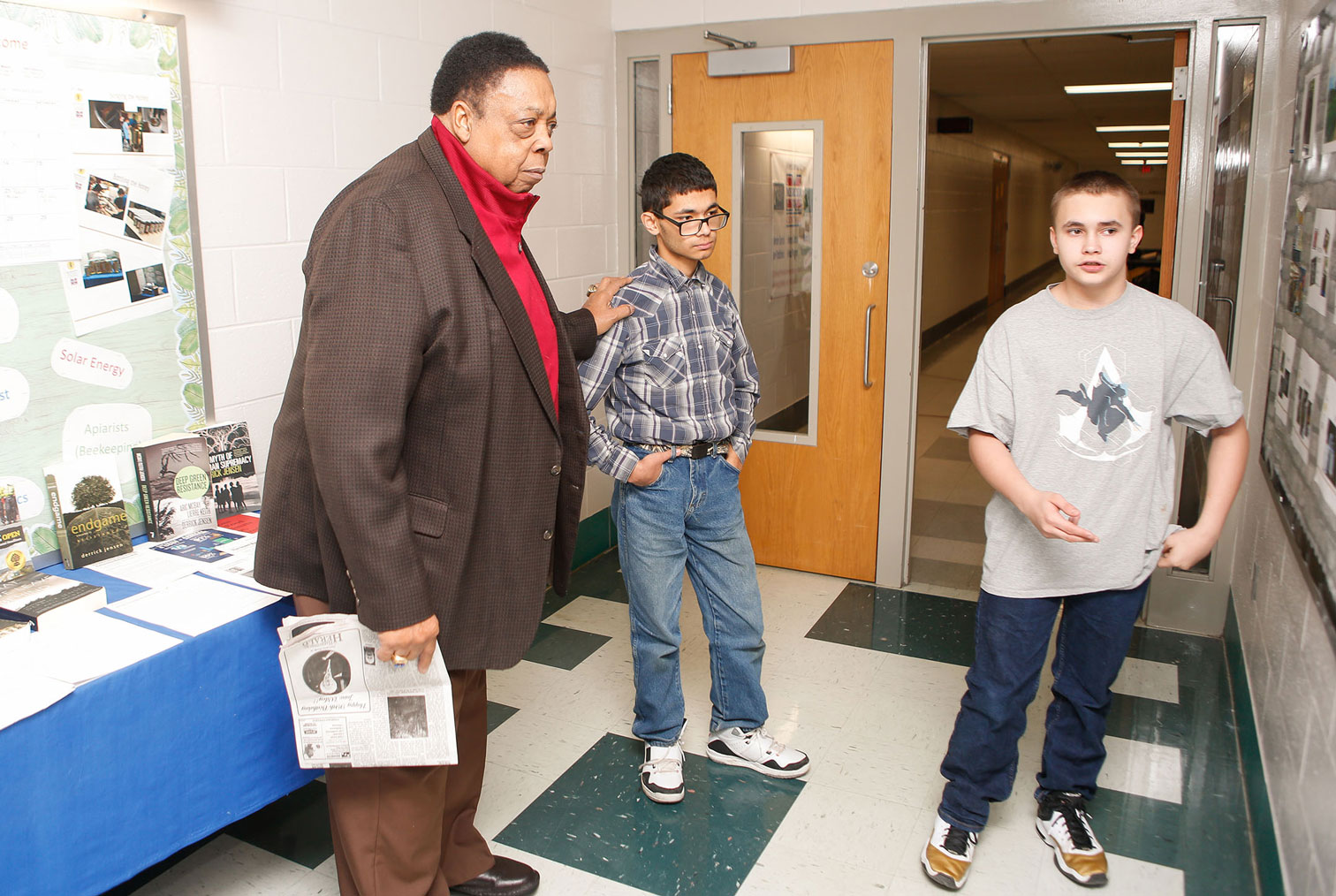
Melanie Santiago answers a question for James Rutledge and Antoneo Watkins during her freshman civics class at Western High School (Jefferson County). Santiago is a graduate of Western High School. Photo by Amy Wallot, Nov. 30, 2011
Anyone can understand Kentucky’s Unbridled Learning assessment and accountability system if they understand the basic concept, according to one of its designers.
“We’re going to give schools one score, tell them they’re better than a certain percentage of schools and tell them we want to improve that percentage each year,” Office of Assessment and Accountability Associate Commissioner Ken Draut said. “At the highest level, it’s a very simple system.”
In late summer 2011, the Kentucky Board of Education (KBE) approved an even simpler accountability system it was ready to use. Under that version of the plan, schools would have received a score and been placed in one of three categories: needs improvement, proficient or distinguished. But they would not have had an annual improvement goal for accountability. However, waiver guidelines from federal No Child Left Behind (NCLB) Act regulations require the state to enact annual measurable objectives (AMOs) for schools and districts.
That caused Kentucky Department of Education (KDE) staff to redraft parts of the accountability system, Draut said.
“What we wanted to do, of course, from the beginning was move our single state accountability system into this area to take the place of the NCLB accountability system, so we would have one accountability system model, not two,” he told the board in December. “That’s caused problems over the years.” Read the full story
Posted in Features
Posted on 06 December 2011. Tags: achievement gaps, digital learning, learning outcomes, National Assessment of Educational Progress, resources, Task Force on Transforming Education in Kentucky

Commissioner Terry Holliday
Technology can be a wonderful tool for learning.
It allows access to up-to-date information, increases communication, and offers interactivity and relevance as we prepare ALL students to be college- and career-ready in a global, technology-driven world.
It also holds immense instructional promise for students who, due to financial, physical or learning disabilities and other educational barriers, struggle to achieve their highest potential.
Nationally we have seen how technology is increasingly impacting teaching and learning. In Kentucky, just in the past several months, we announced an iTunes project that offers educators access to high-quality digital content resources; witnessed the emergence of 1:1 tablet projects in school districts that provide digital learning resources and textbooks to students; seen school districts utilize Skype to bridge physical barriers to providing rigorous coursework; and introduced a mobile portal application that enables parents to monitor their children’s progress. Read the full story
Posted in Commissioner's Comments
Posted on 24 November 2011. Tags: achievement gaps, Commissioner's Raising Achievement/Closing Gaps Council
The Commissioner’s Raising Achievement/Closing Gaps Council (CRACGC) has released a new document that is designed to help parents and community members become engaged in their schools and districts and to focus on statutory and regulatory expectations related to achievement gaps.
Guidelines for Closing the Gaps for All Students is referenced in a new state regulation, 703 KAR 5:220, the regulation related to school and district accountability recognition and support. The guidelines are designed to be parent-friendly, so that parents know what is expected of schools and districts. It also provides guidelines that schools and districts can follow to help ensure that students receive a high-quality, consistent and equitable education.
Because closing achievement gaps and implementing best practices to do so have been deemed aspects of parental involvement, schools and districts may use a portion of their Title I parent involvement funds to print copies of the documents for distribution to families. Read the full story
Posted in News
Posted on 27 September 2011. Tags: achievement gaps, college- and career-readiness, Kentucky Core Content Tests, No Child Left Behind
The Kentucky Department of Education today released data related to schools’ and districts’ status under the federal No Child Left Behind (NCLB) Act; results of the Kentucky Core Content Tests (KCCT); college/career-readiness data and information about achievement gaps.
This data is based on student test score results from the spring 2011 administration and other factors.
Detailed information on AYP, KCCT, college/career readiness and achievement gap data of each Kentucky public school and district is available through the Open House section of the KDE website.
NCLB results
Data indicate that 42.6 percent — 489 — of Kentucky’s 1,148 accountable public schools made Adequate Yearly Progress (AYP) in the 2010-11 school year under the requirements of the federal No Child Left Behind (NCLB) Act. Read the full story
Posted in News
Posted on 16 June 2011. Tags: achievement gaps, business, early childhood, education, elementary, health, leadership, parents
Great by 8, a statewide initiative to educate and engage local communities to improve economic growth through advocacy for early education, is hosting a statewide summit June 21-22 in Louisville.
The goal of Great by 8 is to expand and strengthen support to programs and services for Kentucky’s children from birth through age 8. The effort emphasizes building leadership capacity to increase program collaboration and coordination and help communities determine how best to meet their local needs for improving the quality of schools, programs and services for all children. The ultimate goal is to eliminate achievement gaps that exist between groups of students by giving all of them a high-quality start on learning. Read the full story
Posted in Leadership Letter, News
Posted on 04 November 2010. Tags: achievement gaps, Commissioner's Raising Achievement/Closing Gaps Council
The Commissioner’s Raising Achievement/Closing Gaps Council (CRACGC) has issued a set of recommendations and strategies to help close achievement gaps between all groups of Kentucky’s public school students. Read the full story
Posted in News
Connect With Commissioner Holliday