Posted on 15 March 2012. Tags: Murray State University, No Child Left Behind, performing arts, study
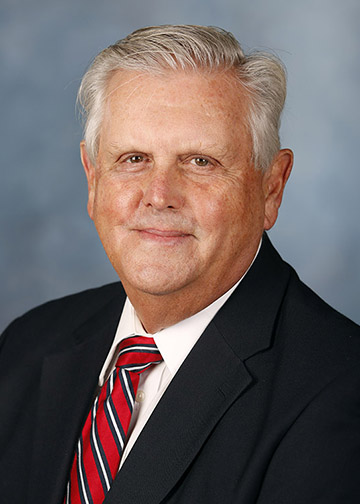
Richard Dodson, assistant professor at Murray State University, is conducting research on the effect No Child Left Behind (NCLB) has had on performing arts education in Kentucky schools since its enactment in January 2002.
The study also will focus on what Kentucky performing arts educators believe will happen for their programs as a result of Kentucky’s recent waiver from NCLB. In this study, performing arts are defined as dance, music, theatre, visual arts and playwriting programs.
Educators from every Kentucky school that has one or more of these programs, whether private, magnet or public, are invited to participate. A survey may be accessed at http://www.surveymonkey.com/s/ZJB2GKX. The survey will be available through April 1. It should take only about 10 to 15 minutes to complete.
Participation is voluntary, and all responses on this survey will be anonymous.
Posted in Announcements
Posted on 06 March 2012. Tags: accountability, flexibility, No Child Left Behind, Race to the Top, Teacher and Principal Professional Growth and Effectiveness System, Teacher Effectiveness Steering Committee, waiver
Since the White House announced the waiver process in September, the Kentucky Department of Education (KDE) team and its partners have worked many hours to prepare and negotiate the waiver and flexibility from the rigid requirements of NCLB.
The goal from the beginning has been to have one accountability system rather than two — state and federal. Having two accountability systems was confusing to parents and schools. Also, the federal system began to lose credibility due to the details of NCLB.
The waiver will allow schools and districts some funding flexibility with regard to Title I and other federal dollars that were once tied to tutoring and other services mandated by NCLB. This flexibility, which will allow money to be reallocated to other efforts aimed at bolstering student achievement, comes at a very important time. State budgets for education have been reduced, and schools/districts will be looking at ways to redirect existing dollars to address the components of Senate Bill 1. Read the full story
Posted in Commissioner's Comments
Posted on 09 February 2012. Tags: accountability, college- and career-readiness, Elementary and Secondary Education Act, No Child Left Behind, U.S. Department of Education, Unbridled Learning, waiver
The U.S. Department of Education (USED) announced today that Kentucky’s application for flexibility under federal Elementary and Secondary Education Act/No Child Left Behind (ESEA/NCLB) has been approved.
Nine other states also received waivers including Indiana, Colorado, Florida, Georgia, Massachusetts, Minnesota, New Jersey, Oklahoma and Tennessee.
With the granting of flexibility, Kentucky’s public school system will have one comprehensive system of accountability for both state and federal purposes to ensure college/career readiness for all students
The application and related appendices may be seen on KDE’s Unbridled Learning page, here.
“Kentucky is once again leading the nation in the area of public school accountability,” said Gov. Steve Beshear. “This federal flexibility opens a new chapter in the Commonwealth’s work to ensure a well-educated citizenry. I congratulate our teachers, administrators, state agency staff, Kentucky Board of Education members, legislators and education partners on this great accomplishment.”
“The granting of this request means that Kentucky can continue the forward momentum that began with the passage of Senate Bill 1 in 2009,” said Kentucky Education Commissioner Terry Holliday. “The accountability model that we will use for state and federal purposes provides in-depth information about every school and district, so that we can focus our resources on the areas of greatest need and challenge our students and educators to constantly improve toward the ultimate goal of college and career readiness.” Read the full story
Posted in News
Posted on 09 February 2012. Tags: Declaration of Participation Report, No Child Left Behind
District administrators need to turn in their Declaration of Participation Report no later than April 1 in accordance with the No Child Left Behind Act of 200.
This report is used to identify the number of students enrolled in area private non-profit and home schools. Federal programs participating in the Declaration of Participation are Title IIA -Teacher Quality and IDEA-B -Individuals with Disabilities Education Act (including American Recovery and Reinvestment Act funding).
The coordinating forms needed to complete this request have been posted on the Kentucky Department of Education website. For more information, contact Becky Stoddard.
If you have additional questions please contact either Tracy Billingsley (Title IIA 502-564-1979), Judy Howard (Title III-LEP 502-564-1979), Chris Thacker (IDEA-B 502-564-4970).
Posted in Leadership Letter
Posted on 13 December 2011. Tags: accomodations, assessment, Exceptional Child Education, Kentucky Board of Education, Kentucky Environmental Literacy Plan, National Assessment of Educational Progress, Next-Generation Learners, No Child Left Behind, Program Review, teacher- and principal-effectiveness, Unbridled Learning, waiver
By Matthew Tungate
matthew.tungate@education.ky.gov

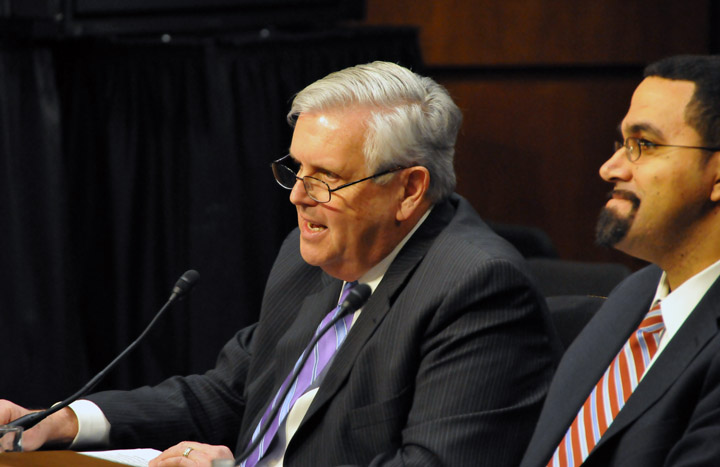
Associate Commissioners Ken Draut, Dewey Hensley and Felicia Cumings-Smith speak to the Kentucky Board of Education regarding the new assessment and accountability system. Photo by Amy Wallot, Dec. 7, 2011
If approved by the U.S. Department of Education, Kentucky schools and districts will have an annual improvement goal under a revised version of the state’s Unbridled Learning assessment and accountability system.
Under previous versions of the plan, schools would have received a score and been placed in one of three categories: needs improvement, proficient or distinguished. But they would not have had an annual improvement goal for accountability. However, waiver guidelines from federal No Child Left Behind (NCLB) Act regulations requires the state enact annual measurable objectives (AMOs) for schools and districts.
Staff from the Kentucky Department of Education briefed the Kentucky Board of Education on the requirements of the waiver during the board’s Dec. 7 meeting.
In addition to AMOs, other changes caused by the waiver include new designations for schools and districts based on how they perform under the requirements of Unbridled Learning; inclusion of student growth as a component of the state’s teacher and principal evaluation system; and removing specific accommodations for students with special needs previously allowed during testing of reading and mathematics.
The new accountability model includes student data from testing, gap, growth, college/career readiness and graduation rate (Next-Generation Learners); principal and teacher effectiveness (Next-Generation Professionals); and Program Reviews (Next-Generation Instructional Programs and Support). Scores from each of the three areas ultimately will be totaled for an overall score. Read the full story
Posted in Features
Posted on 15 November 2011. Tags: Elementary and Secondary Education Act, No Child Left Behind, Unbridled Learning, waiver
The Kentucky Department of Education (KDE) has submitted the state’s application for flexibility under the Elementary and Secondary Education Act (ESEA) of 1965, which was reauthorized in 2001 as the No Child Left Behind (NCLB) Act.
The application and related appendices may be seen on KDE’s Unbridled Learning page, here.
To help states move forward with education reforms designed to improve academic achievement and increase the quality of instruction for all students, in September, President Barack Obama and U.S. Education Secretary Arne Duncan outlined how states can get relief from provisions of NCLB in exchange for serious state-led efforts to close achievement gaps, promote rigorous accountability and ensure that all students are on track to graduate college- and career-ready. Read the full story
Posted in News
Posted on 01 November 2011. Tags: accountability, college- and career-readiness, No Child Left Behind, Unbridled Learning, waiver

Commissioner Terry Holliday
It was my great pleasure to participate in the 2012 Kentucky Teacher of the Year announcement two weeks ago.
As I told those who gathered for the ceremony at the Capitol Rotunda, the handing out of the award is my favorite day of the year.
I am proud and grateful for the hard work these and many other educators around the state undertake on behalf of Kentucky’s children.
We ask a lot and expect a lot of our teachers in this state, especially these past few years as we overhaul and increase the rigor of our standards and embrace Kentucky’s Unbridled Learning Accountability System.
While some of those who were honored on Oct. 18 received monetary awards for their work, we know those types of occasions are rare in teachers’ careers. Their work is measured not by their pay checks, but by the impact they have on their students and this state.
It is work that is critical to our children and Kentucky, and it is not work we can expect them to do alone. That is why the Kentucky Department of Education is focused on partnering with teachers, and offering them support and resources through various initiatives, including the Teaching, Empowering, Leading and Learning (TELL) Kentucky survey, the Continuous Instructional Improvement Technology System (CIITS), District 180 and many more. Read the full story
Posted in Commissioner's Comments
Posted on 27 September 2011. Tags: achievement gaps, college- and career-readiness, Kentucky Core Content Tests, No Child Left Behind
The Kentucky Department of Education today released data related to schools’ and districts’ status under the federal No Child Left Behind (NCLB) Act; results of the Kentucky Core Content Tests (KCCT); college/career-readiness data and information about achievement gaps.
This data is based on student test score results from the spring 2011 administration and other factors.
Detailed information on AYP, KCCT, college/career readiness and achievement gap data of each Kentucky public school and district is available through the Open House section of the KDE website.
NCLB results
Data indicate that 42.6 percent — 489 — of Kentucky’s 1,148 accountable public schools made Adequate Yearly Progress (AYP) in the 2010-11 school year under the requirements of the federal No Child Left Behind (NCLB) Act. Read the full story
Posted in News
Posted on 23 September 2011. Tags: No Child Left Behind

Kentucky Education Commissioner Terry Holliday joined President Barack Obama and U.S. Education Secretary Arne Duncan in Washington, D.C. for the announcement of flexibility under the federal No Child Left Behind (NCLB) Act. Photo submitted, Sept. 23, 1011
Kentucky Education Commissioner Terry Holliday joined President Barack Obama and U.S. Education Secretary Arne Duncan in Washington, D.C., today for an announcement about flexibility under the federal No Child Left Behind (NCLB) law.
During the event, the president outlined how states can get relief from provisions of the Elementary and Secondary Education Act – NCLB – in exchange for serious state-led efforts to close achievement gaps, promote rigorous accountability and ensure that all students are on track to graduate college- and career-ready.
Duncan indicated that the process by which states may apply for flexibility will now open, and states will have up to seven weeks in which to apply. The first round of waivers could be announced in late December or early January.
Kentucky education officials plan to apply, after slightly reworking the state’s original request for flexibility to fit federal guidelines. Read the full story
Posted in News
Posted on 11 August 2011. Tags: NCLB, No Child Left Behind, U.S. Department of Education, USED
Kentucky, along with other states, has called for greater flexibility in implementing the requirements of the federal No Child Left Behind (NCLB) Act, and the U.S. Department of Education (USED) has responded.
USED announced recently that President Barack Obama has approved the development of a waiver request process to enable states to ask for flexibility in implementing the requirements of NCLB during the 2011-12 school year.
Read the full story
Posted in News