Posted on 27 March 2012. Tags: chemistry, economics, high school, Newport Independent, physics, science
By Susan Riddell
susan.riddell@education.ky.gov

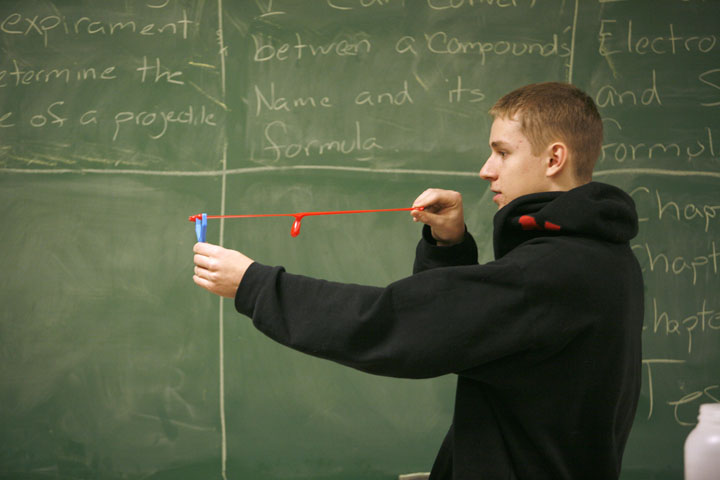
Senior Andrew Marsee launches a sling shot device during a lab on projectile motion in Michael Barker's Honors Physics class at Newport High School (Newport Ind.). Photo by Amy Wallot, Feb. 9, 2012
Michael Barker, a science teacher at Newport High School (Newport Independent), would love to have a projectile motion launcher from Pasco in his classroom.
It’s the $349 price tag that he finds less palatable – or even practical.
“In no way am I trying to say that that piece of equipment is overpriced,” Barker said. “However, I can use a foam dart launcher and a plastic protractor for a similar – albeit a less accurate lab – for between $3 and $5.”
The projectile launcher is just one example of Barker’s frugal approach to finding supplies for his science classes. Every month, he said, he makes monthly trips to thrift stores, looking for anything from stopwatches to toy cars.
“Adaptability and the ability to improvise are skills that are useful to every science teacher,” said Sean Elkins, science consultant for the Kentucky Department of Education. “Mr. Barker’s creative approach to improvised materials means his students will have the opportunity to experience natural phenomena in a meaningful way despite a limited materials budget.”
Barker said the hands-on activities to bolster the learning experience. Continue Reading
Posted in Features
Posted on 27 March 2012. Tags: Barren, BAVEL, digital learning, Digital Learning 2020, JCPS eSchool, Jefferson

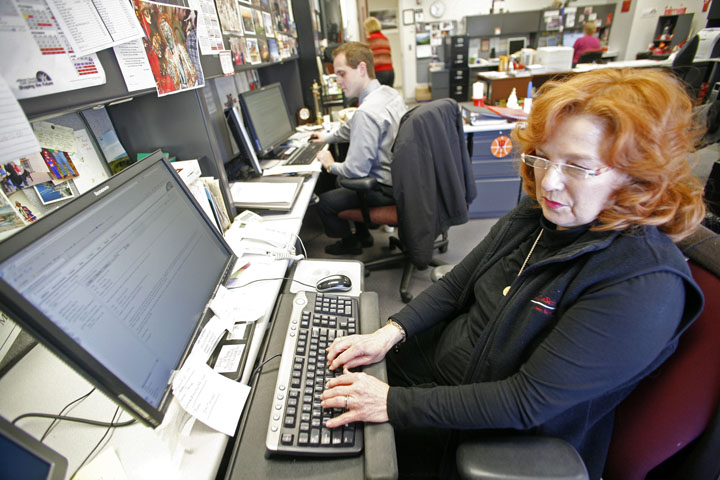
Ruth Ann Driggers teaches Spanish classes through the JCPS eSchool. Driggers has been with the program since its beginning in 2000. “I found it a really great opportunity after 31 years in the classroom. I can use that content knowledge to help students online,” she said. Also pictured is English teacher Erik Nicholson.
The school bell rings and a student looks up from her smartphone, where she’s been chatting via Facebook with a boy from Brazil. They are working collaboratively on a project about each other’s home country.
The teacher, skyping from a neighboring district, in Portuguese tells the girl and her classmates to take the first 15 minutes of class to use their smartphones or iPads to answer the question posted on the interactive white board. Many students start by looking in their e-textbook, which their teacher compiled before the semester started. Others simply go to Google.
Once the 15 minutes are over, the teacher directs the students to a website where they have to use what they have learned to help an Indiana Jones-like explorer complete missions. It’s more like a video game than a quiz, but the teacher can tell by how they do who did the work and who didn’t. She’ll send those who didn’t do well an e-mail with links to the information after school, along with an assignment for them to turn in – electronically, of course – the next day.
This and similar scenes will be typical in Kentucky schools if David Cook at the Kentucky Department of Education and other drafters of a recent report can bring their vision to fruition. Continue Reading
Posted in Features