Posted on 21 August 2012. Tags: Shelby County school district initiative helps former students get that much-needed diploma.

By Susan Riddell
susan.riddell@education.ky.gov

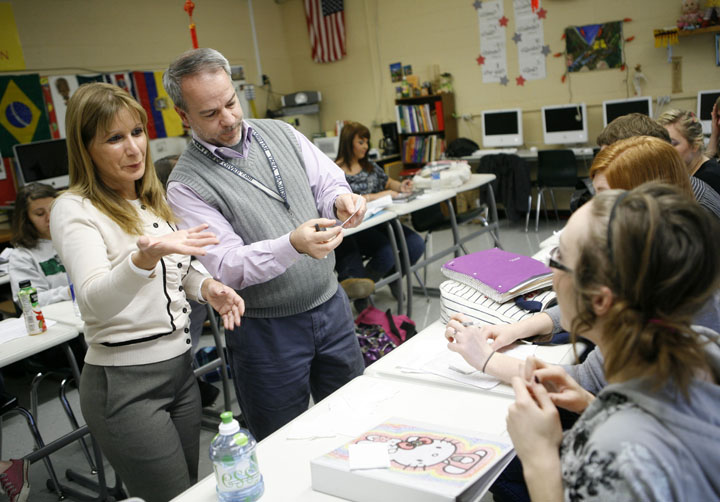
Kamala Combs helps Marissa Hilgerson with English IV work during the Diploma Recovery Academy at Shelby County High School. Hilgerson is the first student in the program to receive her diploma. Photo by Amy Wallot, April 25, 2012
The Kentucky Department of Education’s Unbridled Learning initiative is focused on better preparing students for college and/or career.
Students can’t achieve this preparedness, however, without graduating and receiving that all-important diploma.
School districts are facing the battle against losing students prior to graduation head on. Many, like the Shelby County school district, have added night school to provide an opportunity for students who have already dropped out of school to acquire a high school diploma.
“School districts like Shelby County are creating successful models for allowing students who have dropped out to come back to school for their diplomas,” said Sherri Clusky, program consultant with the Kentucky Department of Education’s Division of Student Success. “Not every district may take the same approach, but the intent is still the same, and it’s an important one. Students who come back to school for a diploma will reap so many rewards and benefit both personally and professionally once they earn it. Continue Reading
Posted in Features
Posted on 21 August 2012. Tags: Menifee, Spanish, Uruguay, world language
By Matthew Tungate
matthew.tungate@education.ky.gov

Maris Montes, a principal in Uruguay, and Randy Barrette help senior Jessy Workman with phrases about morning activities during Barrette’s Spanish II class at Menifee County High School.
Randy Barrette has spoken Spanish for 23 years, teaching it for 15 years. He has visited South America. He is the outgoing president of the Kentucky World Language Association. The Spanish and world cultures teacher at Menifee County High School is hardly a novice representante de la española (speaker of Spanish).
Still, he had to play “catch-up” the first night at the Uruguayan home of his counterpart in an international teacher-exchange program.
“Their pronunciation and many of the slang words they used put my brain into overdrive,” Barrette said. “I had to remind myself that only four months ago I was speaking Spanish in Spain, but this was not quite the same.”
For instance, Uruguayans have a distinct sound for “y” and “ll,” he said. There were some words they used that were unique to the culture, like the words for shoes, sandals and noise.
“As a professional, those are the kinds of experiences that you really need. Otherwise you’ll never know – you’ve got to have those,” Barrette said. “That is why this program is crucial.” Continue Reading
Posted in Features