
 Kentucky Board of Education (KBE) members dug deeper into data from Kentucky’s assessment and accountability results during the virtual KBE meeting Feb. 4-5, including a discussion on student group performance trends and how to address achievement gaps.
Staff members with the Kentucky Department of Education’s (KDE’s) Office of Assessment and Accountability provided board members with detailed data results from multiple sources, including the 2024-2025 Kentucky Summative Assessment, the 2025 ACT administration, the 2024 National Assessment of Education Progress in Reading and Mathematics, and the 2024-2025 Kindergarten Readiness report.
KDE Associate Commissioner Jennifer Stafford said the data was provided in response to board members seeking more information to explore potential areas to address.
“As we look at the data, it clearly demonstrates that – despite improvements that we have seen – achievement gaps persist across race, across gender, ethnicity, language, disability groups and particularly around socioeconomic status,” Stafford said.
KDE included a breakdown of the data by grade level and student demographics, and Stafford said while performance is rising or holding steady across nearly all racial, gender and socioeconomic groups, the achievement gaps between those groups is persistent. Stafford noted Kentucky Summative Assessment data shows progress and steady gains in reading and math at all grade levels.
KDE Chief Performance Officer Karen Dodd and Strategic Data Analyst Leslie McKinney provided an overview of state and national research into the potential causes of achievement gaps, focusing on how issues of poverty play into academic performance and how achievement gaps emerge early, often by kindergarten.
“The research we looked at also points out that these gaps are not our destiny,” McKinney said. “We can certainly make improvement and they’re possible with long-term commitments.”
Board members discussed potential avenues to address achievement gaps and other issues, including promoting evidence-based practices and collaboration with businesses and the community, advocating for more education funding and highlighting the importance of access to opportunities for students.
KBE Vice Chair Lu S. Young said the data presented provides a good blueprint for where the board should focus, where it should advocate for funding and where there are opportunities to innovate.
“We have to begin with honesty. Poverty matters. It affects access to healthcare, housing, stability, trauma, nutrition, technology and time; all of those things shape the lived experiences of kids and their families in our schools,” Young said. “But by acknowledging that reality, it’s not the same as lowering expectations. Poverty does shape the starting line, but it doesn’t have to define the finish line for us.”
Young mentioned the work of the Kentucky United We Learn Council and schools across the Commonwealth to address areas within assessment and accountability to provide more authentic and vibrant learning experience. KBE member Juston Pate highlighted the Kentucky High School Transformation Network’s ongoing efforts to improve the high school experience as another example of work being done in Kentucky to address achievement gaps.
McKinney outlined the KDE research team’s next steps with the department’s ongoing analysis of student performance trends, including identifying specific factors and patterns that fall within KDE’s operational reach to ensure resources are targeted effectively. The priorities also include investigating the impact of school- and community-level poverty on student achievement, prioritizing efforts to investigate gaps related to kindergarten readiness, and examining success stories at the local level where gaps have been reduced.
Micki Marinelli, KDE’s chief academic officer, reviewed KDE’s efforts to support student growth, including increased access to high-quality instruction resources (HQIRs) and curriculum-based professional learning for educators. This includes recent success with statewide literacy coaches and with Language Essentials for Teachers of Reading and Spelling, better known as LETRS, offered through the Kentucky Reading Academies.
Marinelli pointed to research, including the recent ICF third-party evaluation of the Kentucky Reading Academies’ LETRS program and from the school-based literacy coaching model, that shows students in classrooms where educators have access to HQIRs and professional learning perform better than students in other situations. Kentucky is near the middle of states in terms of the growth of HQIR implementation, according to data from the RAND Corporation that was presented to board members.
KBE Chair Sharon Porter Robinson said the board will continue focusing on student performance and how to address achievement gaps at future meetings.
Career and Technical Education Celebration
February is Career and Technical Education (CTE) Month, which is a time to celebrate the accomplishments and achievements of Kentucky’s CTE students and raise awareness of how CTE prepares students for college and career success.
Representatives with KDE’s Office of Career and Technical Education provided an overview of Kentucky’s CTE programs and the different pathways students can choose, touching on sectors such as manufacturing, education, health science and agriculture. The pathways allow students to progress through work-based learning and earn industry certifications and postsecondary education opportunities.
During the 2024-2025 school year, 145,369 Kentucky high school students participated in a CTE pathway. Out of that group, 76,134 students participated in a career and technical student organization. The graduating class had 14,253 students earning more than one postsecondary credential upon graduation. Data presented by KDE showed how the number of students participating in CTE classes has continued to grow in recent years.
The presentation also included information on state funding for CTE programs, how KDE is adapting to emerging technology – including artificial intelligence – and how KDE is using a grant to improve career exploration at the middle school level.
KDE Associate Commissioner Beth Hargis said talking with students early about their careers is important.
“Middle school is where we really want to be able to set that hook so that students are more able to make an informed decision when they’re entering high school and they know what classes they need to take,” Hargis said.
Board members praised the progress in CTE offerings and student enrollment, highlighting how the work is engaging for students and prepares them for the future, in line with the board’s and KDE’s United We Learn vision. KBE member Randy Poe said the growing rate of students going from CTE pathways to college and postsecondary education is especially encouraging.
“Back in the day when I was teaching, the whole issue was CTE was going to distract you from postsecondary attainment,” Poe said. “And now what you’re showing us is that you’re engaged (as a CTE student) and once you’re engaged, you’re saying, ‘Look, I’m going to be employed in this area, but I’m not going to just stay at this employment level; I want to be able to advance,’ so they’re getting their postsecondary degrees.”
The board originally had planned a celebration of CTE students in Frankfort after the meeting, but the meeting was moved from in-person to virtual due to weather conditions.
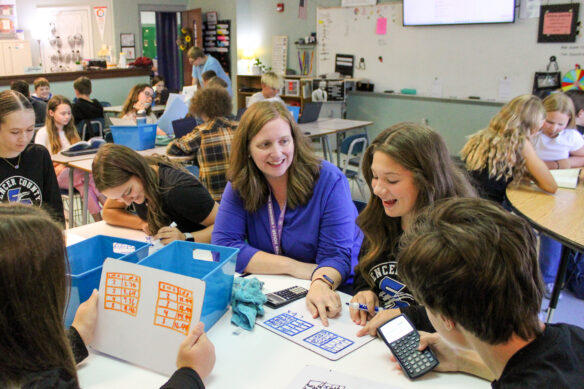
Spencer County Middle School teacher Michelle Gross is a champion for vibrant learning experiences in the projects she leads to help students understand how math applies to their lives. Gross, who has 22 years of teaching experience in math, was named the 2026 Kentucky Teacher of the Year during a ceremony in Frankfort on Oct. 7. (Photo submitted)
Kentucky Teacher of the Year
Michelle Gross, the 2026 Kentucky Teacher of the Year and the recently named finalist for the 2026 National Teacher of the Year award, provided an update to board members about her experience in education and everything she has done so far since earning the Kentucky Teacher of the Year honor in October.
Gross said the United We Learn vision of vibrant learning experiences, innovative practices and collaboration with the community resonates deeply with her as she has tried to integrate the same priorities into her work.
“At the heart of my work is belief of creating community in the classroom,” Gross said. “I believe in the power of connection, belonging and giving the students a purpose for learning that goes far beyond a grade.”
Gross has 22 years of experience teaching math, including 20 years in Spencer County. She teaches 7th-grade math classes, and a gifted and talented class called The Academy where students pick a subject area to dig into deeper. Gross was among nine educators who were honored as 2026 Kentucky Teacher Achievement Award Winners during the Kentucky Teacher of the Year ceremony on Oct. 7.
Gross said one of the projects she is the most excited for each year is the Spencer County Middle School dream house project. Students research homes to design one they would like to build for themselves in the future and then build a model – either through physical items like popsicle sticks and cardboard or digital tools – to showcase to the community.
“Regardless of their background, they begin to see themselves as future homeowners and problem-solvers,” Gross said. “It’s proof that hard work, learning and collaboration opens doors.”
Gross said the project helps students build a sense of community by interacting with other students in their classroom as well as professionals in the community to understand the home design process.
The sense of community isn’t just important for students though, Gross said; it’s important for teachers as well. Gross talked about her experiences as a GoTeachKY Ambassador and mentoring students in the Educators Rising program, aiming to build connections that help promote the profession.
“Across Kentucky and the nation, our schools are working to address teacher shortages. And while competitive pay matters, what truly sustains teachers is a sense of purpose and belonging,” Gross said. “Teachers stay where they feel valued, supported and connected to something meaningful.”
Gross said she interviews with the Council of Chief State School Officers in Washington, D.C., for the National Teacher of the Year Award March 5-6.
In other business, KBE members:
- Heard an update on the Kentucky legislative session from KDE Director of Government Affairs Brian Perry, including a discussion on where several pieces of legislation related to education currently stand.
- Approved an amendment to 702 KAR 7:065, the designation of an agent to manage middle and high school interscholastic athletics, and heard a presentation from the Kentucky High School Athletic Association on changes approved by member schools, including measures dealing with transfer rules, sports medicine and officiating;
- Accepted the Kentucky High School Athletic Association’s annual operations and management report and annual report on Title IX reviews and deficiencies;
- Approved an amendment to 704 KAR 3:305, minimum requirements for high school graduation, following the passage of House Bill 342 (2025), which requires the completion of at least one financial literacy program for students entering 9th grade on or before June 30, 2025, or the completion of a one-credit course on financial literacy for students entering 9th grade after June 30, 2025;
- Heard a presentation on the department’s new strategic dashboard which allows stakeholders to monitor KDE’s progress toward department goals; and
- Awarded the 2025 Kevin C. Brown Strategic Priority Award to Bullitt County Public Schools.

Leave A Comment