
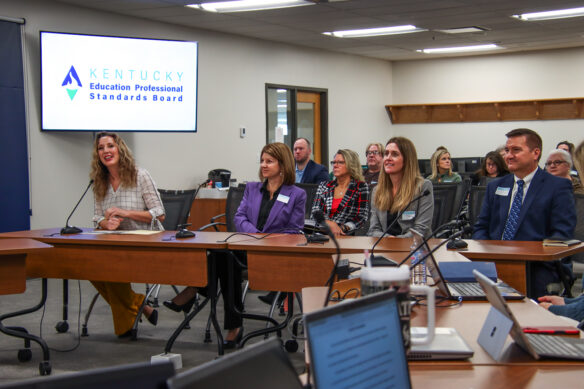
Representatives with the Northern Kentucky University College of Education – from left to right: Dean Ginni Fair, Associate Dean Ginger Blackwell, Department Chair Eileen Shanahan and Department Chair Jim Allen – speak with the Education Professional Standards Board. Photo by Joe Ragusa, Kentucky Department of Education, Feb. 17. 2026
(FRANKFORT, KY) – Representatives with Northern Kentucky University (NKU) presented information on their educator preparation program during the Education Professional Standards Board (EPSB) meeting on Feb. 17 as the EPSB continues to spotlight educator preparation programs at universities that prepare the next generation of teachers for the classroom.
NKU College of Education Dean Ginni Fair explained the university’s “Norse Up” philosophy and how they strategically plan goals to accomplish in the region, including a new mission and vision statement they developed with help from the community to “create exceptional adaptable educators and leaders who are going to make dynamic differences in their communities.”
The new strategy also focuses on a portrait of a graduate with 12 different competencies the NKU College of Education wants graduates to develop through each of its programs, from undergraduate to doctoral-level studies.
“Our districts around us are creating their portraits of a learner or their portraits of a graduate,” Fair said. “And we thought, you know what? If we are going to be preparing teachers, educators and leaders for our districts, we want to model that as well and we want to be intentional about the skill set that our graduates are leaving our college with.”
Fair said the university has also worked to develop more teacher pipelines, including collaboration with Educators Rising and a recently developed pathway for paraeducators.
“We’re trying to build capacity and interest in pipelines across our region, and we feel like we’re really leading the way in that regard,” Fair said.
The paraeducators program – which falls under Option 9 for educator certification – allows people to earn their bachelor’s degree and initial teacher certification in a three-year period while working in a non-teaching position in a school district. Students in the program at NKU currently work in one of 12 public school districts in the region or the Covington Diocese.
The program includes an in-person class at least once a week along with virtual learning. Fair said when students graduate, they’re ready to take on teaching roles within their districts in elementary, special education and interdisciplinary early childhood education fields. The first cohort of 13 students is set to graduate this May.
Fair also went over student demographic group data from 2024-2025 school year, which included 49% first-generation college students and 53% from a low-income background. Fair highlighted record retention rates of undergraduates within the university and education program: 91% of undergraduates returned and 84% of undergraduates in the College of Education were retained.
“They’re taking courses, for sure, but we also – with our unique populations of students – we’re really taking good care of them so they feel supported and successful,” Fair said.
Fair said NKU has various partnerships with local school districts and research partners to improve the student experience and scholarships that are available for students, continuing the emphasis on recruiting low-income and first-generation students. The university has partnered with the community in several ways, including a Safe Schools Institute in partnership with the Kentucky Center for School Safety and revamped advisory councils with business groups and other education stakeholders in the area.
In other business, EPSB members re-elected Amber Snell as chair and C.J. Fryer as vice chair of the board for another one-year term. The EPSB also honored Cassie Trueblood, policy advisor for the Kentucky Department of Education and lead counsel for EPSB, who will be leaving her position with the Kentucky Department of Education on March 1.
Leave A Comment