
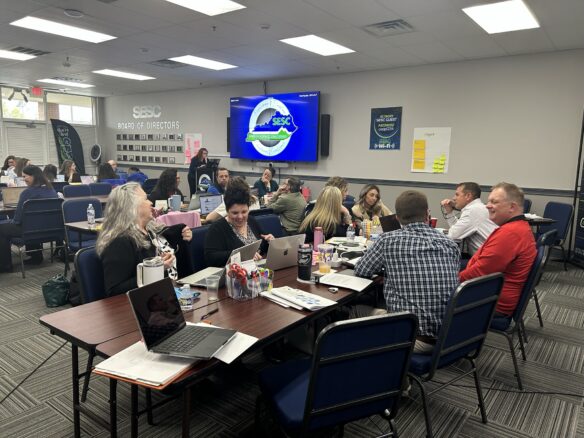
Leaders from five districts in Eastern Kentucky, along with representatives from the Kentucky Department of Education, REL Appalachia and other education groups, discussed ways to improve school attendance during the Reducing Chronic Absenteeism workshop at the Southeast South-Central Educational Cooperative office in London. Photo by Fiona Morgan, Kentucky Department of Education, March 27, 2026
(LONDON, KY) – Five districts in Eastern Kentucky discussed ways to combat chronic absenteeism during the Reducing Chronic Absenteeism in Kentucky workshop at the Southeast South-Central Educational Cooperative office in London on March 27.
Hosted by the Kentucky Department of Education (KDE) and REL Appalachia, this kickoff session is the first of two workshops and three collaborative strategic planning sessions to help districts combat chronic absenteeism in their schools. The workshop was also attended by representatives from Southeast South-Central Educational Cooperative, Central Kentucky Educational Cooperative and the Kentucky Valley Educational Cooperative.
The workshop included presentations, discussions and coaching sessions about the different resources KDE offers on chronic absenteeism. KDE defines a student as chronically absent if they have missed more than 10% of the time enrolled in school. This includes both excused and unexcused absences. KDE has a goal to reduce the average statewide absenteeism rate from 25% to 15% by 2029.
As part of this goal, KDE is increasing outreach to schools to help increase educators’ capacities to promote consistent school attendance. During the workshop on March 27, KDE officials and REL Appalachia staff learned from districts about what challenges they face in combatting the problem.
Representatives from Harlan County, McCreary County, Montgomery County, Wayne County and Wolfe County each shared what their districts do to address chronic absenteeism. District leaders also discussed contributing factors to chronic absenteeism, including mental health challenges, housing and food insecurity, transportation issues and apathy from students and parents.
Leah Coots, director of special education at Harlan County, said this year her district has worked hard to show their communities everything happening inside the district.
“We just announced a new STEM academy, we have preschool programs where we’re trying to catch kids at age 4 … and we’ve just tried to be really visible on social media,” Coots said. “We’ve really tried to create safe schools and promote our image inside schools. We have (school resource officers) in every school, we have weapon detectors, and we have tons of educational and extracurricular opportunities for our students, and we try to promote all of those things.”
Coots said promoting many of their programs, initiatives and extracurriculars helps encourage students to get involved and feel welcome in school.
Darrell King, director of pupil personnel at McCreary County Schools, attended an open house at the beginning of the school year to talk to parents about the impacts of missing school and the different levels of truancy, including when parents start facing legal consequences.
Throughout the year, he said the district gives prizes to students with perfect attendance and maintains contact with families of students who are chronically absent.
“We’re implementing to where we at least make three ways of contact, whether it be through email, through text messages, through (Infinite Campus) messenger or through the daily one call, and then also being able to go do a home visit for every kid,” King said.
Chris Barnett, director of pupil personnel at Montgomery County Schools, said even in situations where the county attorney gets involved, students did not receive enough corrective action to address their attendance issues. So last school year, the district partnered with the county attorney to implement a truancy tracking structure.
Under the program, teachers would contact a student twice about absences, and by student’s third absence, the district sends its local Family Resource and Youth Services Center (FRYSC) representative to do home visits.
Barnett said the district also started hosting parent engagement meetings at the elementary schools. As a result of the district’s work, leaders saw a 74% reduction in the number of students having 15 or more unexcused absences in the most recently completed school year.
“Building the relationships, talking to kids, talking to the parents, has paid off and (is) growing dividends for us,” Barnett said.
Another goal of the workshop was to build district leaders’ capacity to analyze and interpret data at the state, district and school level to identify patterns, contributing factors and areas of concern related to chronic absenteeism. KDE representatives shared resources with evidence-based strategies at the district level.
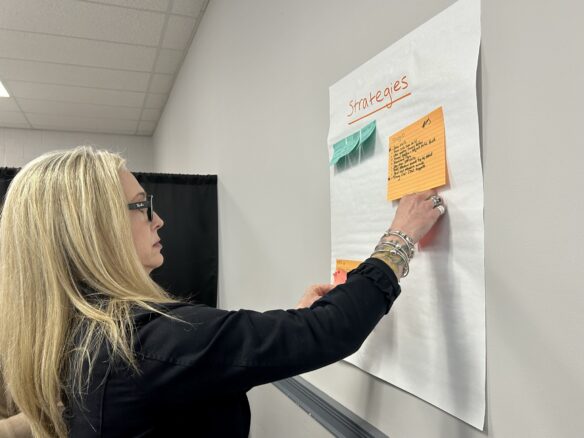
Christina Watford, education program consultant with the Kentucky Department of Education’s Office of Continuous Improvement and Support, puts up sticky notes that describe what strategies districts use to combat chronic absenteeism. Photo by Fiona Morgan, Kentucky Department of Education, March 27, 2026
KDE representatives gave each district a personalized interactive Power BI dashboard with specific data on chronic absenteeism, culture, climate, and contextual factors for both their counties and communities. A companion action planning guide accompanied the Power BI dashboard to assist in streamlining decision-making around chronic absenteeism.
The data tools provide insight into patterns, disparities and trends across schools, grade levels and student groups. The guide can help prepare and support facilitators in leading informed, data-driven discussions with district leaders and community leaders about chronic absenteeism.
The intent was to gain insight from participating districts by having them help determine which specific data points are most critical for addressing the issue from a school and local community level. The pilot serves as a research-driven effort in helping to pinpoint exactly which types of data empower districts as leverage points. Attendees were encouraged to bring the data back to their districts and share it with other districts.
Ashley Gates, Persistence to Graduation consultant at KDE, said she learned a lot from district personnel, especially about the unique challenges each district faces. She said being able to coach and engage directly with districts was the most helpful part of the workshop.
“It really starts with something as simple as being in the presence of people, so the fact that we’ve had five different communities come in and we can all be engaged and learn from one another, you just don’t see that often,” Gates said. “I think that’s why all of us showed up, because we’re committed to trying to figure out how to come together and support some of our most vulnerable communities, students and families.”
KDE is also hosting a You Belong! Attendance Matters video and poster showcase, a student-led initiative that elevates student voice while shining a spotlight on chronic absenteeism and strategies to address it. Students from across Kentucky are making videos and posters showing what makes their school unique for a contest category in the upcoming 2026 Student Technology Leadership Program State Championship on April 24.
A second workshop session will take place on July 27 to bring school-based staff into the conversation and further examine strategies to reduce chronic absenteeism. KDE will collaborate with district and school staff throughout the year to support reflection and implementation efforts.


Leave A Comment