
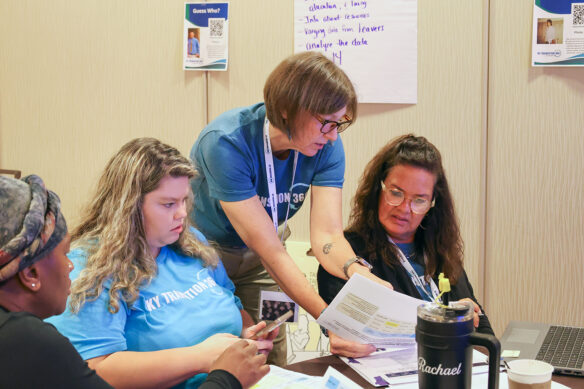
Tracy Parks (middle), a coaching coordinator in the Kentucky Department of Education’s Transition Education Unit, teaches educators at the 2025 KY Transition 360 Summer Institute. Photo submitted
The Kentucky Department of Education (KDE) provides a variety of support for schools to help students with disabilities pursue career and technical education (CTE) pathways.
“We know that career and technical education is an evidence-based predictor of positive post-school outcomes for students with disabilities in the area of employment, so we’ve been doing a lot of work in this area,” said Jason Wheatley, director of the Transition Education Unit in KDE’s Office of Special Education and Early Learning.
Wheatley said his office meets regularly with KDE’s Office of Career and Technical Education to collaborate on projects, discuss professional development opportunities and design curriculum.
One collaboration product is the new virtual reality field trips for special education students pursuing CTE pathways. KDE partnered with CareerViewXR to bring virtual reality field trips into classrooms at Monroe and Wayne County’s area technology centers and the Paducah Innovation Hub. The virtual field trips highlight careers in construction, marine transportation and tourism.
Another collaboration between KDE’s Office of Special Education and Early Learning and Office of Career Technical Education is an ongoing workgroup exploring how programs can better support students with disabilities in career and technical education pathways, particularly in achieving concentrator and completer status.
When a student completes two classes within an approved pathway, they’re considered a concentrator. When they complete four classes, they’re considered a completer. According to the Association of Career and Technical Education data from 2025, students concentrating in CTE programs – including students with disabilities – have significantly higher graduation rates: 93% of concentrators graduate, compared to 80% of students who are not concentrators.
The work group looked at which area technology centers, career and technical centers, college and career centers and local education agencies with CTE programming were having the most success supporting students with disabilities in achieving concentrator and completer status to see what was contributing to their success.
KDE found that many of those programs were supporting students with disabilities through initiatives such as intentional and prioritized scheduling, one-on-one planning with students and families, and choosing pathways aligned to interests and skills, promoting student success.
The Wayne Country Area Technology Center is one program which is successfully supporting students with disabilities. During the 2024-2025 school year, KDE ran six pilot programs for area technology centers in different parts of the state that did not have special education support staff on-site.
One grant went to the Wayne County Area Technology Center. During the fall of 2024, they had 22 students with IEPs who were failing classes. They hired three part-time instructors who were retired teachers to help support their special education students on site.
By the end of spring 2025, no student with an IEP was failing any classes. Now, the school has a full-time special education teacher for CTE programming.
Helping Students Find the Right CTE Pathway
Based on the findings from the workgroup and success in programs like Wayne County Area Technology Center, KDE launched a new guidance document on careers, skills, and postsecondary opportunities for Kentucky CTE Pathways. The document is on the CTE web page on KDE’s website.
The document describes all 135 CTE pathways and outlines careers within them. It lists the skills students would need to be successful in each pathway, allowing them to see whether it would be a good fit.
John Paise, education administration program consultant in KDE’s Office of Career and Technical Education, said school counselors can use the document to advise students on appropriate CTE pathways aligned with their career goals. It lists post-secondary opportunities within each pathway and helps align the student, family, and individualized education program team in planning transition.
“Because each pathway is highly specialized, no one school counselor could know in depth knowledge of all 135 pathways, so this document is designed to offer a snapshot when talking to students and shows potential career aptitude students need for common work environments,” Paise said.
Bill Bates, exceptional child education consultant in KDE’s Transition Education Unit, said in a Sept. 10 Family Partnership Council meeting that the guidance document can help special education teachers have better success with helping students choose careers.
“As a former special education teacher in CTE, if I would have had this when I was scheduling students, I would have been more effective; I would have been more knowledgeable; I would have known who I need to involve and talk to about what support students need to be successful,” Bates said. “I would have supported more students successfully. I would have been able to support the students within the program more successfully and more students would have been CTE pathway concentrators and completers just by the use of this one document.”
Professional Development
Wheatley shared that many CTE educators transition directly from industry roles, bringing valuable real-world expertise, while potentially benefiting from additional exposure to pedagogical approaches often gained through traditional education degree programs.
KDE offers many ways for CTE teachers to achieve that same level of pedagogical knowledge, including professional learning opportunities such as the Transition 360 for Educators program and New Teacher Institute (NTI).
“Many of our CTE teachers bring extensive experience from industry roles,” Wheatley said. “To build on this foundation, we’re providing resources that enhance their skills in high-quality instructional strategies and classroom management. That’s an important piece to enhance the success of students with disabilities in CTE classes. It’s making sure all educators are equipped with effective strategies to support vibrant learning for students, and (KDE) has provided CTE instructors with access to those resources.”
The Transition 360 for Educators is a statewide professional learning opportunity for educators in all roles who are interested in strengthening post-school transition outcomes for students with disabilities. The program includes three tiers which support educators from foundational learning through advanced system-level leadership.
In a KY Transition 360 for Educators spotlight, CTE Teacher Kourtney Hieneman said the program greatly influenced her work with students. She teaches at Ashland Blazer High School (Ashland Independent).
“I have gained new strategies to support student transitions from high school to postsecondary education and careers, particularly in helping them build confidence, workplace readiness and awareness of available career pathways,” Hieneman said. “The program has also expanded my professional network, giving me the chance to collaborate with other educators and industry partners.
“This collaboration has not only provided fresh ideas and best practices for my classroom, but has also strengthened my ability to connect students with real-world opportunities. Overall, it has reinforced my role as both an instructor and a mentor who prepares students for long-term success.”
Tracy Parks, a coaching coordinator in KDE’s Transition Education Unit, works to provide coaching services to CTE teachers to help them support students with disabilities. She leads professional development and professional learning activities focused on curriculum designed for students with disabilities.
“We’re engaging in supporting districts all across the state and enhancing their transition planning,” Parks said. “We explore what they can do as a school or district to strengthen supports for students with disabilities who make that transition into post-school success, that happy adult life, including continuing education, employment and independent living. We want them to have that happy life.”
Parks said she does a lot of work to help design curricula that are more friendly to students with disabilities.
Universal Design for Learning (UDL) is a framework to optimize teaching and learning for students of all abilities by providing multiple means of engagement, representation and expression.
“You want to design an environment that suits the learner rather than trying to kind of force-fit the learner to the environment that they’re in,” Parks said. “Because you don’t know how much they know, you don’t know what skills they have, you don’t know their learning styles when you’re designing that lesson, … you have to design it to be inclusive and supportive of everybody.”
Parks works to make sure CTE professionals, as well as anyone serving students with disabilities, have an enhanced knowledge of what Universal Design for Learning is and how they can incorporate its principles into their CTE classrooms. She also helps remove barriers in curricula for students with disabilities and helps make their CTE curricula more accessible for students.
“It’s a really good fit with UDL and CTE because in the CTE realm, relevance and mentorship and autonomy are really core elements to career and technical education, and that’s perfectly aligned with UDL,” Parks said. “It really kind of gives the educator or the CTE instructor a voice in guiding the development and design of that instruction.”
More information about professional development opportunities and other instructional resources offered by KDE can be found on KDE’s special education webpage.
Leave A Comment