
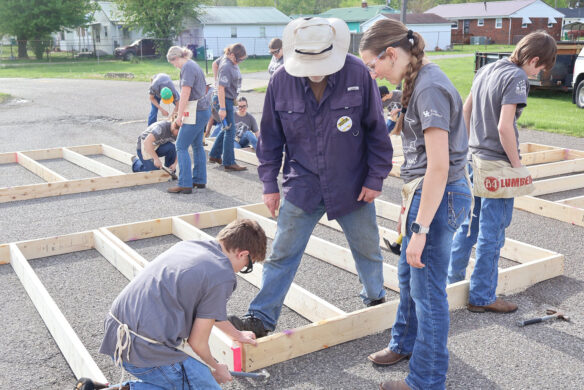
The Greenup County School of Innovation works with several community partners, including Habitat for Humanity of the Tri-State. Photo courtesy of Melissa Bowling
As the assistant principal of the Greenup County School of Innovation (GCSI) in Northeastern Kentucky, I have the privilege of working every day to help make certain that our school is not just a place of learning for students, but also a welcoming, supportive hub for families and the broader community.
My name is Melissa Bowling, and in my role at GCSI, I’ve been deeply involved in leading our family engagement work and guiding our school through the process of becoming officially recognized as a Family Friendly certified school in the Commonwealth of Kentucky. I truly believe that students thrive when their families feel valued and included in the educational process.
Our district decided to embark on the journey of Family Friendly Certification through the Prichard Committee because we saw, first-hand, the transformative power of strong school-family partnerships. In our rural area of Northeastern Kentucky, schools are often the heart of the community – yet we realized that not all families felt equally welcome, heard or empowered to engage with us. Some families were hesitant to visit the school; others were unsure how to support their children academically, and some felt disconnected altogether. We recognized that while we worked hard to educate our students, we needed to be equally intentional about building trust and relationships with their families. Research consistently shows that when families are engaged in their children’s educations, attendance improves, behavior improves, and academic outcomes improve – and that was exactly what we wanted for every single student at GCSI.
Once we made the decision to prioritize this work, we approached it thoughtfully and systematically. We started by taking a close look at what we were already doing and identifying areas where we could improve. Principal Brandi Litteral and I led a team of faculty members in reviewing our communication methods, observing the physical environment of the school, and surveying families to better understand their needs and perceptions. We also spent time learning what it really means to be a Family Friendly School – that it’s not just about holding a few events or sending newsletters home, but about creating an authentic partnership with families, where their voices matter and they feel ownership in their children’s educational experiences. We gathered data from family surveys, held focus groups, and encouraged open dialogue at our parent meetings. We listened carefully to what our families told us: they wanted clear, timely communication; they wanted to feel welcome when they came into the building; and they wanted more opportunities to be involved in meaningful ways beyond volunteering for field trips or attending parent organizational meetings.
When we first began this journey, we actually weren’t aware of the stipulations of the official Family Friendly Schools certification program. At the time, our focus was simply on doing the right thing for our students and their families. It was only after we had begun making changes and building momentum that we learned about the certification through the Kentucky Department of Education and our district office. A district employee reviewed the certification and the rubric of best practices that schools could use to assess themselves. As soon as I saw the rubric, I thought, “This is exactly what we’re working toward already.” It was validating to see that our efforts were aligned with research-based standards and best practices.
The certification process itself was very manageable, though it required some honest self-reflection and intentional effort. The process cannot be described as easy, because it involved taking a critical look at our practices and making sure we had evidence to back up the work we were doing. But it wasn’t cumbersome, either — in fact, it gave us a very clear roadmap to follow and helped keep us focused. We assembled a team of teachers, staff, and parents to work through the self-assessment, collect evidence, and submit the necessary documentation. One of the most valuable parts of the process was seeing how far we had already come while also identifying a few key areas where we still had room to grow. It was also rewarding to involve parents in the process – they provided valuable insights and felt proud to see their school striving for excellence in engaging families.
In order to meet the certification requirements, we didn’t have to completely overhaul our approach, but we did make some intentional adjustments. For example, we created a more formal process for gathering and responding to parent feedback on a regular basis, instead of relying solely on informal conversations. We also updated our seating around the building to make it more welcoming and easier to navigate for visitors. We added more culturally inclusive materials in our front office and our classrooms to reflect the diversity of our students and families. We also began offering more flexible opportunities for family engagement – including virtual options and events at different times of day – so that all families could participate, regardless of work schedules or transportation barriers. These changes weren’t difficult, but they required us to be more intentional and mindful about every aspect of how families experience our school.
We know that maintaining this work is just as important as achieving the certification. At GCSI, we are committed to making family engagement a permanent part of our culture, not just a temporary initiative. We have included family-friendly goals in our school improvement plan, and we regularly revisit the standards to ensure we’re continuing to meet and exceed them. We plan to continue collecting family feedback every year and adjusting our practices based on what we hear. We also provide ongoing professional development for our staff to help them build their skills and confidence in engaging families effectively. This is not something that’s ever “done” – it’s an ongoing journey of growth and improvement, and it is one we’re proud to continue.
The impact of becoming a Family Friendly School has been noticeable and incredibly positive. Our school feels warmer, more welcoming and more inclusive than ever before. Families have told us they feel more comfortable reaching out to teachers and administrators, and they feel like their input is valued. Our community partnerships have expanded, ranging from Meals on Wheels to Habitat for Humanity of the Tri-State. We’ve seen increased attendance at family events, more parents volunteering in meaningful ways, and more open, two-way communication between home and school. Perhaps most importantly, our students have benefited from knowing that the adults in their lives are working together to support them. They see their families and their school as a team, and that sense of community and connection has improved both behavior and academic performance.
Reflecting on this journey, I’m proud of what we’ve accomplished at the Greenup County School of Innovation, and I’m excited about what the future holds. Being a Family Friendly educational establishment isn’t just a box we’ve checked – it’s who we are and who we strive to be every day. As Assistant Principal, it has been deeply rewarding to see how this work has strengthened our school, brought families closer, and ultimately helped our students thrive. Wurtland, the home of Greenup County School of Innovation, is a close-knit community, and our school now reflects that same sense of connection and care. We look forward to continuing to grow and serve as a model for what it truly means to be a Family Friendly School.
Melissa Bowling is the assistant principal of the Greenup County School of Innovation.
The Family Friendly Schools Certification is awarded by the Prichard Committee after applications are reviewed and scored by a working group of families, educators and community organizations. The group is focused on increasing open communication, learning opportunities and shared decision-making power across the Kentucky education system.
The next certification window is open now and will close on Oct. 1. For more details on the Family Friendly Schools Certification, visit the Prichard Committee’s Family Engagement website.

Leave A Comment