
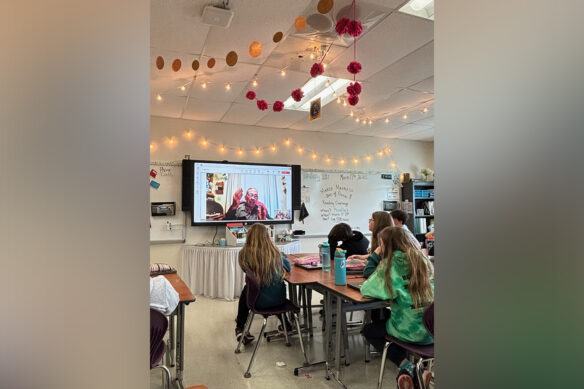
Don Soupiset, the grandfather of a 6th-grade student at Rowan County Middle School, speaks with the English language arts class as part of a discussion on the book “The Boy Who Harnessed the Wind” by Bryan Mealer and William Kamkwamba. District leaders incorporated virtual technology as part of their family engagement efforts. Photo courtesy Whitney Watercutter
My name is Whitney Watercutter and I am the Family Resources and Youth Services Center (FRYSC) coordinator at Rowan County Middle School, and the chair of the Rowan County Middle School Family Friendly Committee.
My first introduction to the idea of the Prichard Committee’s Family Friendly Groundswell Initiative was through my career with FRYSC. My former regional program manager, Doug Jones, put me onto the path of joining the Prichard Committee’s Equity Coalition- as he believed that my work within the district would lend to the work of the coalition and vice versa. As a long-standing member of the Equity Coalition, I was able to attend many eye-opening meetings about the great things that the Prichard Committee was doing across the state in terms of creating intentional, equitable pathways that empower all of our students to succeed. The mission of Family Friendly Schools and the mission of FRYSC marry well together. Therefore, when our district began the process of becoming a Family Friendly school district, I was selected at my school to be the chair of our committee.
As a former FRYSC herself, my district’s Community Schools director, Kellyn Gussler Poage, has a heart for work that involves bridging the barriers to success for all students. When we began the Family Friendly Certification process, she was my expert and my go-to for all resources on the initiative. She helped to build our Family Friendly team on the school level- by including our administrators, our guidance counselors, our social emotional learning coaches, our instructional coach, and bringing everyone to the table to create a big picture of our goal: we wanted to get certified Family Friendly, but even if we didn’t get certified we were determined to begin the process of creating meaningful, sustainable partnerships alongside our parents.
The process of becoming certified was a challenge. We knew that we had been doing a lot of programming with our students in mind, and we knew we had been trying to intentionally lay the groundwork to become a school that parents and guardians not only felt they could speak with, but a school that invests in and champions parent involvement.
It is a challenge, in this techie day and age, to build trust within communities. However, the Family Friendly initiative had created space to cultivate it and had given us valuable tools and training to at least try.
I believe that a lot of schools implement this type of intentional community building with stakeholders and must confront the same line of questioning that we found ourselves challenged with: How were we moving from doing to parents to doing with parents? How are we working together with our families and our community to incorporate shared decision-making in our schools? And finally, was there anything we already had in place that we could build upon?
If you want to build a partnership with parents, you must begin with parent input, so we started there.
The first thing we did was to work with what we had: A couple of our biggest parent groups with a voice are the parents on my FRYSC advisory council, and the parents of FRYSC Multicultural Achievers. I asked our parents for a meeting at the beginning of the year to discuss the direction of the club and inquire candidly about the ways we as a school could incorporate parent voice into our work. I presented this to our school Family Friendly Committee. We continued to meet regularly throughout the school year through my advisory committee, and we always worked Family Friendly into our meeting agendas.
Secondly, our teachers on our Family Friendly Committee sent home “Hopes and Dreams” letters. These letters are two-way communication between parents and teachers that highlight the hopes and dreams that parents have for their children during the school year. Our team analyzed the data and used it to tweak our FRYSC Needs Assessment Survey- the survey that addresses the needs of our community and gives parents a voice and a way to be included in decision making processes. We are very excited for the implementation of the new Needs Assessment Survey in the upcoming school year.
Lastly, our Family Friendly Committee team broke down all the programming that we do in my school and we listed it out in simple terms: YSC summer camps, Profile of a Learner, Family Engagement Nights, Kindness Carnival, community gardens, mentoring groups, grief groups, anti-bullying symposiums, social emotional learning clubs, career days, cultural fairs, Student Technology Leadership Program (STLP) clubs, math nights, partnerships with Pathways or other community health providers, etc. There are so many fantastic programs that schools across the state of Kentucky are implementing. Schools have really become a catch-all for multi-tiered systems of support programming and I personally think it’s wonderful. As a FRYSC coordinator, we are always looking for programming that serves not only the needs of the students and their families but addresses the community as whole. Family Friendly gives us the opportunity to reframe how we think about what programming looks like within our schools and expand the collaborative network of stakeholders.
After listing our programming, our unofficial motto for our new school year when we discuss initiatives will be: What is the parent’s role in this programming? To answer this question, we hope to introduce parent cafes, topical symposiums, and parent surveys that will help us to incorporate a larger reach of parent voice.
My school district views the Family Friendly Certification process as an investment. The trainings we attended, and the application process require a school to really delve into the big questions of who, how, and why we need each seat at the table: school employees, students, guardians, stakeholders. It helped my school to build relationships with families that turned into symbiotic partnerships. We all benefit from it.
Communities, such as school communities, are the best way to invest in Kentucky’s future. Acting as individuals will not be enough to sustain the type of community that we are trying to invest in, however, if we intentionally act in partnership with each other, we can all thrive. I for one, as a FRYSC, am very excited about my school’s journey in collaboration with Family Friendly.
Whitney Watercutter is the Family Resources and Youth Services Center (FRYSC) coordinator at Rowan County Middle School.
The Family Friendly Schools Certification is awarded by the Prichard Committee after applications are reviewed and scored by a working group of families, educators and community organizations. The group is focused on increasing open communication, learning opportunities and shared decision-making power across the Kentucky education system.
The next certification window is open now and will close on Oct. 1. For more details on the Family Friendly Schools Certification, visit the Prichard Committee’s Family Engagement website.
Leave A Comment