
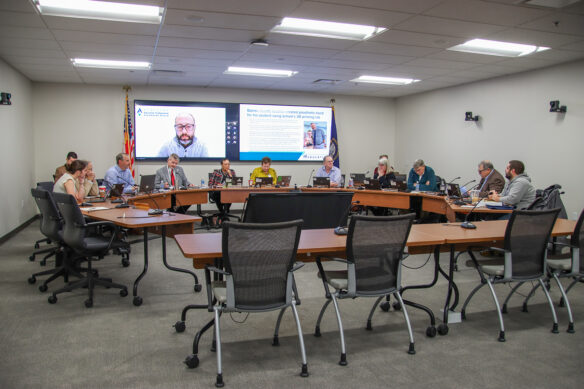
Members of the Kentucky Board of Education convene during the second day of their regular December meeting. Photo by Joe Ragusa, Kentucky Department of Education, Dec. 4, 2025
(FRANKFORT, KY) – Kentucky Board of Education members discussed Kentucky’s latest assessment and accountability results, along with efforts to improve education outcomes and potential next steps, during their meeting on Dec. 3-4.
Jennifer Stafford, associate commissioner of the Kentucky Department of Education’s (KDE’s) Office of Assessment and Accountability, presented data from the 2024-2025 Kentucky assessment and accountability results and the 2024 National Assessment of Educational Progress report, the most recent edition of what’s known as the Nation’s Report Card.
Kentucky students performed at proficient or distinguished levels at a higher rate during the 2024-2025 school year in reading and mathematics than they have in previous years. Several other categories were either slightly above or slightly below where they were in the 2023-2024 school year.
“We did see a rise in many of our student demographic groups, but we do still see those persistent gaps in achievement level with some of our demographic groups, so that is an area that we need to continue (to work on),” Stafford said. “We can celebrate the successes that we have but also note that there’s more work to be done.”
The presentation also included information from KDE Chief Academic Officer Micki Marinelli on what KDE and other educational partners have been doing to support districts.
With literacy, the Kentucky Reading Academies have already rapidly advanced outcomes for early learners since the professional learning program began three years ago, according to a report from third-party evaluator ICF earlier this year. Marinelli said this includes expanded content knowledge for participants and improved assessment results for 4th- and 5th-grade students in classrooms with educators who participated in the Kentucky Reading Academies.
Facilitated by KDE’s Division of Early Literacy, the academies provide access to Lexia’s Language Essentials for Teachers of Reading and Spelling, better known as LETRS, an evidence-based professional learning that is rooted in the science of reading.
Marinelli said that while more than 7,000 educators have either gone through or are actively participating in LETRS, “there are many other teachers that we still need to be able to support in science of reading instruction to ensure that students are consistently getting access to grade-level, high-quality instruction in the early literacy space.”
KDE also supports districts with the adoption of high-quality instructional resources and started providing coaching to educators through state literacy coaching specialists in the 2024-2025 school year. Other KDE efforts to improve literacy in Kentucky include working with universities that train teachers for improved alignment in their curriculum about the science of reading for preservice teachers and partnering with the new Kentucky Reading Research Center.
KDE and its partners have further initiated numerous efforts to advance access to high-quality numeracy instruction, per the Kentucky Numeracy Counts Act. The Kentucky Center for Mathematics’ K-5 Numeracy Counts Academy and the Partnership Institute for Math and Science Education Reform’s Numeracy Counts Administrator Academy began in 2025, along with other professional development opportunities for educators and administrators, including an expansion of AdvanceKentucky’s Access to Algebra and EPIC’s Kentucky Numeracy Alliance pilot program.
Kelly Foster, associate commissioner of KDE’s Office of Continuous Improvement and Support, provided an overview of the schools that were identified federally as the lowest-performing and the supports that are being provided to them.
Federal accountability calculations determine which schools are the lowest performing for potential classification such as Comprehensive Support and Improvement (CSI), Targeted Support and Improvement (TSI) and Additional Targeted Support and Improvement (ATSI).
Schools have been identified for CSI and ATSI on a three-year cycle. This year is the year new schools are identified. Following the passage of House Bill 298 (2025), KDE will identify new CSI schools on an annual basis moving forward.
CSI status schools were identified based on three criteria: If the school is in the bottom 5% of all schools by level based on the overall school score; if they have a graduation rate below 80%; or if they fell under ATSI status for at least three years. A total of 53 schools were identified as CSI schools in 2025, including those that were identified previously and did not meet exit criteria.
Schools that were identified for TSI in the immediately preceding year and continue to have an underperforming subgroup of students were identified for ATSI. TSI schools are those that have a student group performing at or below the bottom 5% of all schools by level for three consecutive years. For 2024-2025, 39 schools were identified for TSI and 102 schools were identified for ATSI.
Foster said the CSI schools were invited to an orientation on Nov. 24 to go over the CSI designation and what supports they will be receiving, including the assignment of an education recovery support team that started working with the schools this month. Foster said those teams will prepare the schools for a diagnostic review process where KDE and Cognia, a nonprofit accreditation organization KDE partners with for school improvement, will evaluate the schools for areas of improvement.
“When a school is identified for CSI, we go in with a team of educators and, based on Cognia’s standards of improvement, evaluate their school,” Foster said, “not to point out what’s necessarily wrong, but where they are, what structures they have in place, what systems they have in place, how they’re targeting those students that are not on grade level.”
A turnaround team made up of school and community leaders will then develop an improvement plan based on the diagnostic review.
These schools will be eligible to apply for federal school improvement funds in July while the education recovery support team continues working with the district on its improvement plan.
Several board members shared thoughts about the data and the efforts to improve outcomes for Kentucky’s students, including a discussion about how educator preparation programs should include the same types of literacy training that are currently available to Kentucky in-service teachers. KBE Vice Chair Lu S. Young said efforts are already underway to do just that, and the Education Professional Standards Board has been working with educator preparation providers to ensure alignment.
Board members also discussed science results and the potential need for investment in improving professional development opportunities for science instruction at the state level.
Commissioner of Education Robbie Fletcher noted that future board working sessions, which the board voted to add to their regular meeting schedule starting in January, will allow for continued review and discussion of efforts to support student achievement.
Legislative Priorities
Fletcher presented an update on the KDE’s and KBE’s legislative priorities for the upcoming session.
One of the largest priorities is pursuing changes to Kentucky’s assessment and accountability systems. KDE has worked with stakeholders from across the Commonwealth for years on reimagining assessment and accountability, culminating in a Model Framework that emphasizes innovation, collaboration and vibrant learning experiences.
Fletcher said he and KDE staff have been meeting with lawmakers to discuss a potential assessment and accountability bill, along with several other topics.
The Kentucky legislature will be working on a two-year budget this legislative session, which Fletcher said will be a factor in what may get passed this year. KBE has already approved a list of funding priorities, including additional budget requests, which was shared with the governor’s office for consideration in his budget proposal. Fletcher said other priorities for KDE and KBE include legislation to expand and revise the teacher scholarship program, legislation to clean up Senate Bill 181 (2025) dealing with communication between students and school staff, and several other clean-up bills.

Four Kentucky schools were honored at the Kentucky Board of Education’s (KBE) meeting on Dec. 4 for qualifying as National Blue Ribbon Schools. From left: Commissioner of Education Robbie Fletcher; Maxwell Spanish Immersion Elementary School (Fayette County) teacher Lisa Hicks, Instructional Media Coach David Mato and Principal Matthew Spottswood; Graves County Central Elementary School Principal Keri Cornwell, Assistant Principal Stephenie Wheller and teacher Deena Green; Tamarack Elementary School (Daviess County) Instructional Coach Kristy Bean and Assistant Principal Jessica Morris; Meadowthorpe Elementary School (Fayette County) Principal Stephanie Price and Assistant Principal Tamara Forsyth; and KBE Chair Sharon Porter Robinson. Photo by Myles Young, Kentucky Department of Education, Dec. 4, 2025
The 2026 regular legislative session begins Jan. 6 and ends on April 15.
Blue Ribbon Schools
KBE members recognized four Kentucky elementary schools that met the criteria to be named National Blue Ribbon Schools (NBRS) by the U.S. Department of Education (USED).
“This award highlights the commitment to excellence that teachers, staff, families and communities have, as well as the dedication they have to be All In, for their students,” Fletcher said. “Being named a Blue Ribbon School is quite an honor and these schools should take pride in this accomplishment.”
The Kentucky schools recognized are:
- Tamarack Elementary School (Daviess County);
- Graves County Central Elementary School;
- Maxwell Spanish Immersion Elementary School (Fayette County); and
- Meadowthorpe Elementary School (Fayette County).
Leaders from each school shared their stories with the board about how they achieved the NBRS honor.
The nominated schools ordinarily would have been recognized by the 43-year-old federal program in a ceremony this fall in Washington, D.C. Just before the announcement naming the 2025 National Blue Ribbon Schools was to be made, state officials were informed in a letter from USED dated Aug. 28 that the program was abruptly ended.
Schools across the nation had completed the vigorous applications and were being certified by their respective state departments of education – the last step in the process – when letters were sent to state officials announcing the end of the program.
Fletcher said he reached out to Gov. Andy Beshear and Lt. Gov. Jacqueline Coleman and their offices quickly put together an acclamation honoring the four schools this year, which Fletcher read during the meeting.
KBE Chair Sharon Porter Robinson said it was the perfect moment for KBE members to hear from representatives of this year’s Kentucky National Blue Ribbon Schools.
“The opportunity to celebrate Kentucky’s Blue Ribbon Schools inspires our continued efforts on behalf of all our schools,” she said.
The NBRS program recognized schools based on all student scores, subgroup student scores and graduation rates. Kentucky’s four schools met the criteria to qualify as Exemplary High-Performing Schools.
These four schools are among hundreds across the country that would have been recognized nationally this year.
In other business, KBE members:
- Discussed the results of the board’s self-assessment facilitated by the National Association of State Boards of Education;
- Approved revisions to 704 KAR 3:370, the Kentucky framework for personnel evaluation, moving the required evaluation period from three years to five years in line with changes made by House Bill 48 (2025);
- Approved revisions to 702 KAR 3:130, regulations for internal accounting for school activity funds, commonly known as the Redbook;
- Approved revisions to 707 KAR 1:002 and 707 KAR 1:350 as it relates to special education placement decisions, including revisions to clarify how maximum class sizes should be determined;
- Approved local district working budgets for the 2025-2026 school year;
- Approved the federal Carl D. Perkins Consolidated Annual Report;
- Approved the 156 salary schedule, which sets minimum salaries for certified and equivalent staff within Kentucky’s area technology centers and the KDE Office of Career and Technical Education central office;
- Approved the appointment of Robin Cochran, superintendent of Washington County, to the Kentucky School for the Deaf Advisory Board; and
- Awarded the 2025 Kevin M. Noland/Mary Ann Miller Award to Allison Johnson of KDE’s Office of Special Education and Early Learning.
The KBE is next scheduled to meet Jan. 7 and, starting in 2026, will begin meeting monthly, alternating between virtual and in-person regular meetings. Regular meetings of the board during odd-numbered months are for the purpose of conducting board working sessions.

Leave A Comment