
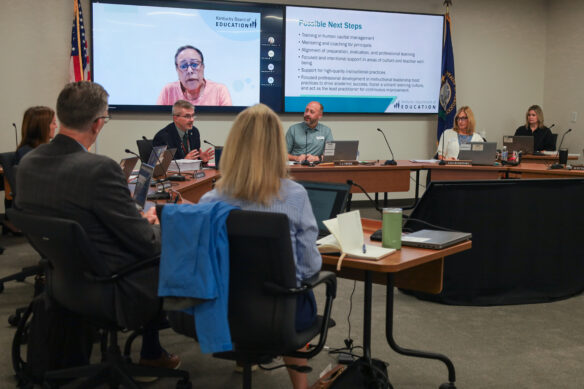
Kentucky Commissioner of Education Robbie Fletcher speaks with members of the Education Professional Standards Board. Photo by Joe Ragusa, Kentucky Department of Education, June 22, 2026
(FRANKFORT, KY) – Members of the Education Professional Standards Board (EPSB) provided feedback on potential changes to Kentucky teacher certification during the EPSB’s meeting on June 22.
EPSB members discussed a proposed amendment to 16 KAR 2:010, the regulation on Kentucky professional and provisional teacher certificates. The amendment would update the grade bands for certification, specifically by adjusting elementary to include kindergarten through 6th grade, middle to include 4th grade through 9th grade, and secondary to include 7th grade through 12th grade.
Further changes would add a secondary general science certificate and provide a pathway for a certified teacher in secondary sciences to add additional science credentials.
The amendment comes following the work of the Education Certification Structure Workgroup, which began in December 2024. The group was made up of principals, teachers, school counselors, human resource officers, leaders from Kentucky’s universities, state lawmakers and other educator stakeholder groups.
Members of the work group analyzed current grade bands and credential structures to see if they meet districts’ needs. The workgroup reviewed state and national data and identified that some of the challenges within the current system could be addressed by modifying the existing certification grade bands and certification permissions.
The workgroup narrowed down a list of recommendations taking into consideration how other states operate and discussions with district leaders in Kentucky. Workgroup members then sought input from several groups, including the Local Superintendents Advisory Council, to finalize the recommendations.
Todd Davis, division director in the Kentucky Department of Education’s (KDE’s) Office of Educator Licensure and Effectiveness, said the presentation was designed to gather feedback from the EPSB ahead of a vote on the proposed amendment, which is expected to occur at the EPSB’s meeting in August. EPSB members asked questions and provided feedback on a few different aspects of the amendment, including details on the additional secondary science credentials and an expansion of the Highly Qualified certification route.
KBE/EPSB Research Practice Collaborative
Kentucky Board of Education (KBE) Chair Sharon Porter Robinson joined the EPSB to discuss recommendations made by a research collaborative between the two boards designed to improve teacher recruitment and retention efforts.
The KBE/EPSB Research Practice Collaborative was created in October to gather insights from Kentucky education stakeholders on what drives educator retention, why teachers leave mid-career and how vibrant classroom learning environments – especially in literacy and numeracy – influence teacher satisfaction and career persistence.
Participants of the collaborative include KBE members, EPSB members, KDE staff members, classroom educators, school and district administrators, educator preparation program faculty, and education-focused community stakeholders. The group narrowed down two recommendations for the full KBE and EPSB to consider.
The first recommendation is to develop a continuum of growth and support for educators from preservice to retirement.
EPSB Vice Chair C.J. Fryer outlined several possible next steps for this recommendation, largely aimed at improving professional development opportunities, mentoring, coaching and other resources for educators.
Fryer said the recommendation was made, in part, due to pressure some teachers feel to become administrators as they progress through their education career.
“While we need a lot of really fantastic educators to (go into administrative roles), … we also have a lot of great teachers who we want to stay in the classroom and lead from the classroom,” Fryer said. “No one is ‘just a teacher’, right? We can have some of our best statewide leaders in the classroom.”
The second recommendation is to develop a continuum of support and growth for school leaders, specifically looking to strengthen principal capacity for talent management, working conditions and instructional leadership.
Potential next steps related to this recommendation include improved management training for principals, focused support for school culture and teacher well-being, and support for high-quality instructional practices, Robinson said.
“We want to really continue our work to understand how together, we can have more effective advocacy for the things that really work,” Robinson said.
Robinson also said there could be a focus on “human resource management and talent management” at the school level for principals.
Commissioner of Education Robbie Fletcher mentioned more professional development opportunities are on the horizon following the passage of Senate Bill 4 during the 2026 legislative session, which creates a four-year principal training and mentoring program. Fletcher said KDE plans to create a new position and repurpose others to help with the training. The department is also meeting with several education stakeholder groups for input on how the program should take form.
Robinson said recommendations from the KBE/EPSB Research Practice Collaborative will be on the agenda for further discussion at the KBE’s meeting in August.
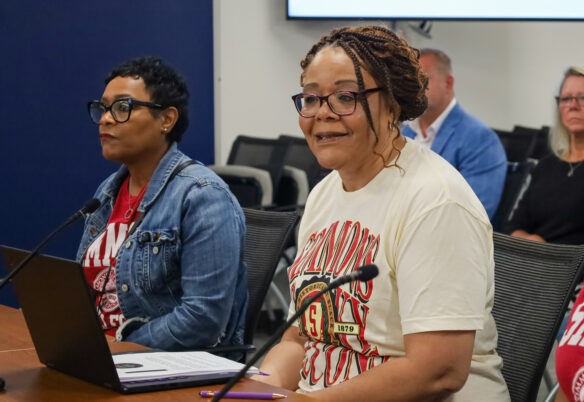
Representatives with William J. Simmons University – from left: Harriet James, academic success coach and faculty member, and Kathy Stovall, chair of the Simmons Teacher Education Program – make a presentation during the EPSB meeting. Photo by Myles Young, Kentucky Department of Education, June 22, 2026
Educator Preparation Program Spotlight: William J. Simmons University
The EPSB continued spotlighting educator preparation programs at Kentucky universities by having leaders with William J. Simmons University present about their program.
The university made the change from Simmons College of Kentucky to William J. Simmons University in February 2026. Founded in 1879, Simmons University is one of two historically black colleges and universities (HBCUs) in Kentucky, along with Kentucky State University.
Kathy Stovall, chair of the Simmons Teacher Education Program, said the university is committed to building strong leaders in the classroom.
“We believe that teachers should be and are change agents for the future, and we actively are working to improve learning experiences by challenging inner inequities, embracing innovation, and advocating for all students to succeed,” Stovall said. “And it involves using knowledge, leadership and compassion to inspire meaningful changes in classrooms, schools and communities. We are here to shape the future of education and educators.”
Stovall went over the university’s history, including how it was a major producer of Black teachers during segregation. Within the past five years, the university started rebuilding its educator preparation program and began offering its first bachelor’s degree program for teachers in August 2024. As of May, the university now offers two bachelor’s degree programs – a Bachelor of Science in teacher education (K-5) and a Bachelor of Science in interdisciplinary early childhood education – with plans to expand offerings to include master’s and doctorate degrees.
“Our future, we believe, is bright, and we’re excited about what we can do to make a difference in education,” Stovall said.
Stovall highlighted the university’s collaboration with public and private schools in Jefferson County to help prospective educators with clinical hours. Simmons University also works with several early learning centers in the community and the University of Louisville.
“We want them to have a well-rounded experience when it comes to working in a school,” Stovall said.
Stovall also provided the university’s vision for the growth of its educator preparation program, including growing the curriculum and the programs offered, as well as a focus on boosting literacy instruction.
“I believe literacy is the root of all educational success, and literacy is the focus of Simmons College of Kentucky because it is the foundation for all learning, empowering students to think critically, communicate effectively, and succeed across every academic discipline and career path as an institution rooted in equity and social justice,” Stovall said. “Prioritizing literacy also equips students to be able to overcome challenges and to become educators for the future.”
In other business, EPSB members:
- Approved a regulatory waiver of 16 KAR 5:020 allowing the use of the SAT as an assessment of basic knowledge for admission into an educator preparation program. The board also discussed an amendment to 16 KAR 5:020 to add the SAT as an approved admissions examination.
- Approved a regulatory waiver of 16 KAR 5:040 to extend certain student teacher flexibilities for the 2026-2027 school year, including allowing experience as an emergency certified substitute teacher to meet student teaching requirements, allowing student teachers to maintain classified employment, and allowing educator preparation programs to conduct two (2) student teaching observations The board was also presented with an amendment to 16 KAR 5:040 that would implement these flexibilities in the governing administrative regulation.

Leave A Comment