Tag Archive | "standards"

State board supports science standards, raising dropout age to 18

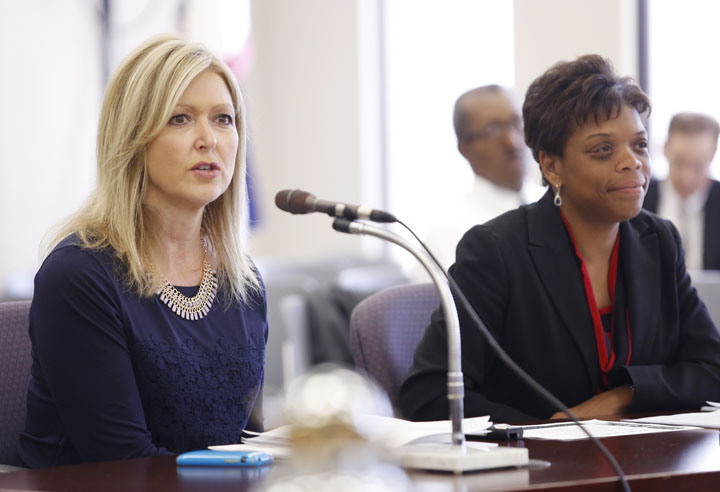
Karen Kidwell, left, director of Program Standards for the Kentucky Department of Education, speaks to the Kentucky Board of Education reguarding the new science standards during their April meeting. Photo by Amy Wallot, April 10, 2013

Karen Kidwell, left, director of Program Standards for the Kentucky Department of Education, and Office of Next-Generation Learners Associate Commissioner Felicia Cumings Smith address the Kentucky Board of Education regarding the new science standards. 
Photo by Amy Wallot, April 10, 2013

By Matthew Tungate
matthew.tungate@education.ky.gov

The Kentucky Board of Education reviewed  at its meeting last week  proposed  Next Generation Science Standards (NGSS) one day after they were released.

Kentucky was one of 26 states that partnered in developing the Next Generation Science Standards (NGSS) as part of a collaborative state-led process. About 40 Kentuckians, including P-12 science teachers, state science and policy staff, higher education faculty, scientists and engineers were involved. Two drafts of the standards were released for public comment.

Karen Kidwell, director of the Kentucky Department of Education’s Division of Program Standards, said the Kentucky team gave detailed and descriptive feedback on the early drafts.

“Our feedback was very well received, and much of our feedback was incorporated in the standards,” she said.

The new standards, which have been in development for two years, meet the mandate for new standards in Senate Bill 1 (2009). They are internationally benchmarked, rigorous, research-based and aligned with expectations for college and careers; and they provide for deeper understanding of content and application. Read the full story

Posted in FeaturesComments (0)

PTA’s National Standards for Family-School Partnerships

Family-school partnerships are important for student success. Research shows when families are involved in their children’s learning both at home and at school, their children do better in school.

The national PTA has developed National Standards for Family-School Partnerships to help guide schools in establishing positive relationships with parents and other family members. The updated standards shift the focus from what schools should do to involve parents, to what parents schools and communities can do together to support student success.

Standard 1: Welcoming all families into the school community—Families are active participants in the life of the school, and feel welcomed, valued and connected to each other, to school staff, and to what students are learning and doing in class.

Standard 2: Communicating effectively—Families and school staff engage in regular, two-way, meaningful communication about student learning.

Standard 3: Supporting student success—Families and school staff continuously collaborate to support students’ learning and healthy development both at home and at school, and have regular opportunities to strengthen their knowledge and skills to do so effectively.

Standard 4: Speaking up for every child—Families are empowered to be advocates for their own and other children, to ensure that students are treated fairly and have access to learning opportunities that will support their success.

Standard 5: Sharing power—Families and school staff are equal partners in decisions that affect children and families and together inform, influence and create policies, practices and programs.

Standard 6: Collaborating with community—Families and school staff collaborate with community members to connect students, families and staff to expanded learning opportunities, community services and civic participation.


Posted in Leadership LetterComments (0)

Social studies standards update

The Social Studies Assessment, Curriculum, and Instruction (SSACI) collaborative, a consortium of 22 states and organizations, including Kentucky, convened by the Council of Chief State School Officers, is working to publish a new Framework for Social Studies in preparation for new standards.

SSACI is working to explicitly ensure that the Framework for Social Studies will support the Common Core English/language arts standards and is working to identify resources and criteria for resources that will support teachers in meeting both sets of standards.

The anticipated completion date of the Framework for Social Studies is spring 2013. KDE will convene a standards revision/development team to identify standards that will align to and address the Framework for Social Studies in the summer of 2013. Look for details in the spring.

Posted in Announcements, Bulletin BoardComments (0)

Something to talk about

By Susan Riddell
susan.riddell@education.ky.gov

Fifth-grade student Parrie Kay Reed talks about her vocabulary term "border states" while her classmates listen during Karen Schulz's 5th-grade class at the Kentucky School for the Deaf. They were learning about the Civil War. Photo by Amy Wallot, April 17, 2012

Fifth-grade student Parrie Kay Reed talks about her vocabulary term "border states" while her classmates listen during Karen Schulz's 5th-grade class at the Kentucky School for the Deaf. They were learning about the Civil War. Photo by Amy Wallot, April 17, 2012

Cathy White is formerly a Kentucky Department of Education (KDE) specialist for students with special needs and an expert in issues related to deafness.

As the mother of a deaf child who doesn’t use his voice to communicate, White was recently looking over a list of the speaking and listening standards included in the Kentucky Core Academic Standards (see box).

Each time she read one off, she had the same reply: “There’s no reason a deaf or blind student can’t do this.”

Click here to read a recent Kentucky Teacher article about the speaking and listening standards.

That’s the message echoed by many stakeholders at KDE and Kentucky School for the Deaf (KSD) and Kentucky School for the Blind (KSB).

“The speaking and listening standards are about communication, and students who don’t use their voices to communicate have multiple ways to communicate nonetheless,” said White, branch manager of Teacher and Leader Effectiveness in the Office of Next-Generation Learners. Read the full story

Posted in FeaturesComments (0)

Implementing standards and assessement practices

Teachers and administrators can join international experts and practitioners as they showcase successful practices for implementing standards and effective assessment practices at the Meeting the Challenge: Implementing Standards and Assessment Practices conference.

This event will be July 16-18 in Lexington, and early-bird registration has been extended to May 25.

Pre-conference sessions provide an in-depth focus on implementing Highly Effective Teaching and Learning (HETL), focusing on the standards, assessment, literacy and leadership for effective change. Conference sessions provide a variety of curricular, instructional and leadership strategies for educators at all levels to assist in providing high-quality instruction to students, improving their learning and ensuring they are college- and career-ready.

A maximum of 450 participants can participate.

Go to http://www.uky.edu/p12mathscience for more information.

Posted in Bulletin Board, Conferences & WorkshopsComments (0)

Letter grades ‘standard’-bearers no more

By Matthew Tungate
matthew.tungate@education.ky.gov

First-grade teacher Marty White helps Nicolas Phillips sort beans to illustrate addition and subtraction problems at Chandlers Elementary School (Logan County). Photo by Amy Wallot, Jan. 9, 2012

First-grade teacher Marty White helps Nicolas Phillips sort beans to illustrate addition and subtraction problems at Chandlers Elementary School (Logan County). Photo by Amy Wallot, Jan. 9, 2012

If a team of professors from the University of Kentucky’s College of Education had its way, Kentucky students would be graded only on their academic achievement – not whether or not they turn in all their homework or bring in tissues for extra credit.

The three have worked with dozens of school districts in the state and published an article calling for schools to use standards-based grading rather than a single percentage or letter grade. Standards-based grading requires teachers to list individual areas of knowledge within a subject area or course and assign a level of proficiency or mastery to each area for each student. It also requires splitting grades into academic factors, such as assessment results, and process factors, such as behavior and turning in homework.

Education Professor Thomas Guskey stresses the increased honesty and meaning this brings to grading. With traditional approaches to grading that combine everything into a single symbol, a student may ace the Advanced Placement (AP) and International Baccalaureate (IB) exams in calculus, for instance, but get a C in the subject because he didn’t do the homework, Guskey said. Another student also may get a C by turning in all the homework and being compliant with teacher requests without learning the subject and doing poorly on tests, he said. Read the full story

Posted in FeaturesComments (0)

Kentucky Selected as Participant for National Focus Group

The U.S. Department of Education has asked Westat to conduct national focus groups to inform the planning of two national meetings on College and Career Ready Standards and Educator Evaluation Systems that will be held in March 2012.

Three states – Florida, Idaho and Kentucky — have been selected to conduct the focus groups. The findings from the qualitative data collected from the focus groups will be used to better inform the planning of the national meetings in March.

Westat will conduct interviews with three panel groups representing district administration, school-building administrators and teachers from the Bullitt, Jessamine and Magoffin County school districts. Group discussions with Westat have been scheduled for Friday, February 17 at KDE. Representatives from the Division of Next-Generation Professionals and Division of Program Standards will represent Kentucky at the national panel discussion in Washington, D.C.

Posted in NewsComments (0)

Kenton County students create investments that count

By Susan Riddell
susan.riddell@education.ky.gov

Gina Benham helps 7th-grade student John Monson with a decimal problem during her mathematics class at Woodland Elementary School (Kenton County).

Gina Benham helps 7th-grade student John Monson with a decimal problem during her mathematics class at Woodland Elementary School (Kenton County).

Woodland Middle School (Kenton County) teacher Gina Benham has taught mathematics for four years, but when it comes to stocks and investing she is just like any one of her 7th graders.

“I love an opportunity to learn alongside my students,” said Benham, whose class began involvement with a program in October that ties investing to a real-world mathematic curriculum. “Value is added to this experience when the kids realize they are learning something some adults know little about.”

All 7th-grade classrooms at Woodland Middle and Turkey Foot Middle School (Kenton County) have been participating in the “Investing in Students, Making Math Count” initiative. Following the October kickoff, the students played the PortfoliosInvestment Simulation Game with volunteers from Fidelity Investments to get a feel for the game.

The volunteers meet with students at both schools on a monthly basis, using investment and finance as a context to address concepts in the 7th-grade mathematics curriculum, according to Jennifer Barrett, Kenton County school district middle and high school mathematics consultant. Read the full story

Posted in FeaturesComments (0)

STEM curriculum builds confidence and cool things, too

By Susan Riddell
susan.riddell@education.ky.gov

Rebecca Logan helps students come to their own conclusions during her 5th-grade STEM class at Elkhorn Elementary School (Franklin County). Photo by Amy Wallot, Nov. 9, 2011

Rebecca Logan helps students come to their own conclusions during her 5th-grade STEM class at Elkhorn Elementary School (Franklin County). Photo by Amy Wallot, Nov. 9, 2011

A 5th-grade girl in Rebecca Logan’s class at Elkhorn Elementary School (Franklin County) had barely spoken during the first two months of the school year.

“She was so shy, and I don’t remember her being excited about anything in class,” Logan said.

But when the class was working on a Mars rover STEM (science, technology, engineering, mathematics) curriculum project, the girl’s model design was chosen by her team to be built and used for competition.

“That just validated something in her, and she totally took off with the unit we were studying,” Logan said. “I’ve just been blown away by this project and the curriculum. It’s really given my quieter students a voice and the confidence to take on more leadership roles. Every child is engaged. It’s just been amazing to watch.”

This past spring, Logan’s class piloted a STEM Mars rover project, which involved students working with radio-controlled car parts and batteries to create cardboard-constructed models. The lesson, made possible by Franklin County High School engineering instructor Mark Harrell and Project Lead the Way, was such a big hit with her students, Logan spent her summer researching ways to fill her curriculum with STEM activities throughout the day.

“I teach language arts in the morning, and the rest of the day is devoted to STEM,” Logan said. “STEM is just so important today if you are looking at the workforce. I think it’s a great idea to go ahead and introduce young students to it. Read the full story

Posted in FeaturesComments (0)

Have you heard? Speaking, listening standards make sense

By Susan Riddell
Susan.riddell@education.ky.gov

Sophomore Tiara Brand, right, gives a humorous and informative speech about freshman Mason Stamm, left, for her first speech of the year during Steve Meadows Speech 1 class at Danville High School (Danville Ind.). Photo by Amy Wallot, Aug. 16, 2011

Sophomore Tiara Brand, right, gives a humorous and informative speech about freshman Mason Stamm, left, for her first speech of the year during Steve Meadows Speech 1 class at Danville High School (Danville Ind.). Photo by Amy Wallot, Aug. 16, 2011

For Steve Meadows, an English teacher at Danville High School (Danville Independent), the emphasis on speaking and listening standards in the Kentucky Core Academic Standards makes perfect sense.

“For me personally, it’s an exciting shift in emphasis to include what I’ve always loved best – speech and speaking – as part of the general curriculum,” said Meadows, who has been an educator for more than 20 years. “I’m a great believer that our job in language arts is to empower students to be able to communicate clearly for the rest of their lives.

“Students will communicate more through speaking and listening in real life than they will through reading and writing, so including the full range of literacy in the standards and in our coursework makes sense to me.”

Meadows coaches the Danville High forensics/speech team that won the 2011 Kentucky Educational Speech and Drama Association (KESDA) state title.  Read the full story

Posted in FeaturesComments (0)

Page 1 of 212
Sign up to receive e-mail updates from us!

More Contact Options

Kentucky Teacher
Attn: Editor
612 Capital Plaza Tower
500 Mero Street
Frankfort, KY 40601

Phone: (502) 564-2000
Fax: (502) 564-3049
E-mail: kentuckyteacher@education.ky.gov

Send Us Submissions for Bulletin Board

Your Name: (required)

Your Organization: (required)

Your Email: (required)

Bulletin Board Subject: (required)

Bulletin Board Message: (required)

Commissioner Holliday's Twitter Stream


Kentucky Teacher is a publication of the
Kentucky Department of Education.

Education Resources


More Education Resources

Content Calendar

May 2013
S M T W T F S
« Apr    
 1234
567891011
12131415161718
19202122232425
262728293031