
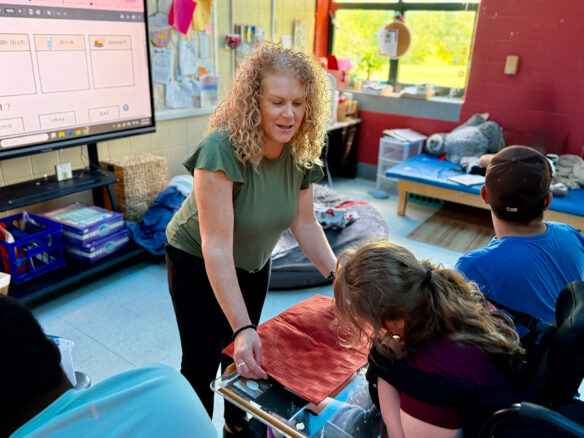
NBCT Lorraine Thomas, a high school low-incidence resource specialist at Fayette County Public Schools, teaches a group of students with special needs. Photo submitted
Teachers who attain the National Board Certified Teacher (NBCT) status often face challenges throughout the process of becoming certified, but teachers have shared that they’ve been able to overcome challenges with help from different supports.
NBCT Lorraine Thomas said that as someone diagnosed with dyslexia, she may have spent longer on the certification process than other teachers. But she used the supports she had to complete it successfully.
Growing up in Ireland, she said she had difficulty reading but didn’t know she had a learning disability until later in life. She was always drawn to working with students with special needs and worked as a peer tutor for a care school.
When she came to the U.S., she continued working with special needs students as a moderate and severe disabilities (MSD) teacher. She taught at Dunbar High School (Fayette County) as an MSD teacher for 13 years.
For the past 14 years she has taught at Fayette County Public Schools as a high school low-incidence resource specialist, where she supports all the district’s 27 high school MSD teachers. She also provides supports for the students in classroom instruction, behavior, transition, post-secondary resources and community-based instruction.
“I just really had a love for special education in general, and then with me struggling myself and not really learning how to read or write until I was a little older, I just had a heart for kids that struggled and I wanted to be there to help them,” she said.
Thomas said her experiences as a student are something that inspires her to help other students with disabilities.
“That’s really what encouraged me to be a teacher is I struggled myself and wanted to just encourage students. … Even though you may struggle, even though you may learn differently, you still can be as successful as anybody else,” Thomas said.
When becoming a teacher, Thomas said she had to work very hard, but she found strategies that worked for her to learn better. She looked into getting her NBCT certification in 2005 and became certified in 2006.
Administered by the National Board for Professional Teaching Standards, the NBCT designation is the highest certification that pre-K-12 educators may obtain. It was designed to develop, retain and recognize accomplished teachers and to generate ongoing improvement in schools.
Thomas had been wanting to get her Rank 1 certification, but felt she did not have time to go back to college. After learning about National Board Certification, she felt like it was a better option for her.
“At first, I didn’t think that’s something that I could do because there was so much writing, and writing was not one of my strong suits, and then so much reading. But I was like, I got through college, I graduated with a 4.0 (GPA), I can do this; I just have to do it a little differently than other people,” she said. “I realized I really wanted to grow as a teacher, to make sure my students receive the best possible educational experience that they can. … I felt like this is what I wanted to do.”
Educators must submit a detailed portfolio of student work, examples of what they have done outside of the classroom to improve student achievement and video recordings that show how they teach. Teachers also submit a reflective piece on student learning and then take a rigorous exam to demonstrate they have mastered their certification area.
Thomas completed the certification in one year, and credited sticking to a schedule as something that helped her immensely. She said the process was additionally stressful with two small children, but she was able to rely on support from a mentor provided by her district who helped her stay on schedule, stick to the rubrics and complete assignments in specific times.
Thomas completed her maintenance certification in 2016, 2021 and this year. While the recertification process is not as involved as the initial certification, educators still must complete components that show they’re continuing to learn and grow, keeping up with the evidence-based practices, resources and learning opportunities.
Thomas encourages teachers who might be hesitant to become National Board Certified to not let their fears or challenges stop them.
“If you’ve gone through college and you’re a teacher and you’ve mastered all of those things, you can master National Board too,” she said. “There’s lots of great resources out there to help you get organized, people that you can reach out to to support you and help you. … If that’s something that you truly desire, to want to help your students receive the best education they possibly can and ensure that you’re providing them with the best resources, then National Board Certification is the way to go.”
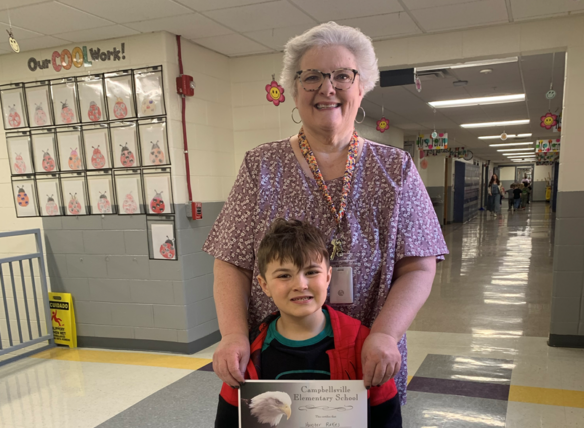
NBCT Darlene Humphress, an exceptional child educator at Campbellsville Elementary School (Campbellsville Independent), poses with Campbellsville student Hunter Rakes when he was chosen as the school’s Leader of the Month. Photo submitted.
Darlene Humphress, Campbellsville Independent
NBCT Darlene Humphress echoed a similar sentiment. When she was pursuing National Board Certification in 2015, she had an unexpected loss in her family.
Humphress has been a teacher since 2009. She started as an anti-drug educator and soon found a teaching position in special education. She has taught at Memorial Elementary School and LeGrande Elementary School, both in Hart County. Now she’s an exceptional child educator at Campbellsville Elementary School (Campbellsville Independent).
She pursued National Board Certification because she was looking to get her Rank 1 but didn’t feel that going back to college was the right option for her.
In the middle of her first year pursuing certification, her brother unexpectedly passed away.
“We weren’t expecting this. He was a big grain farmer; so now here I am trying to help my parents who are elderly and retired. We have crops out and he had over 1000 acres of farmland. He had huge equipment, huge debts of farming and everything,” Humphress said.
She said helping with the farm, helping her parents and getting her brother’s estate in order took up a huge amount of time on top of becoming certified. But she overcame those challenges by sticking to a schedule and relying on supports.
She joined Facebook support groups where educators help with general portfolio questions, as well as specialized group sites for exceptional needs where educators worked on specific inquiries. She also attended two workshops in person where work samples were critiqued by peers and NBCTs.
“I was blessed that there were a lot of support systems online. There were tons of committees and groups nationally and statewide that I could send stuff to or get ideas from,” Humphress said. “We would get on there and share, ‘What do you think about this?’
‘How does this sound?’ ‘What’s wrong with this?’ ‘What more can I do with that?’ … If it wasn’t for that network, I don’t think I would have gotten it done with everything else that was going on.”
Kentucky NBCTs and those pursuing certification are encouraged to join the Kentucky National Board Network, which is a community of NBCTs, candidates and supporters from across the Commonwealth that provide resources to candidates pursuing NBCT status.
Once they’ve successfully gone through National Board, Kentucky teachers currently holding a Rank II certificate are eligible to apply for Rank I status, and those currently holding a Rank III certificate are eligible to apply for Rank II. Kentucky NBCTs also are entitled to an annual $2,000 salary bonus for the life of their certificate.
Leave A Comment