
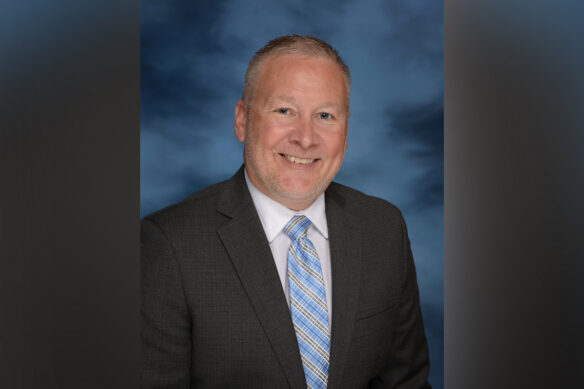
The Nicholas County board of education approved hiring John Derek Faulconer to be the new superintendent in June 2026. Photo courtesy John Derek Faulconer
The new superintendent of Nicholas County, John Derek Faulconer, grew up with a desire to serve people. He turned that desire into a career in education and now helps mentor young people in multiple capacities, both in school and in the military.
“I always had that desire to serve and have a servant leader’s heart,” Faulconer said.
Faulconer worked in a variety of places before coming to Nicholas County. He grew up in Harrison County and is a 1996 graduate of Harrison County High School. He earned a bachelor’s degree in education from the University of Kentucky, a master’s degree in educational leadership from Tennessee Technological University, and a doctorate in educational leadership and policy analysis from East Tennessee State University.
He served as a special education teacher and assistant principal with Anderson County Schools in Clinton, Tenn., then became principal of Corbin High School (Corbin Independent) in 2010. He joined Knox County Schools in Knoxville, Tenn., in 2013 as a principal, and in 2025, became the district’s first director of military enlistment. He was also the founding principal of Career Magnet Academy, which is the only magnet high school that sits on a community college campus in Tennessee.
After a long journey, Faulconer decided to come back home to a county right next to the one he grew up in.
“My parents still live in Harrison County, and it was just time to get back closer to home and I wanted to explore the opportunity to become a school superintendent, so that’s how I ended up in Nicholas County,” he said.
Before deciding to pursue public education, Faulconer had a dream of joining the military. He grew up seeing his father and grandfather serve in the military. After years in public education, he still felt that desire to serve.
“After I completed my doctorate, I thought I was going to wake up after graduation and think that I had accomplished this big thing by getting my doctorate; but I woke up the next morning and thought, ‘There’s just something missing,’” Faulconer said. “There was just something that I felt called to do and that call was to join the military.”
He began the process of joining the military at age 43 and didn’t get in until he was 46. He said he had complications with joining due to his age.
“It took a lot of begging with recruiters to at least give me a chance, because I was way over the age limit of letting somebody into the military,” he said.
He joined as a captain in the U.S. Army Reserve with the 489th Civil Affairs Battalion. He is a civil affairs-qualified officer and civil affairs education specialist. He completed the Medical Center of Excellence Basic Officer Leadership Course at Fort Sam Houston, Texas, in 2025 and graduated from the Civil Affairs Captain’s Career Course at the U.S. Army John F. Kennedy Special Warfare Center and School in Fort Bragg, N.C., in 2026.
As an education specialist in the army, he looks at curriculum and works with local educators and local recruiters to find ways to get the message out there about the opportunities in the military. He also acts as an unofficial mentor to soldiers younger than him.
“It has been a great thing for me to be able to do and see experienced soldiers who are just a few years older than regular high school kids, so it kind of took me back to still having that principal hat on,” Faulconer said. “They’re soldiers just like me, but they’re 21, 22, 23, and they still need that guidance from somebody who’s a little older and still need kind of the same things that a high school kid needs after they graduate.”
Since he joined Nicholas County, he has been doing work on teacher recruitment and retention, working with deans of local universities, including Eastern Kentucky University, to build a pipeline for new educators to join the district. He has been looking at ways to develop new teacher academy strategies to help new teachers come on board and help the onboarding process.
He has also been looking at ways to help the district’s principals and assistant principals become more of an instructional leader in their building. He helps them look at their own instructional leadership growth, how they’re implementing walkthroughs and having instructional dialogue with teachers.
“When instructors and principals can be on the same page and understand what your high-quality instructional strategies look like and can have those conversations, we know that’s going to provide the biggest output and the return on the investment for students,” he said. “We’re also looking at ways that we can provide students opportunities, because we are a small school district. It’s being able to broaden the horizon for students so they can see that there’s other things out there and how we as a school district, especially a small school district, can provide opportunities for kids moving forward.”
He said the district has a major focus on its portrait of a learner. He has been working to increase awareness of their portrait of a learner to people in the community.
“When I’m having conversations with community partners and community leaders, I’m leading with, ‘Hey, these are the students who really are becoming our ambassadors for our portrait of a learner;’ and the community is now starting to realize this is what the portrait of a learner looks like; this is what our district is molding our kids into, and it’s been met with a lot of great success,” Faulconer said.
He said he looks forward to continuing to work with the community on what they want students to learn, as well as increasing opportunities for students.
“We want to give them opportunities to go out and see the world and hope that we can build those pipelines for teachers to come back into our district and become part of this family; it’s been great,” he said.
Leave A Comment