
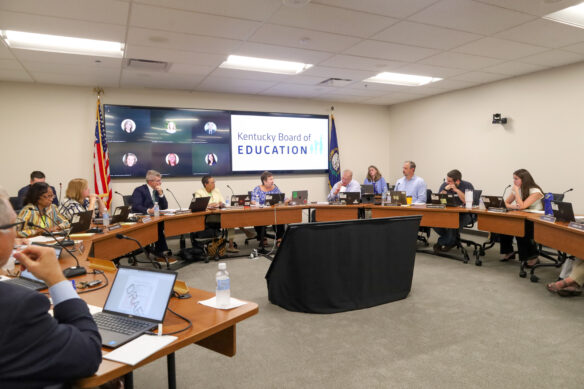
Members of the Kentucky Board of Education met in Frankfort on Aug. 6-7. Photo by Myles Young, Kentucky Department of Education, Aug. 6, 2025
Members of the Kentucky Board of Education (KBE) discussed the results of a $1.2 million special examination of the Kentucky Department of Education (KDE) conducted by the Kentucky Auditor of Public Accounts (APA) during the KBE meeting on Aug. 6-7. The second day of the KBE meeting was held on location at the Paul Sawyier Public Library in Frankfort.
The audit was mandated by House Bill 825 (2024). KBE Vice Chair Lu Young said there were a lot of positives highlighted in the APA’s report, but also a lot to learn from.
“One of the things I urge you to do is to read the report itself,” Young said. “The tenor of the report was extremely supportive. It was, I believe, in keeping with the expectations of the General Assembly when they mandated the report, and we found it to be extremely helpful on lots of fronts.”
The final report, issued on July 1, identified recommendations and noteworthy accomplishments of the department. Among the positives, the audit report noted:
- Commissioner of Education Robbie Fletcher has worked quickly in his first year to build relationships with the state legislature.
- KDE staff had overall positive perceptions related to workload, staff levels, role clarity, resources and support.
- The overall culture at KDE is positive and morale is high. Staff take pride in their work, care about student success, believe in the mission of the agency and overall work well together and with districts.
- Most superintendent survey respondents agreed that KDE produces high-quality resources, considers the diverse needs of families and community stakeholders when making decisions, takes action to improve student success and positively contributes to student success in Kentucky.
- The (KBE) conducts business and interacts with each other in a commendable manner. Board members are respectful to each other, to KDE staff, and in their interactions with the general public during KBE meetings. Board members demonstrated a high level of professionalism and commitment to their role.
Fletcher said KDE is actively reviewing the recommendations to see what work is already being done, what issues have already been addressed and what more can be done.
Fletcher said many of the audit’s recommendations line up with current priorities for KDE, including potential legislative fixes to the district facilities funding process, career and technical education strategic planning, more funding for area technology centers and refined special education monitoring, with a focus on improved outcomes for students with disabilities. He also mentioned the hiring of four special assistants to the commissioner – all former district superintendents – assigned to regional education cooperatives as a step toward facilitating more conversation and collaboration between schools and KDE.
KDE received a preliminary report on June 6. KDE Deputy Commissioner and General Counsel Todd Allen said the department had the chance to respond – noting several errors and omissions within the audit – and recommended edits before the final audit was published July 1. Fletcher said the response was about 80 pages long.
“(The auditors) made some changes, but typically they wouldn’t remove a recommendation,” Allen said. “They may just tweak some of the language of it.”
Some board members expressed concerns with the audit’s findings, including some of the findings on special education. Fletcher said KDE’s Office of Special Education and Early Learning has been doing a tremendous job, pointing to the fact Kentucky has received the top federal rating for special education implementation for the 16 straight years. The U.S. Department of Education’s Office for Special Education Programs found no corrective actions were required following an audit of Kentucky in 2024, as well.
“That was one aspect of some of the (audit) recommendations that we found discomforting because they were in conflict with other requirements, and there were a few that were just plain wrong,” KBE Chair Sharon Porter Robinson said.
KBE member Juston Pate said he was concerned about the accuracy of some of the information contained in the audit.
“I feel like we need to be proactive to let people know that a lot of this isn’t even right, but we’re working on it and we’re using it as a chance to grow,” Pate said.
Board members also discussed communicating with stakeholders regarding the department’s response to the audit recommendations, particularly recommendations that would require substantial funding from the Kentucky General Assembly or some sort of legislative intervention. KBE member Randy Poe said he wants to make sure KDE’s response is clear about the differences between what was recommended and what can be done.
“I would hate to have to go through another session and (lawmakers) come back and say we need to do a follow up report to see whether they’re doing this and us spend $1.2 million out of (KDE’s budget) – taking away from children versus their funding,” he said.
The board also discussed audit recommendations related to the board’s oversight of the commissioner of education, the department’s oversight of the Kentucky School for the Deaf and the Kentucky School for the Blind, and interscholastic athletics.
A report from KDE to the Legislative Research Commission is due within 60 days of the audit’s publishing, explaining steps being taken to address the recommendations or explanations for why they aren’t achievable.
New KBE Meeting Calendar
Board members approved the 2026 KBE meeting calendar, which includes the addition of six virtual meetings to its current meeting frequency.
Young said the proposal to hold virtual meetings came about from member interest, along with recommendations from the APA, to have more time for open discussion on issues.
“We felt like having these (discussions) in a virtual setting would make it easier on you all in terms of scheduling, give us a little bit of relaxed time,” Young said to board members, “still meeting open meeting laws and requirements, of course … but in a virtual way that would make it a more manageable way for us to address some of these concerns.”
The first virtual meeting is scheduled Jan. 7, 2026, ahead of the board’s in-person meeting on Feb. 4-5, 2026, and the schedule would alternate between virtual and in-person meetings each month after that.
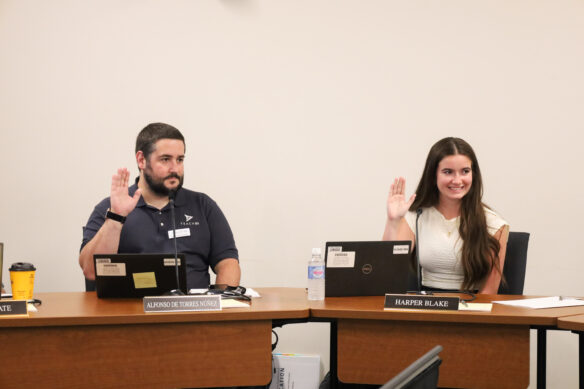
The August Kentucky Board of Education meeting was the first one for the board’s new non-voting members: Alfonso De Torres Núñez, a teacher in Jefferson County, and Harper Blake, a junior at Marion County High School. They were sworn in at the start of the meeting. Photo by Myles Young, Kentucky Department of Education, Aug. 6, 2025
New Members
The August KBE meeting was the first one for the board’s new non-voting members: Alfonso De Torres Núñez, a teacher in Jefferson County, and Harper Blake, a junior at Marion County High School.
De Torres Núñez said he felt blessed about having the responsibility of representing teachers on the board.
“I carry many voices with me that I hope that I’m able to bring over here, and I hope that I can use my skills and my abilities and put them to the service of KBE and also to you all personally as well, for the benefit of our students who should be at the very center of each of our conversations and interactions,” he said.
Blake said she’s still in disbelief that she was chosen for the student member KBE role.
“I’m very excited to be able to represent the students of Kentucky,” she said. “I hope that I can represent all students and further my knowledge on the struggles that people go through in the school system of Kentucky.”
The student and teacher representatives serve a one-year term that expires June 30, 2026.
KASA Superintendent of the Year
Breckinridge County Superintendent Nick Carter, the 2025 Kentucky Association of School Administrators (KASA) Superintendent of the Year, made a presentation to the board on his education experience and priorities.
Carter has been an educator for more than two decades, including nine years as superintendent of Breckinridge County, and said it was an honor to present to the board. He highlighted the importance of early education, including the district’s efforts to bolster preschool.
“We’ve worked very hard to promote kindergarten readiness,” Carter said. “I think that’s been a big challenge over the last few years, to do everything we can to help our youngest learners enter kindergarten ready to soar.”
He said Breckinridge County has two childcare centers for the entire county, so having universal preschool would help not only the children, but also the workforce. He said transition readiness – making sure children are prepared for careers after high school – is also one of his priorities, highlighting several partnerships the district has with KDE, local colleges, educational cooperatives and area businesses.
Carter said one of the biggest difficulties he’s had is navigating the political landscape, but he has great relationships with local lawmakers.
“I don’t know any superintendent that goes to bed at night thinking, ‘Tomorrow I’m going to see if I can pick a fight over some political issue.’ That’s not what we all do,” he said. “We all were teachers to start with. We’re all educators. That’s why we’re in the business, but that is our greatest challenge.”
Carter said despite the politics of the position, it’s a great time to highlight the great work in education, including the collaboration that’s going on with the community as Breckinridge County develops a Profile of a Graduate to prioritize the essential skills, knowledge and attributes they want students to have when they leave high school.
Waiver Request Changes
Members of KDE’s Office of Legal Services presented several changes to the waiver process for school district leaders, 701 KAR 5:170 and 701 KAR 5:170E, brought on by Senate Bill (SB) 207.
SB 207 provides a new process for requesting waivers from the KBE. Local school boards may request waivers from the requirements of an administrative regulation promulgated by the KBE or from a statute over which the KBE has enforcement authority. KDE staff also went over what can’t be waived, which includes any statue or regulation relating to health and safety, civil rights, compulsory attendance or anything required by federal law.
The new regulations outline four major types of waiver requests – new applications, renewals, amendment applications and special education maximum class size waiver applications. KDE staff explained each one, how to submit applications and the review process before KBE members signed off on the regulatory changes.
School Improvement
KBE members also approved amendments to school improvement procedures, 703 KAR 5:280, based on House Bill 298.
The legislation affects what happens when a school is identified as a Comprehensive Support and Improvement (CSI) school under the federal Every Student Succeeds Act of 2015 and KRS 160.346. House Bill 298 requires KDE to identify CSI schools annually.
Staff members in KDE’s Office of Continuous Improvement and Support went over the changes, including updates necessary to facilitate the transition to annual CSI school identification, to ensure that schools meet the new statutory requirements related to professional learning and high-quality instructional materials, and changes to bring the regulation into alignment with current best practices for managing school turnaround.
The measure KBE members approved also clarifies some of the language around advisory leadership teams – which are made up of stakeholders such as teachers, parents and other school leaders – that replace the school-based decision making councils when schools are identified for CSI.
In other business, board members:
- Re-elected Sharon Porter Robinson and Lu Young to their positions of board chair and vice chair, respectively;
- Approved a prioritized list of KDE’s additional budget requests to send to the governor’s office for budget-making purposes during the 2026-2028 budget cycle;
- Approved the release of $15.4 million to the Kentucky Education Technology System (KETS) to fund Kentucky’s education technology needs. The KETS annual unmet funding was previously approved as part of the KETS Master Plan for Education Technology 2024-2030;
- Approved traceable communication systems for KDE’s Office of Career and Technical Education, the Kentucky School for the Blind and the Kentucky School for the Deaf, in line with changes made to state law in Senate Bill 181;
- Reviewed the board’s goals and legislative priorities;
- Approved amendments to 704 KAR 3:440, primary school program guidelines;
- Approved amendments to the Kentucky Minimum Specifications for School Buses;
- Approved annual amendments to Area Technology Center Policies and Procedures and the Kentucky Tech Student Handbook;
- Approved annual policy adoptions and amendments to the Kentucky School for the Blind and Kentucky School for the Deaf; and
- Awarded the 2025 Grissom Award for Innovation in Special Education to Jefferson County’s Kimberly Chevalier and the Bridges Program at Hogsett Primary School (Danville Independent).


Leave A Comment