
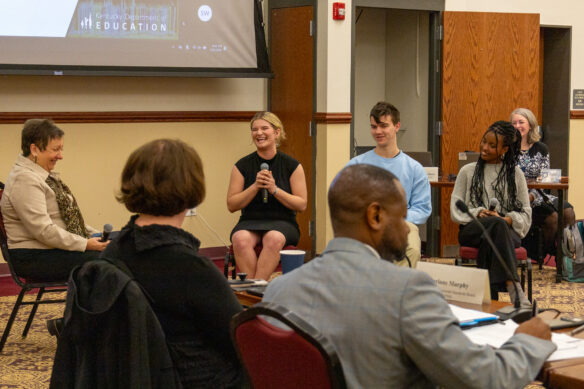
From left to right, Kentucky High School Transformation Work Group Member Lu S. Young shares a laugh with Elkhorn Crossing School students Cathrynn “Cat” Hager, Titus Smith and Maya Felton during the work group’s discussion on the school’s programs. Photo by Fiona Morgan, Kentucky Department of Education, Feb. 26, 2026
Members of the Kentucky High School Transformation Work Group met at Elkhorn Crossing School (Scott County) on Feb. 26 to continue their work of reimagining the high school experience, including hearing from students at the school about their own experiences with personalized learning.
The work group formed last year after the National Association of State Boards of Education invited the KBE to participate in its High School Transformation State Network, which builds the capacity of state boards to enable rich student experiences that foster content mastery and durable skills.
The Feb. 26 meeting discussion tied in with the work group’s primary objectives, as outlined by Work Group Chair Juston Pate: identify potential barriers in the way of high school transformation, seek out best practices to promote and craft potential policy proposals for lawmakers to consider.
The group’s second meeting was held at Elkhorn Crossing School, which weaves career and technical education (CTE) into the traditional curriculum to emphasize project-based learning and skills that are applicable to the real world. The school has what it calls villages, which are concentrations of CTE pathways in specific fields that lead to industry certifications and opportunities for students to earn college credit while still in high school.
Amanda Ellis – senior vice president of the Council on Postsecondary Education, which is one of the organizations represented in the work group – commented on how the personalized learning at Elkhorn Crossing isn’t reducing the rigor of the academics.
“Clearly you have had rigorous coursework, so that hasn’t changed,” Ellis said to student panelists presenting to the work group. “But how the teacher has adapted that to make it relevant in your lives; that hasn’t lowered the rigor and the expectation. There are still clear standards that you are learning and being prepared to do work, it’s just being connected to your interests.”
Personalized learning, as defined in the Kentucky Innovation Guide, is a student-centered, customized learning model that addresses the diversity of a student’s background and needs and sets high expectations for all students. This may entail a formalized plan and process that requires students to set learning goals based on personal, academic and career interests with the close support of adult mentors that include teachers, parents and other members of the community.
The work group met with a trio of students from Elkhorn Crossing – Cathrynn “Cat” Hager, Titus Smith and Maya Felton – to hear about their experiences working through the programs at Elkhorn Crossing and how they – along with educators – have incorporated personalized learning opportunities to support their post-secondary goals.
Hager, an engineering student, has a background in agriculture and has organized multiple community service projects around agriculture, including an “Incubation Station” project that teaches about chicken and other poultry.
She discussed working in the supervised agricultural experiences program at Elkhorn Crossing, collaborating with district leaders to implement more agriculture projects into the elementary and middle school classrooms while accomplishing milestones within her own studies that she recently displayed during a defense of learning event at the school.
Smith is a student in the biomedical sciences village at Elkhorn Crossing and explained a recent project he completed where he researched the effects of iron on radish growth to better understand how iron helps plants obtain nutrients. He said the project helped him understand more about the role of scientific research in the community.
“You can see the importance of agriculture. You can see the importance of being effective with your land use,” Smith said.
Maya Felton, a student in the law and justice village at Elkhorn Crossing, explained some of the projects in her class – including how to research and write essays in both a nonbiased and biased way – and how it helps her find her voice with issues that are important to her and her community.
Kentucky High School Transformation Work Member Lu S. Young said Felton’s experience is a perfect example of how a student develops skills that are necessary for life beyond high school.
“One of our Kentucky-model Portrait of a Learner standards is engaged citizen. That’s the kind of engagement – advocacy, critical thinking – the kind of engagement where Maya has the opportunity to share her voice on major topics and be an advocate for other people,” Young said.
Felton also shared how the law and justice village incorporates mock trial settings into the curriculum, so she and her classmates have the opportunity to explore a specific case from every perspective – prosecutors, defense attorneys, judges, etc. – and then act out a trial in a mock courtroom.
“I think a lot of what I’ve learned in law just through the trials that we’ve done is public speaking. I’m not going to say I’m the greatest public speaker, but I definitely am confident enough to sit in front of the panel in front of people and talk, and I’m confident enough to stand up in a courtroom and do objections, whether they’re right or wrong, and it gets sustained or not,” Felton said. “I’m confident enough to do that now and I think … a skill that you’ll always need is to have that confidence in yourself.”
Felton said she also takes lessons from other courses into her law and justice work, including how she incorporates lessons from the book “To Kill A Mockingbird” that she is reading in English class into her courtroom exhibitions.
Work group members discussed the course offerings at Elkhorn Crossing, focusing on how students complete their work in key areas such as English, mathematics and science, while exploring potential career paths in the villages.
Callie Miracle, director of implementation with the Kentucky Chamber of Commerce Foundation, said it was promising to see students excited about learning professions.
“From the business community perspective, I think often what we hear from employers is that having that will over the skill is much more important when it comes to new hires right out of high school,” Miracle said. “Employers say all day long we will invest in the skill set. … We can invest in teaching the technical training, the skills needed to do the job. What you can’t teach is that will that you’re talking about, that opportunity to put the knowledge into practice; those soft skills.”
Commissioner Fletcher also led the work group in a discussion about the Kentucky Innovation Guide, a resource developed by the Kentucky Department of Education (KDE) that details the innovative work happening in Kentucky schools to create vibrant learning experiences for students in collaboration with the community.
The guide details action steps to help districts and schools address areas of interest that were gathered through extensive community engagement, including how to create a local portrait of a learner and how to effectively use funding to support personalized learning. The work group spent time discussing these action items, considering implementation opportunities and challenges for districts across the Commonwealth. Discussion also focused on how to further promote and encourage districts to leverage flexibilities within graduation requirements to provide more opportunities for vibrant learning.
The Kentucky High School Transformation Work Group is made up of individuals focused on examining policies and implementation practices that affect the high school experience. The work group includes Commissioner Fletcher, Kentucky Board of Education (KBE) members Pate and Lu S. Young, Lt. Gov. Jacqueline Coleman and school district leaders in Kentucky.
The group also includes education stakeholders from across the Commonwealth, including representatives from:
- The Kentucky Chamber of Commerce;
- The Council on Postsecondary Education;
- The Education Professional Standards Board; and
- Representatives from the executive and legislative branches of Kentucky’s state government.
The work group’s meeting briefly discussed the recent work of the Kentucky United We Learn Council related to high school transformation and will further consider the council’s feedback on high school transformation best practices, barriers and opportunities at its next meeting.
The work group’s next meeting is scheduled for April 8 in Frankfort.


Leave A Comment