
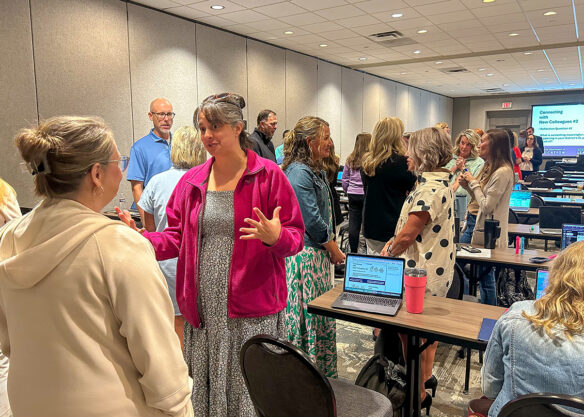
Participants of the Kentucky English Learner Leadership Summit get to know each other during a breakout session. Photo by Fiona Morgan, Kentucky Department of Education, July 7, 2026
(LEXINGTON, KY) – The Kentucky Department of Education (KDE) held an inaugural session of the Kentucky English Learner Leadership Summit in Lexington on July 7.
The Kentucky English Learner Leadership Summit is a new, full-day conference for district English learner directors, coordinators and other leaders. The event followed the first session of the summit in Owensboro on June 17.
English learners (ELs) are students whose primary language is not English and are identified as eligible for English language development services. From 2017 to 2025, English learner enrollment has grown by more than 25,000 students in Kentucky, which is an 89% increase.
Will Spalding, multilingual learner specialist in KDE’s Office of Teaching and Learning, said the purpose of the summit was to share updated KDE guidance and resources with English learner leaders, and to provide opportunities for them to collaborate to learn and grow from one another.
“Being a district or school EL leader requires much, from enrollment to instruction and to assessment, and finding resources and supports on one’s own can be very overwhelming,” Spalding said. “So we hope leaders found it valuable to learn where they can access helpful state-level guidance and collaborate with colleagues on local needs.”
KDE recently released an updated English Learner Program Guidebook, which is a resource designed to support district program leaders, English language development teachers and general education teachers in serving English learners. The guidebook offers practical tools and clear guidance to strengthen instruction and support alignment with state and federal expectations.
Niki Montgomery, an attendee at the Lexington summit, said she uses the guidebook regularly in her position. She’s a districtwide English language development teacher in Anderson County, and she uses the guidebook to help students and other teachers.
“When I first started in this position five years ago, that was the bible that I used because I didn’t really know about the regulations in Kentucky,” Montgomery said. “So this has been a major improvement because they are not just addressing the compliance (components), but they’re also including descriptions of the accommodations and types of scaffolding that teachers can do.”
Spalding said the expanded guidebook includes more instructional strategies, where in the past it mainly focused on policy implementation. It has new information on English learner services and language instruction and ways to support classroom teachers with additional resources.
It now features a chapter dedicated to the World-class Instructional Design and Assessment English Language Development Standards Framework, as well as a chapter on Supporting English Learners in the General Education Classroom that includes practical guidance on scaffolding, grading considerations, multi-tiered systems of support (MTSS) for English learners, and supporting English learners with disabilities.
“What we tried to do was expand the guidance to address real instructional challenges that districts face,” Spalding said.
Montgomery said she believes the additions are helpful and easier to understand.
Leanne Adkins, a Title III coordinator for Grant County, said the summit was helpful to learn about the changes to the guidebook and talk to other educators about the challenges they face.
“I think one of my takeaways today is that the questions that we face in our district about English learners, there are a lot of common scenarios and challenges in our region that other places are grappling with the same things we are,” Adkins said.
She said her district is focusing more on professional development for classroom teachers and uses the resources provided by KDE.
“We’re blessed to have three (English language development) teachers, but it’s difficult for them to really touch all the kids in a way that they need that support, so we’re building that competency and comfortable delivery of interventions and strategies,” Adkins said.
Other resources provided by KDE to help support English learners include the English Learner Educator Connect newsletter. Started in 2026, the newsletter enhances communication and highlights professional development opportunities. KDE also recently started monthly “Voices from the Field” virtual office hours, where KDE staff highlight work by different districts on focused topics. Spalding said they had more than 400 participants throughout the 2025-2026 academic year.
Spalding said the Lexington and Owensboro summits had great participation from districts of all sizes, from the smallest districts with fewer than 10 English learner students to their largest with more than 20,000.
“It was great to host educators with so many different perspectives. We want to create more opportunities to highlight the important work that districts are doing to support multilingual learners,” Spalding said.
Spalding said KDE plans on having yearly in-person summer sessions and is evaluating ways to hold continuing virtual sessions throughout the school year.

Leave A Comment