
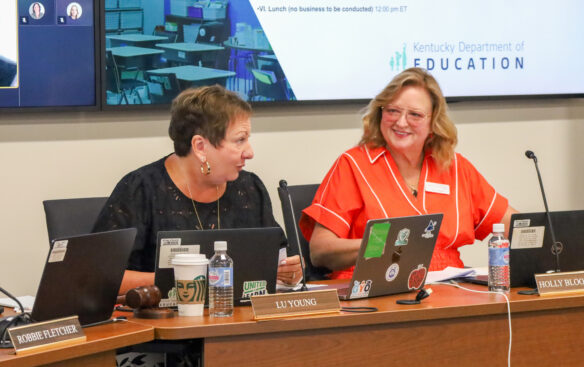
Kentucky Board of Education (KBE) Chair Lu S. Young, left, speaks with Vice Chair Holly Bloodworth at KBE’s August 5 meeting. Photo by Myles Young, Kentucky Department of Education, Aug. 5, 2026.
(FRANKFORT, KY) – Members of the Kentucky Board of Education (KBE) made several suggestions regarding Kentucky’s new assessment and accountability systems during the KBE meeting Aug. 5-6.
The meeting served as the board’s annual retreat and also included a review of the board’s goals, objectives and priorities for the year ahead. The board plans to continue those discussions during the next in-person KBE meeting Oct. 7-8.
KDE’s Office of Assessment and Accountability – represented by Associate Commissioner Jennifer Stafford and Policy Advisor Jennifer Larkins – presented the proposed revisions to 703 KAR 5:270, which come after the passage of House Bill 257 during the 2026 legislative session. The legislation provides districts with the flexibility to work more closely with their communities to establish priorities for their schools and help ensure all students have access to vibrant learning experiences.
The key regulatory changes under House Bill 257 mean Kentucky will use the individual growth of each student in the accountability system instead of change in accountability indicators from year to year. The bill reduced testing by removing on-demand writing and editing and mechanics from Kentucky’s assessment exams, while chronic absenteeism replaced the quality of school climate and safety indicator in the accountability system.
KBE members devoted time to discussing the proposed table to judge growth from year to year, the values assigned within it and whether the chart adequately promotes growth. Members also spent time discussing how much each indicator is weighted in the accountability system, including chronic absenteeism, and suggesting changes to the weights.
The discussion also incorporated recommendations made by other advisory groups KDE leaders have met with, including the School Curriculum, Assessment and Accountability Council, and the Local Superintendents Advisory Council.
KDE leaders will continue meeting with several advisory groups and other education stakeholders to receive input on the regulation. The regulation is scheduled for a second read during the KBE meeting on Oct. 7-8 ahead of a public comment period.

Members of the 2026 Kentucky Board of Education include, front row, from left: Julie Pile, Sharon Porter Robinson, Chair Lu S. Young, Vice Chair Holly Bloodworth and non-voting teacher member Stephanie Phillips. Second row, from left, are: Commissioner of Education Robbie Fletcher, Steve Trimble, Harold McKinney, non-voting student member Trace Brooking, Patti Minter and Felicia Nu’Man. Not pictured: Juston Pate, Randy Poe, ex-officio member Secretary Jamie Link and ex-officio member Aaron Thompson. Photo by Myles Young, Kentucky Department of Education, Aug. 5, 2026.
New Members and Leadership
KBE members elected a new chair and vice chair as the terms of the previous officeholders expired.
Lu S. Young, who had been serving as vice chair, was elected to the role of chair. Holly Bloodworth, a longtime educator from Murray who was the 2014 Kentucky Teacher of the Year, was elected vice chair.
The role of chair is subject to confirmation by the Kentucky State Senate.
Both Bloodworth and Young have been on the KBE since 2019. Young has more than 30 years of service to public education and continues to serve educators through her role with the University of Kentucky (UK) College of Education.
Young is a clinical title series professor in UK’s Department of Educational Leadership Studies. She was superintendent for Jessamine County from 2004 to 2013 and was named the 2012 Superintendent of the Year by the Kentucky Association of School Administrators. Young represents Supreme Court District 5 on the board.
Young paid appreciation to outgoing KBE chair Sharon Porter Robinson, who will remain as a board member representing Kentucky Supreme Court District 4 for a term expiring in April 2028.
“When I think about my time on the board … I count many of the experiences I’ve had as gifts in my professional career,” Young said. “But honestly, getting to know and work with Sharon Porter Robinson is at the very top of that list. … She is fierce. She is accomplished. She is brilliant. She is kind. And I think most importantly, in this role, she is selflessly committed to the best interest of the 650,000 students we serve across the Commonwealth of Kentucky in our public school system.”
Bloodworth spent more than 30 years in K-12 education for Murray Independent and continues to serve Kentucky’s schools through roles at Murray State University. She taught all subjects in grades K-3 and also served as a library specialist at Murray Elementary School.
A National Board Certified Teacher, Bloodworth also supports teachers on their path to National Board certification. Bloodworth represents Supreme Court District 1 on the board.
“Thank you all for your service, and hopefully our momentum will still keep moving forward; getting us down the field,” Bloodworth said to her fellow board members. “Just looking around at the new members of this board, it’s exciting to see the gifts and talents that you’re going to be bringing to this team.”
The August meeting was the first for new board members Patti Minter of Bowling Green and Felicia Nu’Man of Louisville, who were appointed to the KBE by Gov. Andy Beshear on July 30. Their terms expire April 14, 2030, and they are at-large members of the board.
Minter has taught history and legal studies courses at Western Kentucky University (WKU) since 1993. She previously served as the faculty regent on the WKU Board of Regents from 2007 to 2014 and was a state lawmaker from 2019 to 2023.
“It is an honor to join the board at this stage of my life and be able to serve the Commonwealth and education in this way,” Minter said.
Nu’Man is an attorney with experience as a prosecutor and as a private attorney in civil, criminal and family law. She has been director of the Louisville Urban League’s Center for Justice and Policy Initiatives since 2022 and previously worked as an attorney with KDE and the Education Professional Standards Board (EPSB).
KBE members Randy Poe and Julie Pile were reappointed by Gov. Beshear on July 30 to the board with terms that also expire on April 14, 2030. All KBE voting member appointments and reappointments are subject to approval by the Kentucky State Senate.
The new non-voting KBE members – student Trace Brooking of Glasgow Independent and teacher Stephanie Phillips of Ashland Independent – also participated in their first meeting as board members after their one-year terms began July 1.
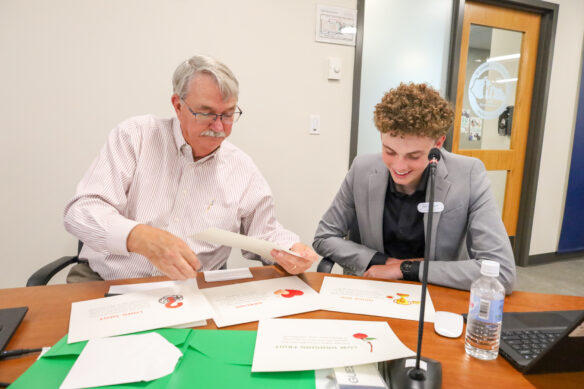
KBE Board Member Harold McKinney and Non-Voting Student Member Trace Brooking strategize together during a research collaborative activity during KBE’s Aug. 5 meeting. Photo by Myles Young, Kentucky Department of Education, Aug. 5, 2026.
KDE/EPSB Research Collaborative
Board members discussed recommendations made by a research collaborative between the KBE and EPSB designed to improve teacher recruitment and retention efforts.
The KBE/EPSB Research Practice Collaborative was created in October to gather insights from Kentucky education stakeholders on what drives educator retention, why teachers leave mid-career and how vibrant classroom learning environments – especially in literacy and numeracy – influence teacher satisfaction and career persistence.
Participants of the collaborative included KBE members, EPSB members, KDE staff members, classroom educators, school and district administrators, educator preparation program faculty, and education-focused community stakeholders. The group narrowed down two recommendations for the full KBE and EPSB to consider.
The first recommendation is to develop a continuum of growth and support for educators from preservice to retirement. Several possible next steps for this recommendation are aimed at improving professional development opportunities, mentoring, coaching and other resources for educators.
The second recommendation is to develop a continuum of support and growth for school leaders, specifically to strengthen principal capacity for talent management, working conditions and instructional leadership.
Potential next steps related to this recommendation include improved management training for principals, focused support for school culture and teacher well-being, and support for high-quality instructional practices.
KDE leaders led board members through a small group activity to address the recommendations through a series of categories, ranging from items that are simple and highly achievable to issues that may be a long shot to address.
Revised Kentucky Academic Standards for Technology
KBE members approved revised versions of some of Kentucky’s academic standards, including the Kentucky Academic Standards (KAS) for Technology, established in 704 KAR 8:090.
The revisions come as part of the typical academic standards revision cycle, with the last revision to KAS for Technology occurring in 2020.
The standards incorporate grade bands encompassing all of K-12 to provide opportunities for students so they are not waiting until high school to demonstrate competencies in technology, which is a Kentucky minimum graduation requirement.
“I would say that with any skillset – whether it be playing an instrument, playing a sport, any kind of skill – you don’t want to wait until the second semester of their senior year to introduce them to those skills,” said David Couch, associate commissioner of KDE’s Office of Education Technology. “You want to have building blocks along the way.”
Laura Raganas, a digital learning coach for KDE, explained the timeline for how these standards were revised, dating back to September 2025 when KDE sought public comment on the existing standards. Multiple teams of educators were assembled to write and review the standards, opening another round of public comment on the proposal in February 2026.
Raganas said the writers were deliberate about ensuring technology standards were aligned with and could be embedded within the rest of Kentucky’s academic standards, focusing on how students use technology to demonstrate how they understood the content they were taught.
Raganas detailed other updates in the new standards, including how artificial intelligence is embedded and how the content concept areas within the technology standards continue to support the statewide Portrait of a Learner, which include making sure students are empowered learners, digital citizens, creative communicators and knowledge constructors.
Part of the discussion among board members on the standards centered around responsible screen usage and how artificial intelligence is regulated within the standards and within school buildings.
“The approach we take here at the department; we look at not only the ethical use of AI, but also the computer science of writing AI … how to program it, how to write it, but also too, how it is used in career pathways” said Commissioner of Education Robbie Fletcher
KBE members also approved:
- Revisions made to the KAS for Social Studies, established in 704 KAR 8:060;
- The Kentucky Education Technology Systems Operational Plan and budget for the 2026-2027 school year;
- An amendment to 701 KAR 5:160, selection and appointment of non-voting Kentucky Board of Education members, to follow House Bill 727 (2026), which requires the non-voting student and teacher members in any given year to represent one of Kentucky’s Supreme Court districts instead of a Congressional district;
- An amendment to 702 KAR 6:090, minimum nutritional standards for foods and beverages available on public school campuses during the school day and required nutrition and physical activity reports;
- Amendments to 780 KAR 3:072, attendance, compensatory time and leave for certified and equivalent service, to include maternity leave as a type of leave under KRS 156.808;
- Waiver requests for Simpson and Perry counties related to property acquisition;
- Updates to policies for the Kentucky School for the Blind and Kentucky School for the Deaf, and updated policies and procedures for Kentucky’s area technology centers and to the Kentucky Tech Student Handbook;
- The 2027 KBE regular meeting schedule for the transaction of business to be held every other month starting in February; and
- Awarded the 2026 Grissom Award for Innovation in Special Education to former Lyon County Director of Special Education Miranda B. Reed and the Oldham County Schools Exceptional Children Services Program.
Leave A Comment