
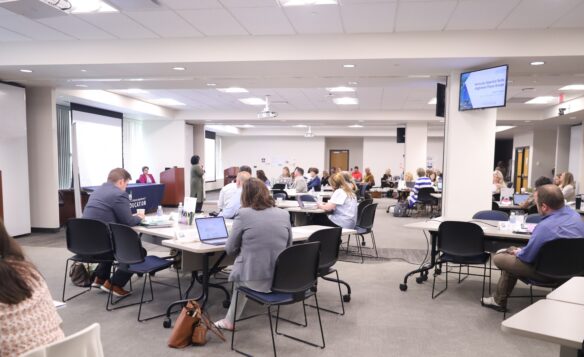
Members of the Kentucky United We Learn Council convene during the July 24 meeting. Photo by Myles Young, Kentucky Department of Education, July 24, 2026.
(FRANKFORT, KY) – The Kentucky United We Learn Council met July 24 to discuss the implementation of reimagined assessment and accountability systems under House Bill (HB) 257 and the resources available to districts to help provide more vibrant learning experiences for students.
“We’re finding areas of growth and saying this is how we need to help the individual student,” Commissioner of Education Robbie Fletcher said. “It’s not about labeling the students; it’s about finding their strengths, finding their areas of growth, and helping them move along. That’s a different way to look at testing, and it’s what we embrace.”
The Kentucky United We Learn Council is a dedicated group of educators, students, family members, community members, and other education stakeholders facilitated by staff with the Kentucky Department of Education (KDE) who bring together voices from across the Commonwealth to reimagine what’s possible for Kentucky’s students.
The group’s work over the past few years heavily influenced HB 257, which provides districts with the flexibility to work more closely with their communities to establish priorities for their schools and help ensure all students have access to vibrant learning experiences.
HB 257 includes locally developed indicators of quality – also known as local accountability – and a state accountability system that meets federal requirements. The local indicators of quality encourage districts and their communities to work together to create their own local indicators that prioritize what residents believe students should know and be able to do before graduating. The local indicators of quality must include vibrant learning experiences for students.
Fletcher spent part of the morning talking about the final version of the legislation and existing support for districts to help implement it.
“At the end of the day, we want our students to have vibrant learning opportunities – quality vibrant learning opportunities. We want to see innovation,” Fletcher said. “There is something else that you’ll see as we move through this work: Districts have a lot of flexibility in what they can do for students, but why are we not using that?”
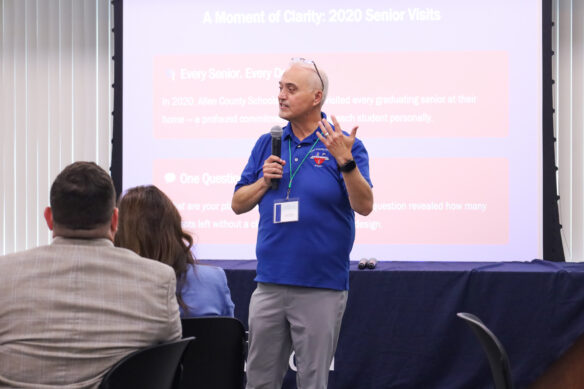
Allen County Superintendent Travis Hamby talks about how they reimagined assessment and accountability with members of the Kentucky United We Learn Council during the July 24 meeting. Photo by Myles Young, Kentucky Department of Education, July 24, 2026.
The discussion included a deeper dive into how local accountability is already working in districts, featuring testimonials from leaders of Allen County and Fleming County on how they reimagined assessment and accountability.
Allen County Superintendent Travis Hamby talked about how the district’s journey with a redesigned high school experience began in 2020 after school leaders had meetings with each member of the graduating class, where they asked about the student’s plans for life after graduation.
“I’ll tell you, it was a sobering experience for me – sobering experience – because what I learned is that there were way too many kids that could not answer that question. They simply did not have a clue what they were going to do,” Hamby said. “And so that was a moment for me that – we have to do something different, right? We’ve got to change.”
Hamby said the district put a focus on determining what students and the community were passionate about in terms of career options and built a local accountability system that prioritizes getting students where they want to go with those passions. The reimagined high school experience in Allen County emphasized providing meaningful learning experiences so graduates leave with purpose, direction and the skills necessary to pursue a fulfilling life.
“We don’t want our kids to just know content; we want them to be able to apply it and transfer it to different settings,” Hamby said.
The district created a process for students to plan their career path over the course of their four years in high school, including the choice of incorporating some of the 27 career and technical education pathways they offer, along with dual credit and Advanced Placement opportunities.
More details on what Allen County developed, including the district’s Profile of a Patriot that further outlines the expectations for students, can be found on the Allen County Schools Making Learning Visible dashboard.
Fleming County Superintendent Brian Creasman said his district’s work on local accountability began in 2017, when discussions with the community led to rethinking the entire local accountability system. The state accountability system still focuses on core subjects such as reading and mathematics, but Creasman said the district used flexibility within the regulations to create a more holistic approach to measuring success.
“Really what we’re trying to do is get back to vibrant learning, but we think we have to really focus on this vibrant ecosystem and that vibrant accountability,” Creasman said. “That ecosystem really allows that kind of vibrant learning to flourish.”
The district offers more information about how it built its local accountability system, including its Measures of Quality, on the Fleming County Schools Measures of Quality dashboard
“What parents really want to know is stories and what the kids are really doing, and the community really wants to know that,” Creasman said. “So, if we’re saying we’re changing the learning experience, they want to see the evidence that we are doing that.”
Kentucky High School Transformation Work Group’s Pressing Issues
Representatives with the Kentucky Board of Education’s Kentucky High School Transformation Work Group, which was made up of individuals focused on examining policies and implementation practices that affect the high school experience, presented the group’s work to council members. The National Association of State Boards of Education invited the Kentucky Board of Education (KBE) to participate in its High School Transformation State Network, which builds the capacity of state boards of education to enable rich student experiences that foster content mastery and durable skills. Kentucky’s work group met four times across seven months as part of NASBE’s state network.
Juston Pate, a member of the Kentucky Board of Education and chair of the Kentucky High School Transformation Work Group, said the group narrowed down five pressing issues to address barriers to transforming the high school experience. The five pressing issues are how to disrupt the status quo; equitable access and funding; trust; building a system around vibrant learning; and teacher training, certification and development.
Pate said advancing innovation and addressing those pressing issues will ultimately help schools address keeping students engaged with school as they get older.
Work group members discussed opportunities to share innovative best practices with districts related to transforming the high school experience, how to remove barriers that may exist and to consider policy recommendations that may improve high school innovation. Pate said the work group invited the Kentucky United We Learn Council to further consider the work group’s discussions and recommendations in future meetings.
Kentucky Department of Education (KDE) staff members presented resources to help districts with assessment and accountability, including the Local Accountability Design Guide and Toolkit. The guide provides a step-by-step approach, real examples from across the Commonwealth and practical tools to help schools and communities design accountability systems that reflect local priorities and create vibrant learning experiences for every student.
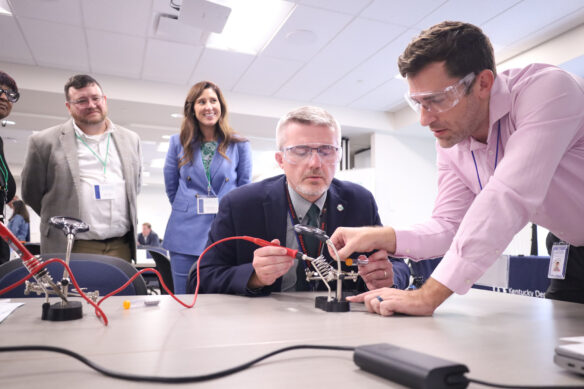
Commissioner of Education Robbie Fletcher participates in a vibrant learning exercise using a soldering iron to make an LED sign during the Kentucky United We Learn Council July 24 meeting. Roger Taylor, an engineering program consultant with KDE, assists in the exercise. Photo by Myles Young, Kentucky Department of Education, July 24, 2026.
Vibrant Learning
Krista Thompson, an engineering teacher at Muhlenberg County High School, led council members in an activity where they applied engineering principles to make a sign with LED lights using a 3D printer, a laser engraver, a soldering iron and other materials. Students in the school’s engineering class work through the step-by-step process of designing and building the sign while applying Ohm’s Law – a mathematical concept where voltage equals the electrical current multiplied by resistance – to build the electrical components.
“They get to see how it’s really used and why it’s important,” Thompson said.
Roger Taylor, an engineering program consultant with KDE, said Thompson’s work has been instrumental in the development of the new Engineering by Design curriculum that is available for free for all Kentucky teachers. That curriculum and other resources are available on KDE’s Engineering Technology Education webpage.
As the terms of the current Kentucky United We Learn Council chair and vice chair were expiring, the council chose Brandy Howard, chief academic officer for Bullitt County, as its new chair and Adam Hicks, assistant superintendent of Shelby County, as the new vice chair.
Leave A Comment