
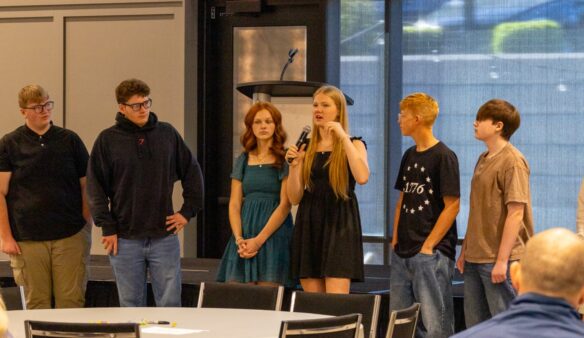
Students from Eminence High School (Eminence Independent) talk about vibrant learning experiences they have in their math class at the Regional Learner Network kickoff event Sept. 28. Photo by Fiona Morgan, Kentucky Department of Education, Sept. 28, 2026
(SHELBYVILLE, KY) – Many districts across the state are coming together to learn about local indicators of quality as the Kentucky Innovative Learning Network (KY ILN) has grown by 59% this year.
The Kentucky Department of Education (KDE) recently welcomed 31 new districts to the KY ILN as the department hosted a kickoff event for the new Regional Learner Network on Sept. 28. The KY ILN now has 52 districts.
The KY ILN is a partnership between local school districts and KDE, providing a shared professional learning space for education leaders dedicated to creating vibrant learning experiences and accelerating innovation.
Brandy Breeze, education program consultant in KDE’s Division of Innovation, explained that KDE is helping create local networks for districts to be able to learn from each other about local indicators of quality, also recognized as local accountability, which is a community-driven approach to school performance that goes beyond state test scores, focusing on vibrant learning, local priorities and inclusive decision-making.
As a core focus of Kentucky’s United We Learn vision for education, vibrant learning experiences are powerful moments characterized by student agency and the application of knowledge and skills aligned with the Kentucky academic standards. They are developed in partnership with students’ families, local communities, and the local workforce, and demonstrate learning through personalized products, outputs and experiences.
Sarah Snipes, director of KDE’s Division of Innovation, said KDE wanted to start a new regional approach to allow better access for districts, since events will be located closer to districts throughout the state.
The Regional Learner Network (RLN) is a new approach to the KY ILN for KDE’s Division of Innovation. The statewide event served as a kickoff for the new upcoming seven regional networks in Boone, Christian, Harlan, Hardin, Russell, Rowan and Woodford counties, which will be working using similar structures as the Local Laboratories of Learning cohorts.
“These regional networks are different in that we want to connect neighbors to learn from one another more often without having to travel to a central location like Shelbyville to work together,” Snipes said.
The kickoff event featured presentations and roundtable discussions about local indicators of quality and vibrant learning from KDE staff and partners from the University of Kentucky Center for Next Generation Leadership and ElevatEd out of the Ohio Valley Educational Cooperative. Other featured presenters included the Prichard Committee and Kentucky Board of Education Chair, Lu Young. The event also featured presentations from students about vibrant learning in their schools, as well as districts about how they have implemented local indicators of quality systems.
Anthony Thompson, principal of Greenup County High School, made a presentation at the kickoff event about how the school district developed its local indicators of quality system.
He said seven years ago, the school met with members of their community and local employers, who shared that students who graduate are good at taking tests, but they don’t necessarily have physical labor or employment skills. Thompson said they built their local indicators of quality system around that feedback, giving every student a roadmap for what they plan to do after school.
“Our community said, ‘We want to have people with high character from Greenup County High School,’ so we worked hard on that; ‘We like kids that think about other people more than they think of themselves,’ so we worked hard on that,” Thompson said. “The biggest thing is that whether you want to go to college or you want to go straight to work or to the military, before you leave Greenup County High School, you must be prepared for that. That’s kind of a non-negotiable for us.”
Joshua Coleman, an Algebra 1 teacher for Greenup County High School, shared a vibrant learning experience he leads in his class around quadratic functions. He leads a project where students use math to determine the trajectory of a t-shirt cannon.
Coleman said when students from years past see him working with current students on the t-shirt cannon project they ask him about quadratics, which he said shows that students remember what they learned as part of that project beyond taking a test.
“When we get to the hands-on learning, getting to that vibrancy, they’re actually taking it further and not just forgetting it by the end of the year,” Coleman said. “It’s the same thing with our careers, we learn by a hands-on approach.”
Thompson said that since Greenup County has developed its local indicators of quality model and increased vibrant learning, culture in the school has changed because of student agency, student input and student choice.
“A lot of good things happened in our school, but it has taken seven years to get to where we are,” Thompson said. “It will not happen overnight, so if you would ask our advice, our advice would be to stay with it but be patient.”
Todd Moody, superintendent of Grant County, said he enjoyed the roundtable discussions and how he was able to hear about how other districts are creating local systems and indicators of quality.
“Being able to participate in roundtables and hearing ideas from other agencies and other districts as to what processes and barriers and obstacles and challenges that they confronted and how they work through those processes was helpful,” Moody said.
Grant County is a new district to the KY ILN. Breeze said she believes the recent passing of House Bill (HB) 257 has encouraged more districts to get involved with developing their own local indicators of quality.
HB 257, passed during the General Assembly’s 2026 regular session, provides districts the flexibility to work more closely with their communities to establish priorities for their schools and help ensure all students have access to vibrant learning experiences. The local indicators of quality include flexible options for districts to measure what community members say is important for their students to know and be able to do. The indicators of quality must include vibrant learning experiences for students.
Breeze said she believes the bill creates momentum for districts to start developing local indicators of quality systems, which in turn encourages them to get involved in the KY ILN.
“I think we had a real grassroots movement, and the thing is, once the district says, ‘Yes I’ll take this on,’ it just snowballs from there because we see the excitement in kids, and they see the excitement in teachers,” Breeze said.
She said people notice the positive effects of vibrant learning experiences and want to create more.
“When both sides of the aisle and legislation agree on it … and put funding behind it, I think that really spoke volumes to our district leaders to say, ‘You might want to check this out,’” Breeze said.
To offset development and implementation costs for districts to create local indicators of quality systems, KDE is authorized to offer a one-time grant of up to $15,000 per district. Districts can submit their request for funding using the diagnostic in the Cognia Improvement Platform and can email Breeze for more information. The submission deadline is Apr. 1, 2027.
Moody said his district started creating their local indicators of quality system last year and now they’re looking for opportunities to strengthen their local indicators of quality dashboard and make the data consistent.
“What I appreciate the most is how different it can look district by district, that there is no template, there is no prescription,” Moody said. “But it really always goes back to, ‘What does your community value and how will you connect that to what students are doing on a daily basis?’”
J.J. Black, director of secondary schools for Shelby County, said her district has been involved with KDE’s work around KY ILN for about 10 years. Shelby County was part of a pilot project for local indicators of quality work.
Black said the kickoff event was a great opportunity to network with other districts and hear their ideas to gain inspiration for their own work.
“This year’s work is more about validation and hearing ideas that can grow what we’re doing, so gaining feedback and things that we’re learning from other districts,” Black said. “For our feedback, it makes our processes (tighter and more cohesive), as well as sharing what we’re doing with other schools. So, it’s kind of a give and take.”
Black said a valuable thing she learned from the event was how the district can be more creative with local indicators of quality through HB 257 and other legal aspects.
“(I enjoyed hearing about) the legal side of it and how we can use that to our advantage to make innovative changes, because now the law is behind us,” Black said.
Black plans to attend the upcoming regional events and looks forward to networking more with districts.
Snipes said the upcoming events can encourage other districts by seeing that they’re not alone in the work they’re doing.
“My hope for the long term is that we connect people together in a relationship that’ll outlast us,” Snipes said. “If two districts today exchange emails or numbers, my hope is that throughout the year, they’ll continue to touch base with each other and they’ll help each other learn and grow, even without us.”
Moody said he also plans to attend some regional events throughout the year because he always learns something.
“I would like to attend as many as I possibly can, because every time I do, I learn something, or I have another realization, or I get a subtle shift in my thinking that makes the target increasingly clear,” Moody said.
Districts can email Brandy Breeze for information about the regional events.
Leave A Comment