
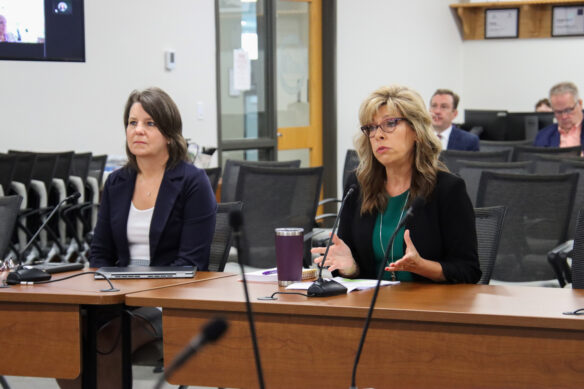
From left, Associate Commissioner Jennifer Stafford and Division Director Shara Savage of the Kentucky Department of Education’s Office of Assessment and Accountability make a presentation about House Bill 257 to members of the Local Superintendents Advisory Council. Photo by Joe Ragusa, Kentucky Department of Education, May 26, 2026
(FRANKFORT, KY) – Members of the Kentucky Department of Education’s Local Superintendents Advisory Council (LSAC) provided feedback on upcoming regulatory changes surrounding the state’s assessment and accountability systems during the LSAC meeting on May 26.
House Bill (HB) 257, passed during the General Assembly’s 2026 regular session, provides districts the flexibility to work more closely with their communities to establish priorities for their schools and help ensure all students have access to vibrant learning experiences. Representatives with the Kentucky Department of Education’s (KDE’s) Office of Assessment and Accountability – Associate Commissioner Jennifer Stafford and Division Director Shara Savage – outlined the new legislation and the timeline for implementation while seeking input from LSAC members.
HB 257 includes locally developed indicators of quality – also known as local accountability – and a state accountability system that meets federal requirements. The indicators of quality include flexible options for districts, encouraging more collaboration with their communities to set their own local indicators. The indicators of quality must include vibrant learning experiences for students.
The legislation makes changes to the current state assessment and accountability systems by:
- Reducing the state testing time;
- Using the individual student growth in the accountability system instead of comparing cohorts of students from year to year, while retaining the ability to compare results; and
- Prioritizing student attendance in the accountability model.
State testing this spring and data reporting in the fall remains the same as they were in 2025. Savage detailed the changes superintendents and school leaders should expect for the spring 2027 testing window and accountability changes for the 2026-2027 school year.
Over the summer, KDE leaders will be meeting with more stakeholder groups as the department finalizes regulations surrounding assessment and accountability for the Kentucky Board of Education to begin considering in August. Stafford said among the topics to be discussed are how student attendance will play into the accountability system moving forward, how individual student growth is assessed and how each indicator is weighted.
Stafford explained LSAC will have more opportunities to weigh in on the upcoming regulatory changes before they make their way to the Kentucky Board of Education (KBE), which is charged with developing and adopting the regulations that govern Kentucky’s 171 public school districts and the actions of the Kentucky Department of Education.
“This is the first step of a multi-step process on gathering feedback,” she said.
Some of the discussion with LSAC members centered on how individual growth will be measured in the accountability system, including the opportunity to include growth in reading and mathematics at the high school level. Stafford said there is no single correct way to implement a growth model.
“Decisions – often both technical and policy in nature – should be grounded in the Commonwealth’s and its shareholders’ vision and priorities for educational accountability,” Stafford said.
Kenton County Superintendent Henry Webb expressed concern over how growth was measured in the past and the need to make sure the system moving forward doesn’t penalize districts with a high number of high-performing students.
“My message is learn from the past: why we changed, what we changed, when we changed. That way we don’t repeat the same mistakes,” Webb said. “Because I promise you, all these passionate people are going to get really passionate when they start getting penalized for having success.”
Superintendents also discussed how chronic absenteeism includes students who are absent for any reason – excused or unexcused – and how that may present some issues for districts with students who miss school due to medical issues or other excused reasons.
“We will have several students across the state, when we begin school, we know they will be chronic absentee students just because of their medical condition,” said Lyon County Superintendent Russ Tilford. “It could be something as simple as living in a rural community and having orthodontics. Those monthly visits … you do that each month, then you have a flu here in the middle of the winter, you’ve maxed out your days with all excused absences.”
The discussion also focused on how individual indicators will be weighed in the accountability system moving forward, including how English language proficiency is measured with English learner students.
KDE has already convened several groups of stakeholders including Directors of Pupil Personnel, English Learner education leaders and Accountability Thought Partners, who are immersed in the work and share their perspectives through an inclusive and collaborative approach.
Several other advisory groups will be consulted for further feedback on the new requirements under this legislation. By February 2027, changes are expected to be finalized with the federal Every Student Succeeds Act State Plan and state regulations.
Waiver Request Regulation
LSAC members recommended approval of an amendment to 701 KAR 5:170, waiver requests.
The changes come following legislation passed during the 2026 legislative session, Senate Bill 263, that cleans up the process for districts seeking waivers from the KBE under KRS 156.161. The changes include:
- Remove special education class size and caseload waivers from the KBE waiver process. These matters will now be handled via exemptions granted by the commissioner of education.
- Update timeline of waiver review and decision by the KBE. KRS 156.161 now provides that the KBE shall consider waiver requests at a meeting occurring no later than 30 calendar days following receipt of a request. Requests received less than 20 days in advance of a KBE meeting will include notification to the KBE that KDE did not have sufficient time to conduct a meaningful review of the request.
- Include a process for consultation with the Education Professional Standards Board (EPSB) when a waiver of EPSB regulations is made to the KBE.
- Remove provisions regarding recommendations for approval or denial to the KBE. KRS 156.161 now prohibits the commissioner and KDE from making such recommendations.
- Include a process for school districts to request technical assistance from KDE in identifying statutes and administrative regulations that must be waived in order to engage in proposed practices.
- Amend forms to comply with statutory changes, including changes to criteria for designation as a school of innovation. KRS 156.161 amends the criteria to provide for designation as a school of innovation if all approved waivers attempt to improve student outcomes in a manner that would be difficult or impossible without the approved waivers.
- Make amendments to clarify that facility waivers no longer expire three full school years following approval.
The waiver process under KRS 156.161 was originally created in 2025 when lawmakers passed Senate Bill 207.
In other business, LSAC members:
- Recommended approval of work-based learning placements to receive career-ready status for state accountability for the 2025-2026 school year;
- Recommended approval of an amendment to 701 KAR 5:090, regulations on teacher disciplinary hearings; and
- Discussed an agency amendment to 702 KAR 5:130, regulations on and standards for vehicles designed to carry nine passengers or fewer.
Regulations recommended for approval by LSAC members will be considered by the KBE at its next meeting in June.


Leave A Comment