
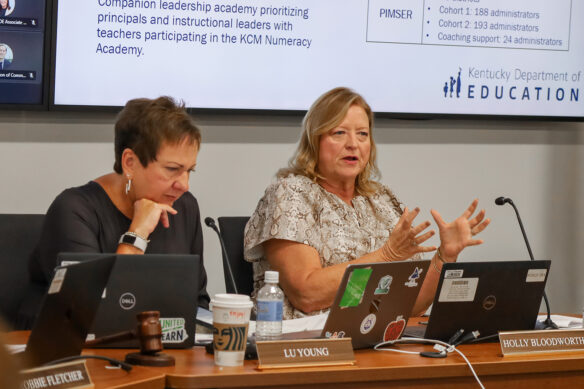
Kentucky Board of Education (KBE) Vice Chair Holly Bloodworth, right, speaks on local indicators of quality during the board’s discussion at KBE’s October 7 meeting. Photo by Myles Young, Kentucky Department of Education, Oct. 7, 2026.
(FRANKFORT, KY) – During the Kentucky Board of Education (KBE) meeting Oct. 7-8, members approved amendments to Kentucky’s accountability system regulation.
The amendment to 703 KAR 5:270 comes after years of work by the Kentucky Department of Education (KDE) and many different stakeholder groups from across Kentucky to design assessment and accountability systems that are meaningful and useful to all learners. This work led to the passage of House Bill 257 during the 2026 legislative session, which provides districts with the flexibility to work more closely with their communities to establish priorities for their schools and help ensure all students have access to vibrant learning experiences.
Assessment changes will impact testing during the 2026-2027 school year. The new accountability system will be reported in the fall of 2027.
The key regulatory changes under House Bill 257 mean Kentucky will use the individual student growth in reading and mathematics performance on state assessments in the accountability system instead of change in accountability indicators from year to year. The bill reduced testing by removing on-demand writing and editing and mechanics from Kentucky’s assessment exams, while chronic absenteeism – a new indicator – replaced the quality of school climate and safety indicator in the accountability system.
KBE Chair Lu S. Young said the board’s goal with assessment and accountability is to have a system that is meaningful and useful to all learners, and House Bill 257 is a good first step in that direction.
“We want to establish a trustworthy system of local accountability that resonates across the Commonwealth,” Young said.
Writing will still be a primary focus for KDE as the department is tasked by the legislation with developing guidelines for writing programs across content areas aligned to the Kentucky Academic Standards and will provide all school districts with professional learning to support effective, standards-aligned writing programs across all content areas. KDE offers resources to help districts on the Guidelines for Establishing a District-Wide Writing Program webpage and KDE’s Writing Program Guidelines document.
As KDE staff has consulted with the KBE, a variety of advisory groups and other education stakeholders, the conversation has focused on the proposed table to measure growth from year to year on state summative assessments in reading and mathematics and the values assigned within it. The discussion has also focused on how much each indicator is weighted in the accountability system, including chronic absenteeism.
Following some of the most recent discussions – including with the KBE during its Aug. 5-6 meeting, with members of the School Curriculum, Assessment and Accountability Council during their Sept. 15 meeting and with members of the Local Superintendents Advisory Council during their meeting on Sept. 29 – KDE Associate Commissioner Jennifer Stafford and Policy Advisory Jennifer Larkins presented a proposed final version of the accountability weight chart and the value table for how individual student growth in reading and mathematics is credited.
The KBE-approved growth value table for individual student growth in reading and mathematics, as well as the KBE-approved overall accountability weights, are listed below.
Growth Value Table for Individual Student Growth in Reading and Mathematics
| Prior Year | Novice Low | Novice High | Apprentice Low | Apprentice High | Proficient Low | Proficient High | Distinguished Low | Distinguished High |
|---|---|---|---|---|---|---|---|---|
| Distinguished High | 0 | 0 | 0 | 0 | 0 | 0 | 100 | 125 |
| Distinguished Low | 0 | 0 | 0 | 0 | 0 | 50 | 100 | 125 |
| Proficient High | 0 | 0 | 0 | 0 | 50 | 100 | 110 | 125 |
| Proficient Low | 0 | 0 | 0 | 50 | 100 | 110 | 125 | 125 |
| Apprentice High | 0 | 0 | 50 | 100 | 110 | 125 | 125 | 125 |
| Apprentice Low | 0 | 50 | 100 | 110 | 125 | 125 | 125 | 125 |
| Novice High | 0 | 100 | 110 | 125 | 125 | 125 | 125 | 125 |
| Novice Low | 0 | 110 | 125 | 125 | 125 | 125 | 125 | 125 |
Overall Accountability Weights
| Level | State Assessment Results in Reading and Mathematics | Individual Student Growth in Reading and Mathematics | State Assessment Results in Science and Social Studies | English Learner Progress | Chronic Absenteeism | Postsecondary Readiness | Graduation Rate |
|---|---|---|---|---|---|---|---|
| Elementary | 36 | 25 | 30 | 5 | 4 | n/a | n/a |
| Middle | 36 | 25 | 30 | 5 | 4 | n/a | n/a |
| High | 36 | n/a | 20 | 5 | 4 | 25 | 10 |
Board members approved using 100 days or more of enrollment for chronic absenteeism, where a student must be enrolled for at least 100 days before their attendance is factored into a school or district’s accountability, and only using days when a student is enrolled in the district toward the accountability indicator.
Chronic absenteeism, as defined in KRS 158.6455, is when a student misses 10% or more of school time for excused or unexcused reasons throughout the school year.
Young said there are still concerns with the 100-day rule and with chronic absenteeism being involved in the accountability system, because there are a variety of scenarios that could take a student out of class for a prolonged period of time.
“We’ll diligently pursue what we need to report (chronic absenteeism) appropriately, but I think there’s a lot to be learned over the next few years about the impact of chronic absenteeism on our accountability system,” Young said.
The amended regulation will continue through the regulatory review process, which includes opportunity for public comment, before it is finalized.
Commissioner Evaluation
The KBE approved its annual evaluation of Commissioner of Education Robbie Fletcher, praising the work he has done the past year.
“It’s an honor to serve kids,” Fletcher said. “Whether you’re in the classroom, whether you’re an administrator, a superintendent, it’s just an honor to get to serve the kids of the Commonwealth, and I’m thankful to be able to do that each and every day.”
Young detailed several of Fletcher’s accomplishments, including how Fletcher has served as a strong ambassador for the United We Learn vision for public education, centered around vibrant learning experiences, innovation and collaboration. Young and other board members also noted how Fletcher has built strong relationships with different education stakeholders, including legislators, and how effective of a communicator he has been while serving as a strong advocate and leader for Kentucky schools and students.
“Your leadership is characterized by transparency, integrity, responsiveness, thoughtful listening, and a consistent focus on students and schools,” Young said.
Board members also noted Fletcher’s work with assessment and accountability, including efforts to advance House Bill 257 with the Kentucky legislature and working with schools and districts across the Commonwealth as they reimagine their own systems.
The board approved a series of goals for the commissioner in the year ahead, including continued work on scaling local accountability and vibrant learning across Kentucky. The goals also include strengthening Kentucky’s education workforce, building up leadership development efforts, advocating for investment in students and schools – particularly with school transportation and facilities funding – and sustaining effective communication with KBE members.
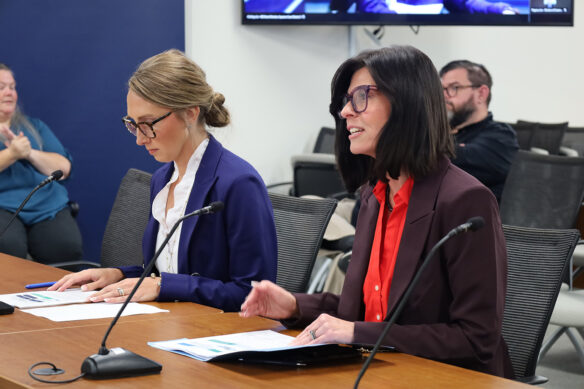
Kentucky Department of Education (KDE) Chief Academic Officer Micki Marinelli, right, and KDE Director of Mathematics Education Chelsey Tingle, provide details on how school districts are participating in the Kentucky Numeracy Counts Academies at the Kentucky Board of Education’s October 8 meeting. Photo by Myles Young, Kentucky Department of Education, Oct. 8, 2026.
Kentucky Numeracy Counts
Representatives with KDE’s Office of Teaching and Learning provided an overview of efforts made to bolster numeracy education through the implementation of House Bill 162 (2024), the Kentucky Numeracy Counts Act.
The legislation aims to strengthen mathematics outcomes for every student through increased access to high-quality mathematics instruction, targeted supports for accelerating student progress and strategic investments in educators and systems.
KDE and various partners have initiated numerous efforts to advance access to evidence-based mathematics instruction. The Kentucky Center for Mathematics’ K-5 Numeracy Counts Academy and the Partnership Institute for Math and Science Education Reform’s (PIMSER’s) Numeracy Counts Administrator Academy began in 2025, along with other professional development opportunities for educators and administrators, including an expansion of Advance Kentucky’s Access to Algebra and EPIC’s Kentucky Numeracy Alliance.
Micki Marinelli, KDE’s chief academic officer, and Chelsey Tingle, KDE director of mathematics education, provided details on how 144 school districts in Kentucky are participating in the Kentucky Numeracy Counts Academies, including hundreds of teachers and administrators.
KDE has also developed the Mathematics Leadership Collaborative, which provides capacity-building for district and school leaders in grades 4-8 to support the goals of the Kentucky Numeracy Counts Act. Participation in the collaborative spans across 24 districts and 86% reported increased confidence in communicating a vision for mathematics instruction. Participants also reported increased confidence in coaching for strong mathematics instruction, using KDE curriculum implementation tools and internalizing high-quality instructional resources.
The Kentucky Numeracy Counts Act also requires KDE to provide grants to help local school districts purchase KDE-approved high-quality curriculum aligned to K-3 academic standards in mathematics and to cover the costs for curriculum-based professional learning. In the 2025-2026 school year, KDE awarded $70,000 grants to 40 school districts. For the 2027-2028 cycle, the grant is expanding to support 50 school districts at $70,000 each.
Marinelli went into other aspects of the Kentucky Numeracy Counts Act, including funding challenges surrounding the development of a mathematics coaching model like what is in place for early literacy, specifically, trying to scale it to a statewide model to support districts with greatest need.
Tingle explained that, currently, the Mathematics Achievement Fund grant program, provides funding for release time for teachers to serve as local school-based mathematics coaches to:
- Observe and provide feedback;
- Model appropriate evidence-based instructional practices;
- Conduct workshops or institutes;
- Establish professional learning communities; and
- Ensure high-quality instructional resources are aligned to the Kentucky Academic Standards for Mathematics.
The Mathematics Achievement Fund coaching grant supports 45 elementary schools, and KDE expanded the model to include 15 middle schools for 2026-2028. Kentucky Summative Assessment data from 2022-2025 shows a positive impact on students in grades 3-5 in Mathematics Achievement Fund schools where the coaching model is in place. Across grades 3, 4 and 5, Mathematics Achievement Fund partner schools had a greater rate of novice reduction compared to the state, and grades 3, 4 and 5 all increased in proficient or distinguished at a higher rate compared to the state average.
More information on district and school implementation can be found on KDE’s Kentucky Numeracy Counts webpage.
KDE/EPSB Research Collaborative
KBE members approved a resolution in support of recommendations made by a collaborative between the board and the Education Professional Standards Board (EPSB). The resolution will also be considered by the EPSB on Oct. 20.
The KBE/EPSB Research Practice Collaborative was created in October 2025 to gather insights from Kentucky education stakeholders on what drives educator retention, why teachers leave mid-career and how vibrant classroom learning environments – especially in literacy and numeracy – influence teacher satisfaction and career persistence.
Participants of the collaborative included KBE members, EPSB members, KDE staff members, classroom educators, school and district administrators, educator preparation program faculty, and education-focused community stakeholders. The group narrowed down two recommendations for the full KBE and EPSB to consider.
The first recommendation is to develop a continuum of growth and support for educators from preservice to retirement. Several possible next steps for this recommendation are aimed at improving professional development opportunities, mentoring, coaching and other resources for educators.
The second recommendation is to develop a continuum of support and growth for school leaders, specifically to strengthen principal capacity for talent management, working conditions and instructional leadership.
Potential next steps related to this recommendation include improved management training for principals, focused support for school culture and teacher well-being, and support for high-quality instructional practices.
KBE Goals
Board members approved a series of goals for the 2026-2028 biennium.
The goals focus on three key ideas: fostering educational innovation through vibrant learning experiences, advancing educational excellence through professional improvement and cultivating collaborative partnerships with the community.
Young said the board put together a detailed list of action items following discussion in August about the goals, including a point about ensuring the board supports “advocacy for every learner of every background.”
With vibrant learning experiences, the board pledges to support educators in designing and implementing engaging, real-world, and content-rich learning experiences that inspire students to participate actively and apply their knowledge meaningfully. The board also pledges to support the continued implementation of reimagined assessment and accountability through House Bill 257 (2026) and support districts and communities as they develop local indicators of quality.
The board pledges to advance statewide efforts in implementing high-quality literacy and numeracy instruction through robust resources for professional development, including continued advocacy for professional learning academies. This goal also includes a push to strengthen statewide support for professional learning for principals and school leaders through the implementation of Senate Bill 4 (2026) and other efforts.
In order to cultivate collaborative partnerships, board members agreed to establish and sustain strong partnerships with all education stakeholders by amplifying the voices of students, educators, families, policymakers and community members. Efforts include the continued engagement of the Kentucky High School Transformation Work Group, the Kentucky United We Learn Council, the EPSB, the Kentucky Council on Postsecondary Education and the Commissioner’s Student Advisory Council.
In other business, board members also:
- Approved an amendment to 702 KAR 3:110 related to document filing dates to comply with House Bill 67 (2026);
- Approved amendments to 780 KAR 2:040, a regulation on live work projects, to update work order agreement forms for Kentucky Tech schools;
- Approved waiver requests from Marshall County, Burgin Independent and Fulton Independent related to tax levies and reporting requirements;
- Received a report from KnowledgeWorks on “Student-Centered Policy Implementation in Kentucky,” funded through the U.S. Department of Education’s Competitive Grants for State Assessments program; and
- Presented the 2026 Kelly Award for Business and Partnership to RiverValley Behavioral Health Vice President of Operations Cate Gaddis

Leave A Comment