
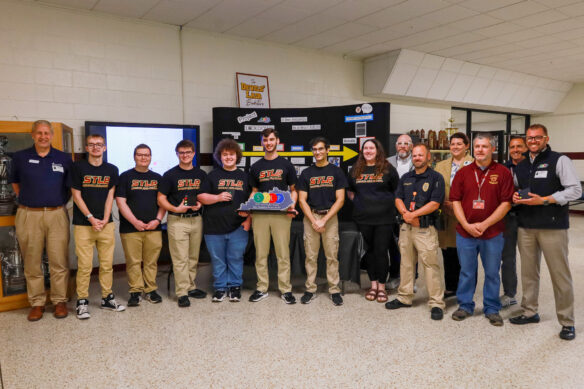
From left to right: David Couch, associate commissioner in KDE’s Office of Education Technology; Project LOCKDOWN makers Jordan Kelley, Avery Green, Bradley Hostetter, Casey Malone, Jackson Morris and Snehan Saroch; Russell High School STLP Leader Carolyn McGranahan; Jeff Sebulsky, KDE STLP leader; Russell Resource Officer Brian Tackett. Photo by Fiona Morgan, Kentucky Department of Education, May 9, 2025
(RUSSELL, KY) – A group of six Russell High School (Russell Independent) students created a safety alert system for their school to help first responders during school emergencies.
Project LOCKDOWN was created by Jordan Kelley, Avery Green, Bradley Hostetter, Casey Malone, Jackson Morris and Snehan Saroch. They were all seniors at Russell High School when they made the project during the 2024-2025 school year.
The microcomputer system displays a map of each room in Russell High School in the front office where first responders usually enter. The group built button panels for each classroom that teachers or students can press when there’s an emergency. Rooms that have a button pressed light up on the map of the school, allowing first responders to find those rooms more quickly instead of searching the whole school.
The panels have four colored buttons to signify the type of emergency: a red button for an attacker, a yellow button for a missing person, a green button for a health emergency and a clear button to signify there’s no longer an emergency.
The system also has cameras in many of the rooms, which allows first responders to see what’s going on in the room. Hostetter said it also allows police to see if anyone causes trouble, such as if a student pulls a fire alarm as a prank.
The project won the Dave Sigler Award for Best Technical STLP Project at the 2025 STLP state championship event.
Run by the Kentucky Department of Education’s (KDE’s) Office of Education Technology, the Student Technology Leadership Program uses project-based learning, technology utilization and digital content creation to empower student achievement. The state championship took place at Lexington’s Rupp Arena on April 23. It featured more than 500 K-12 schools, and more than 600 student teams presented their year-long, technology-based projects.
The Dave Sigler Award for Technical Excellence is one of the four prestigious Best in Kentucky titles presented each year at the STLP State Championship. This award honors the STLP project that demonstrates the highest level of technical advancement, regardless of grade level, and celebrates the spirit of innovation, precision and behind-the-scenes expertise that drive Kentucky’s leadership in educational technology.
Also known as the Dave Sigler Award for Best Technical STLP Project, the award was established in 2015 and debuted as a way to spotlight projects that push the boundaries of technical innovation within STLP.
The award is named in memory of Dave Sigler, a pioneer in Kentucky’s education technology history. Beginning in the early 1990s, Sigler played a pivotal role in making Kentucky the first state in the nation to deliver high-speed internet access to every school and district office. His work didn’t stop there: he later helped lead projects such as bringing wireless internet to school buses, ensuring students could stay connected and learning even while in transit. More information about the award can be found on the STLP website.
Morris explained that the idea for Project LOCKDOWN came from seeing an alarming number of school shootings across the U.S. each year.
“We saw quite the problem,” Morris said. “All of our friends, all of our peers, anyone is susceptible to a school shooting, and they are so random. So we thought, what can we do?”
The group wanted to build a system that gave helpful data to first responders and was also affordable for schools. They collaborated with the school’s chief information officer, network administrator, school resource officers and other faculty and staff at Russell High School. They also worked with Russell’s mayor to help spread the message about the safety system.
“With the help of the school resource officers, they were able to give us their perspective, their methodology of solving emergencies and what they do during school threats,” Saroch said. “Through that, we were able to build our project and improve it.”
Brian Tackett, a school resource officer at Russell High School who has 21 years of experience in law enforcement, said the system is very beneficial to first responders.
“If we have a threat, we have got the whole school to search,” Tackett said. “This narrows it down. Say we see Room 108, they’ve hit the alarm, we know there’s a problem and we can go straight to that room. It’s such a time saver on us.”
Tackett and other officers ran a test simulation to time how long it takes to find emergency locations in the school with the help of the system versus without the system.
The simulation put three people in random rooms at the school. They made noise while police officers searched the building to find them. Without the mapping system, it took officers an average of three minutes to find the emergency rooms. When they ran the simulation using the mapping system, it took officers one and a half minutes to find the emergency rooms.
“When we tested it, I wasn’t expecting it to be a whole minute-and-a-half difference,” Morris said. “We had stressed so much. We put it all together and it’s like we knew the device works, but we didn’t know how well it would work with police.”
In terms of expansion, group members have an idea to possibly send the map over the network to an app that first responders can have on their own computers. Another idea is to allow first responders to remotely view the school’s map. This would allow them to possibly save even more time without having to stop in the school’s front office to see the map.
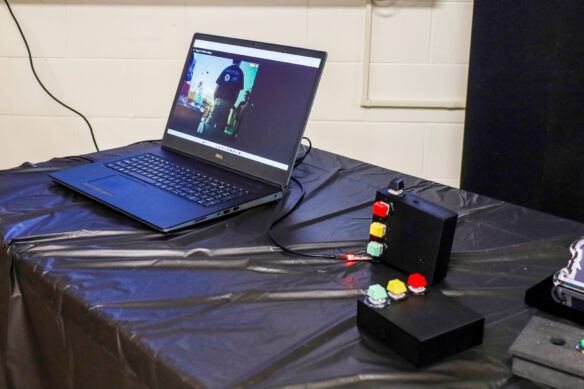
Project LOCKDOWN’s button panels have colored buttons to signify the type of emergency: a red button for an attacker, a yellow button for a missing person and a green button for a health emergency. The panel’s built-in camera shows its video feed on the laptop screen. Photo by Fiona Morgan, Kentucky Department of Education, May 9, 2025
The group has worked on Project LOCKDOWN for dozens of hours since October 2024. The group experimented with different technology options for the button panels, and eventually decided to use ESP32 computers and have a camera. The ESP32 is a low-cost, low-power microcontroller with integrated Wi-Fi and Bluetooth.
The panels use the school’s Wi-Fi system to connect to the map. The group wrote the software code to make the map while using Canva for the visuals.
Each team member had a role to play in putting together the project. While some focused on interviewing collaborators, others assembled circuitry.
Malone said when researching their idea, they found that similar systems cost tens of thousands of dollars to buy and install, and usually need new infrastructure in the school.
“We wanted to build something that was cheap … but then also uses the existing infrastructure, because every school in Kentucky has internet,” Malone said.
He said each button panel costs about $10 to $15 for the materials, and most of that cost is from the battery.
David Couch, associate commissioner in KDE’s Office of Education Technology, said their system can also act as a deterrent for potential criminals.
“It’s unfortunate you’re having to deal with a school safety issue, but these kinds of things may be preventative for folks even attempting, because they know you’ve got an early alarm,” Couch said.
The group wants to take their system to other local schools and businesses. Morris said if it goes well, they could even take it to schools around the country, and/or to nursing homes, offices and churches.
The system is customizable for its location. The panel buttons can be modified and buttons can be added for different types of emergencies.
Before graduating, the group of seniors trained underclassmen to continue operating the project. Morris said they believe the new students can carry the project to even greater heights.
Leave A Comment