
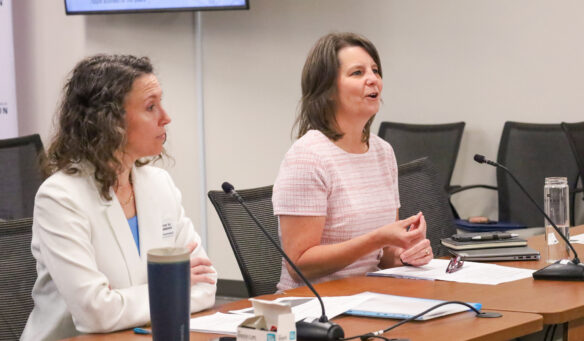
From left, National Center for the Improvement of Educational Assessment associate Laura Pinsonneault and Associate Commissioner Jennifer Stafford of the Kentucky Department of Education’s (KDE) Office of Assessment and Accountability discussed the future of assessment and accountability with members of the Kentucky Board of Education during their June meeting. Photo by Myles Young, Kentucky Department of Education, June 3, 2026
(FRANKFORT, KY) – During the Kentucky Board of Education (KBE) meeting June 3-4, board members discussed the future of assessment and accountability in Kentucky following legislative changes earlier this year.
House Bill (HB) 257, passed during the Kentucky General Assembly’s 2026 regular session, provides districts the flexibility to work more closely with their communities to establish priorities for their schools and help ensure all students have access to vibrant learning experiences. KDE’s coverage of HB 257 on Kentucky Teacher provides more information about the details of the legislation and its impact on assessment and accountability.
Over the next few months, leaders with the Kentucky Department of Education (KDE) will continue to meet with stakeholder groups as the department proposes regulations surrounding assessment and accountability for the KBE to begin considering in August.
During the board meeting, KDE Associate Commissioner Jennifer Stafford and Laura Pinsonneault, an associate with the National Center for the Improvement of Educational Assessment, facilitated a discussion with KBE members on what’s next to consider, including how individual student growth is assessed, how student attendance will play into the accountability system moving forward and how each indicator in the accountability system is weighted.
A large portion of the conversation among board members centered on the different types of growth models used in other states and the positives and negatives associated with them.
“The data reports that, year after year, there are students in certain communities with needs that have not been met. In every case, we know that these communities are alert to the needs of their students and that they are working hard to address their student learning challenges,” KBE Chair Sharon Porter Robinson said. “Now, we have to opportunity to support these communities with a different question: What measures of growth and progress will inform your continued efforts to improve student learning and well-being?”
Robinson said the improvements districts make don’t always get the attention they deserve, so addressing that will be important.
“There are some communities that are really working very, very hard to produce progress and support these students, and I think it just gets – all of that hard work gets washed over with a headline every year,” Robinson said. “And I’d love for those communities to have something more than a headline to reflect on and to inform their subsequent commitment and support of the students in their community.”
The discussion also focused on how individual indicators will be weighed in the accountability system moving forward, including how English language proficiency is measured with English learner students.
KDE has already convened several groups of stakeholders including directors of pupil personnel, English learner education leaders and Accountability Thought Partners, who are immersed in the work and share their perspectives through an inclusive and collaborative approach.
KDE will continue to engage with several other advisory groups for further feedback and to guide the development of policy to align with HB 257.
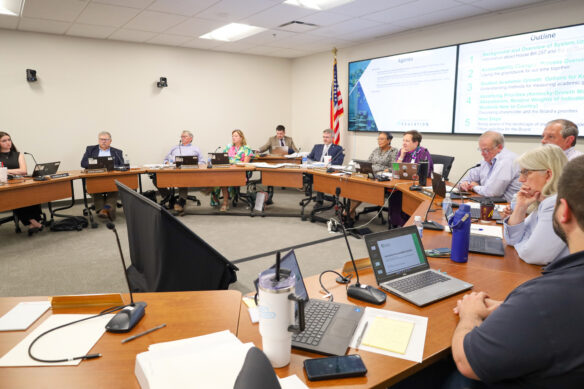
Members of the Kentucky Board of Education convene during the first day of their regular June meeting. Photo by Myles Young, Kentucky Department of Education, June 3, 2026
Local Accountability Design Guide and Toolkit
Representatives with KDE’s Office of Continuous Improvement and Support presented an update on the Local Accountability Design Guide and Toolkit, which is designed to help Kentucky districts transition toward locally developed indicators of quality.
The guide includes six specific action areas for districts and highlights examples of how districts have been using the guide to help define and demonstrate success.
KDE’s Division Director Sarah Snipes detailed data and stories from multiple districts:
- Russell County Schools’ development of a locally owned Portrait of a Learner;
- Hardin County Schools’ project/problem-based instructional model aligned with high-quality instructional resources;
- Bracken County Schools’ strategic plan to scale defenses and exhibitions of learning; and
- Grant County Schools’ community dashboard and three standards of district success.
Snipes also highlighted the new KDE How It’s Working in Districts webpage, which includes several more district spotlights and videos that highlight more stories of innovation within Kentucky school districts.
KBE/EPSB Research Collaborative
Amber Snell, chair of the Education Professional Standards Board (EPSB), and KBE Chair Robinson presented recommendations from a collaborative research effort between the KBE and EPSB.
KBE has statutory authority to manage all common or public schools in the Commonwealth and all programs operated in such schools, while the EPSB establishes and enforces professional standards for preparation, certification, and the responsible and ethical behavior of all professional educators in Kentucky.
The KBE/EPSB Research Practice Collaborative was created in October to gather insights from Kentucky education stakeholders on what drives educator retention, why teachers leave mid-career and how vibrant classroom learning environments – especially in literacy and numeracy – influence teacher satisfaction and career persistence.
“A review of scholarly literature and Kentucky-specific data indicates that working conditions, leadership support, access to high quality embedded professional learning and career advancement opportunities are some of the primary drivers of teacher retention,” Robinson said. “Establishing a coherent, career-long system of support can strengthen educator effectiveness and improve long-term workforce stability in the Commonwealth.”
Participants of the collaborative include KBE members, EPSB members, KDE staff members, classroom educators, school and district administrators, educator preparation program faculty, and education-focused community stakeholders. The group narrowed down two recommendations for the full KBE and EPSB to consider.
The first recommendation is to develop a continuum of growth and support for educators from preservice to retirement. Snell said this goal could be accomplished by establishing a structured statewide system that supports educators at every career stage by integrating mentoring, professional learning, coaching, communities of practice, and teacher leadership.
Snell said this allows educators to grow, lead and remain connected to the classroom.
“For me, this recommendation kind of aligns with that idea of that we are more than just a teacher and that so many of our other professionals in the education field are more than just a teacher,” Snell said. “So, some of the recommendations … are ways to relook at some of the existing endorsements offered by EPSB to look to see if there’s a different credentialing system that we can use.”
Snell outlined several possible next steps for this recommendation, largely aimed at improving professional development opportunities, mentoring, coaching and other resources for educators.
The second recommendation is to develop a continuum of support and growth for school leaders, specifically looking to strengthen principal capacity for talent management, working conditions and instructional leadership.
Potential next steps related to this recommendation include improved management training for principals, focused support for school culture and teacher well-being, and support for high-quality instructional practices, Robinson said.
She also said there could be a focus on “human resource management and talent management” at the school level for principals.
“To help our principals be able to think in those terms and to support them in being able to organize and utilize the expertise that’s there – or to be aware of expertise that they specifically want to recruit to their school – we’re suggesting that this is a further way to strengthen retention by having teachers have their talents recognized and put to work as it benefits strengthening student outcomes,” Robinson said.
Commissioner of Education Robbie Fletcher mentioned more professional development opportunities are on the horizon following the passage of Senate Bill 4 during the 2026 legislative session, which creates a four-year principal training and mentoring program. Fletcher said KDE plans to create a new position and repurpose others to help with the training. The department is also meeting with several education stakeholder groups for input on how the program should take form.
Robinson said recommendations from the KBE/EPSB Research Practice Collaborative will be on the agenda for further discussion at the KBE’s meeting in August. Robinson will also be joining Snell for the EPSB meeting on June 22 to share the recommendations with the EPSB.
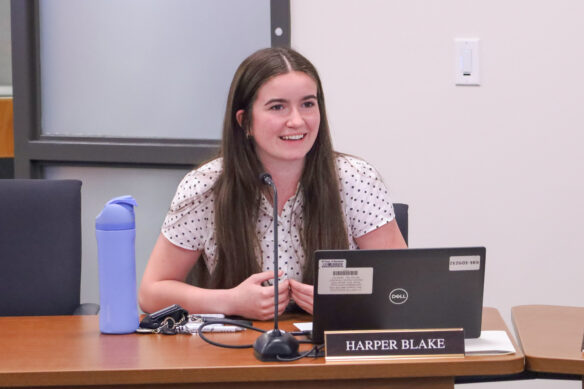
Marion County High School rising senior, Harper Blake, the KBE non-voting student board member, addresses the board during her final meeting. Photo Myles Young, Kentucky Department of Education, June 4, 2026
Reflections from Outgoing Non-Voting KBE Members
The June KBE meeting marked the last meeting for non-voting members Harper Blake and Alfonso De Torres Núñez.
Blake, who will be entering her senior year at Marion County High School in the fall, said she appreciated the board’s dedication to students and wishes she had more time to serve with them.
“I think I’m comforted by the fact that … the confidence that I’ve built this year and the experiences that I’ve gained on this board, I’ll be able to apply to all of my future endeavors, whatever they may be,” she said.
She also said she appreciated the “encouraging and optimistic attitude” board members have shown her.
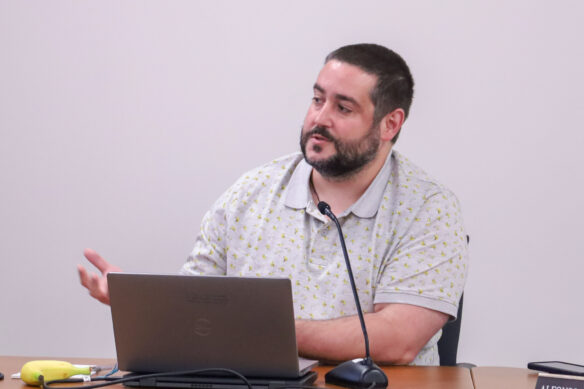
Alfonso De Torres Núñez, a Spanish teacher at Bloom Elementary (Jefferson County), reflects on his past year serving as the KBE non-voting teacher board member. Photo by Myles Young, Kentucky Department of Education, June 4, 2026
De Torres Núñez, a Spanish teacher at Bloom Elementary School (Jefferson County), said he was “proud to contribute to discussions that kept the students at the center of our work,” and appreciated the board’s commitment to vibrant learning experiences for students.
“Perhaps my greatest takeaway from this experience is a renewed sense of optimism,” he said. “Despite everything that is happening in this state and the challenges that we are facing in public education, so great is the talent and dedication and the passion of the people working to address them, and you (KBE members) should include yourselves in this.”
De Torres Núñez said he viewed his role as a bridge between educators and policymakers, and he appreciated the relationships he developed during his time on the KBE.
“These connections deepen my understanding of the opportunities and challenges facing Kentucky’s schools and reinforce my belief that collaboration is essential for meaningful progress,” he said.
The next non-voting KBE teacher and student members were selected by the board during June’s meeting and will be announced prior to the board’s meeting in August.
Waiver Request Regulation
KBE members approved an amendment to 701 KAR 5:170, regulations on waiver requests.
The changes come following legislation passed during the 2026 legislative session, Senate Bill 263, that amends the process for districts seeking waivers from the KBE under KRS 156.161. The changes include:
- Remove special education class size and caseload waivers from the KBE waiver process. These matters will now be handled via exemptions granted by the commissioner of education.
- Update timeline of waiver review and decision by the KBE. KRS 156.161 now provides that the KBE shall consider waiver requests at a meeting occurring no later than 30 calendar days following receipt of a request. Requests received less than 20 days in advance of a KBE meeting will include notification to the KBE that KDE did not have sufficient time to conduct a meaningful review of the request.
- Include a process for consultation with the Education Professional Standards Board (EPSB) when a waiver of EPSB regulations is made to the KBE.
- Remove provisions regarding recommendations for approval or denial to the KBE. KRS 156.161 now prohibits the commissioner and KDE from making such recommendations.
- Include a process for school districts to request technical assistance from KDE in identifying statutes and administrative regulations that must be waived in order to engage in proposed practices.
- Amend forms to comply with statutory changes, including changes to criteria for designation as a school of innovation. KRS 156.161 amends the criteria to provide for designation as a school of innovation if all approved waivers attempt to improve student outcomes in a manner that would be difficult or impossible without the approved waivers.
- Make amendments to clarify that facility waivers no longer expire three full school years following approval.
The waiver process under KRS 156.161 was originally created in 2025 when lawmakers passed Senate Bill 207.
In other business, board members:
- Discussed the 2026-2028 state budget;
- Affirmed the procurement process as outlined by the commissioner, including delegation of the contract development to the commissioner, for the college admissions examination provided by KRS 158.6453;
- Heard an update on the progress toward the objectives identified in KDE’s 2022 Competitive Grants for State Assessments (CGSA);
- Heard a presentation about low-vision clinics hosted by the Kentucky School for the Blind;
- Discussed the Language Essentials for Teachers of Reading and Spelling (LETRS) training and recent analysis from the Kentucky Reading Research Center showing LETRS has a positive impact on student literacy success;
- Approved sharing recommendations from the Kentucky High School Transformation Work Group with the Kentucky United We Learn Council for continued research and development;
- Reappointed Randy McCallon of Murray to the Kentucky High School Athletic Association Board of Control;
- Approved an agency amendment to 702 KAR 5:130, regulations on and standards for vehicles designed to carry nine passengers or fewer;
- Approved an amendment to 701 KAR 5:090, regulations on teacher disciplinary hearings;
- Approved work-based learning placements to receive career-ready status for state accountability for the 2025-2026 school year;
- Awarded the 2026 Teresa Perry Compassion Award to Thomas Clouse, education program manager in KDE’s Office of Teaching and Learning; and
- Awarded the 2026 Karem Award for Excellence in Education Policy to the late Tom Shelton, a longtime education advocate and former superintendent of Daviess and Fayette counties.
Leave A Comment