
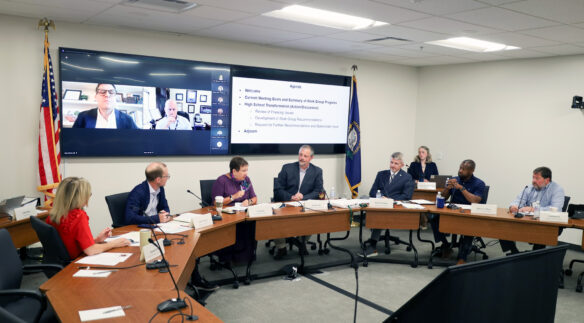
Members of the Kentucky High School Transformation Work Group met for their fourth and final meeting on June 3. Photo by Myles Young, Kentucky Department of Education, June 3, 2026
(FRANKFORT, KY) – Members of the Kentucky High School Transformation Work Group met for their fourth and final meeting on June 3, where they discussed pressing issues around transforming high school experiences – discussions that will continue to be considered and researched by the Kentucky United We Learn Council.
Work Group Chair Juston Pate, who also serves on the Kentucky Board of Education (KBE), said throughout their four meetings, the work group discussed how to strengthen engagement in high schools for all students.
KBE Vice Chair Lu S. Young, who also participated in the work group, outlined the group’s five most pressing issues based on prior input from the KUWL Council. The five pressing issues surrounding high school transformation discussed were how to push beyond the status quo, equitable access and funding, trust, building a system around vibrant learning, and teacher training and certification.
The National Association of State Boards of Education (NASBE) invited the KBE to participate in its High School Transformation State Network, which builds the capacity of state boards to enable rich student experiences that foster content mastery and durable skills.
Work group members discussed opportunities to share innovative best practices with districts, how to remove barriers that may exist and to consider policy recommendations that may improve or speed high school innovation.
During the group’s final meeting, members referred their recommendations around high school transformation to the Kentucky United We Learn Council for continued research and input. The Kentucky United We Learn Council is a dedicated group of educators, community members, students and Kentucky Department of Education (KDE) staff who bring together voices from across the Commonwealth to recommend new policy and practice or recommend changes to existing policy and practice.
In terms of pushing beyond the status quo, Pate said there are resources and tools available to districts to personalize their high school graduation requirements more directly to what students – particularly those in career and technical education pathways – might need in their careers.
Commissioner of Education Robbie Fletcher said one example schools could tailor classes to meet their students’ career needs is by gathering cohorts of teachers to redesign their school’s senior year English class. For instance, a senior English class for students wanting to become lawyers or go into business could be tailored to expose them more to the language they’ll need as professionals.
“When groups come together and feel empowered, they are more willing to take risks while focusing on meeting students’ individual needs,” Fletcher said. “Teachers are also more effective when they feel supported by their colleagues.”
Jon Ballard, former superintendent of Elizabethtown Independent and current senior policy analyst for the Kentucky Senate Majority, suggested creating a model framework based on some of the best practices and innovations already taking place in the state that could be helpful for schools and districts looking for ways to become more innovative. He said the framework could include a list of regulations or laws that would provide more guidance on how to develop an innovative school.
Chris Sanders, executive director of the Office of Educational Programs at the Kentucky Education and Labor Cabinet, spoke about how to address the issue of creating more equitable access to experiences and resources for all students. He said more businesses could engage students during their high school years and prepare them for the local workforce.
“How can we engage those employers to come in and have those conversations, to help them (students) understand the pathways that they’re choosing, and help them really grasp the skills that they need to be building during those freshman, sophomore, junior and then specifically into that senior year, so that they’re prepared for where they’re stepping out and transitioning into those spaces,” Sanders said.
Young added that the state could look at more ways to fund dual credit opportunities which allow students to earn high school credit and college credit simultaneously.
In terms of building trust with their communities, Young suggested schools could hold more town halls focused on high school transformation to encourage gathering more feedback from the community.
Work group member Robert J. Moore, chief of schools for Jefferson County Public Schools, suggested that high schools could always focus on listening to students in every area.
“I don’t care how many certifications, master’s degrees and doctorates you have; there’s always something to learn from our students,” Moore said. “So, I think that is critical for building trust and for our innovation.”
In addition, work group members discussed the importance of continuing to develop more vibrant learning experiences. These experiences move beyond traditional classroom instruction to spark curiosity, creativity and collaboration, preparing students with the skills they need to thrive in school, work and life.
Young noted the need to support teachers and school leaders through innovation, as well as continued conversations related to flexibilities to solve shortages in necessary instruction subjects at the high school level.
Leave A Comment