
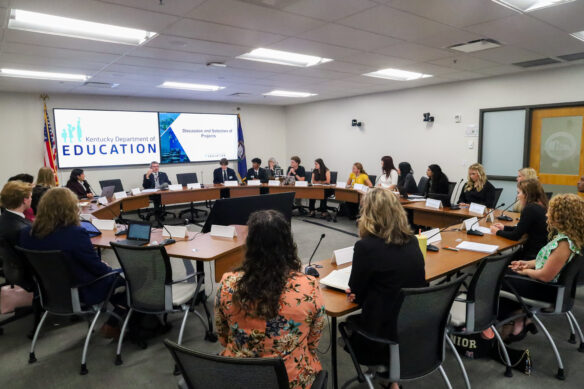
Members of the Kentucky Department of Education’s Commissioner’s Student Advisory Council meet on Aug. 25, 2026. Photo by Myles Young, Kentucky Department of Education, Aug. 25, 2026
(FRANKFORT, KY) – Members of the Kentucky Department of Education’s (KDE’s) Commissioner’s Student Advisory Council voted to start a new year-long project to explore ways to make student representation more meaningful, especially where school and district decisions are being made, during their meeting on Aug. 25. The council’s year-long project to develop recommendations will be presented to Commissioner of Education Robbie Fletcher by next spring.
As their first meeting of the school year with 16 new council members, the council reviewed different ideas for projects they could complete over the course of the school year.
KDE staff discussed ongoing projects at the department that the council may be interested in contributing meaningful feedback this year. Topics presented included:
- Continuing to promote the Individualized Learning Plan (ILP) and expand on the council’s focus last year; gathering feedback from students about what supports student identify that are needed to drive attendance at school;
- Conducting empathy interviews with members of their schools and communities about building and sustaining trust in their schools and sharing those findings with Commissioner Fletcher; and
- Exploring opportunities for students to have a stronger voice in education-related decisions that directly affect them.
Student advisory council members voted unanimously for the proposal about student voice and representation, and the council will discuss next steps for the project at their next council meeting on Oct. 21.
Ashley Gates, education program consultant at KDE, gave a presentation on how chronic absenteeism has become a bigger challenge in Kentucky since the COVID-19 pandemic.
KDE is working to address this challenge with a goal to reduce chronic absenteeism in the state by 50% from 2024-2029. Gates said one way KDE is working to help reduce chronic absenteeism is by looking at ways to encourage students to attend classes regularly by increasing their sense of belonging at school. She presented a project idea for the council to either create a student voice lab, using student voice, stories and data, to explore what helps students feel connected and what gets in the way of them attending school regularly; or to create a statewide survey for students to share what helps them feel connected at school.
Karen Dodd, chief performance officer at KDE, presented a project idea based around transforming high schools and trust between students, school staff, members of the community and stakeholders. Members of the Kentucky High School Transformation Work Group recently identified five pressing issues surrounding high school transformation and the importance of building and sustaining trust in education.
Trace Brooking, the new non-voting student member of the Kentucky Board of Education and a junior at Glasgow High School (Glasgow Independent), proposed that the council could explore ways for students to have a stronger voice in education-related decisions that directly affect them at the local level.
“Being on the state board, I know how essential it is to have my voice at the table,” Brooking said.
Possible ideas for the project included researching ongoing opportunities for student representation in local districts and identifying possible paths to strengthen student voice and representation. Examples discussed included the development of student advisory councils and opportunities for student representation on local school boards.
Harper Blake, a senior at Marion County High School and a former non-voting student member of the KBE, said students know best what issues their schools face.
“Having a student on the board can address individual issues that affect their schools most,” Blake said.
Multiple students pointed out that there are connections between each of the project proposals, as helping one area helps another area.
Ava Adame, a senior at McCracken County High School, said helping increase trust in schools helps students and staff better address other challenges in their schools.
“If students have more trust, they’ll feel more motivated to go to school,” Adame said.
During the 2025-2026 school year, Commissioner’s Student Advisory Council members reviewed Individual Learning Plan (ILP) and postsecondary planning resources to explore how they could be maximized for students’ post-high school transition. The ILP is a personalized framework for advising students in grades 6 through 12 to engage in coursework and activities that will prepare them for opportunities after graduation.
For the council’s final project last year, members created a promotional video for a statewide campaign promoting the ILP and other postsecondary resources. As an extension of the council’s project, KDE is now inviting middle and high school students, teachers and counselors around the state the opportunity to submit commercials that define what the ILP is and how they use it in their district. People can submit their videos by Oct. 23 by going to the Individual Learning Plan Awareness Showcase application.

Leave A Comment